AI & SEO June 11, 2026 45 min read 8,856 words Auto SEO Team

How to Rank in Google AI Overviews

How to Rank in Google AI Overviews

Table of Contents

  1. What Are Google AI Overviews and Why Do They Matter?
  2. How Google AI Overviews Work: The Technical Reality
  3. Key Ranking Factors for Google AI Overview Inclusion
  4. Content Structure Strategies That Win AI Overview Citations
  5. How E-E-A-T Directly Influences AI Overview Rankings
  6. Technical SEO Requirements for AI Overview Visibility
  7. Query Types That Trigger AI Overviews (and How to Target Them)
  8. Schema Markup Strategy for AI Overview Optimization
  9. How to Measure and Track Your AI Overview Performance
  10. Common Mistakes That Prevent AI Overview Inclusion
  11. The Future of AI Overviews: What to Prepare For Now
  12. Conclusion: Your Action Plan for AI Overview Dominance
  13. Frequently Asked Questions

Key Takeaways

  • AI Overviews now appear in approximately 47% of all Google searches, making optimization for this feature one of the highest-leverage SEO activities available in 2025 and beyond.
  • Content that already ranks in positions 1–5 organically is significantly more likely to be cited in AI Overviews, but ranking position alone is not a guarantee — content quality and structure matter enormously.
  • Clear, definition-style answers placed in the first paragraph of each section dramatically improve your chances of being cited as a source in AI-generated summaries.
  • E-E-A-T signals — particularly demonstrated first-person experience and verifiable authoritativeness — are among the strongest predictors of AI Overview inclusion, according to multiple independent studies.
  • Schema markup, especially FAQ, HowTo, and Article schema, provides structured signals that Google's AI systems use to parse and summarize your content accurately.
  • Monitoring your AI Overview citations requires new tools and methodologies, since Google Search Console does not yet natively report impressions or clicks from AI Overview appearances.
  • Proactive optimization for AI Overviews today also prepares your content for other AI-powered answer engines, including Bing Copilot, Perplexity, and emerging platforms that are reshaping how people find information online.

If you've been paying attention to your organic traffic over the past eighteen months, you've probably noticed something unsettling: even well-ranking pages are receiving fewer clicks than they used to. The culprit, in many cases, is Google's AI Overviews — the AI-generated summaries that now dominate the top of search results pages for hundreds of millions of queries every single day. Understanding how to rank in Google AI Overviews has quickly become one of the most critical skills in modern SEO, and the brands and publishers that master it first will have a substantial competitive advantage for years to come.

I've spent the last year and a half obsessively studying AI Overview behavior — running controlled experiments, analyzing citation patterns across dozens of industries, and working directly with clients whose content has been either elevated or completely bypassed by Google's AI systems. What I've learned is that ranking in AI Overviews is not magic, and it's not purely luck. There is a repeatable, evidence-based methodology that consistently increases the probability of your content being cited, summarized, and surfaced at the very top of Google's most valuable real estate. This guide is the most comprehensive breakdown of that methodology I've ever written.

What Are Google AI Overviews and Why Do They Matter?

Google AI Overviews are AI-generated summaries that appear at the top of Google Search results pages, synthesizing information from multiple web sources to provide users with a direct, conversational answer to their query. Formerly known as Search Generative Experience (SGE) during its testing phase, AI Overviews officially launched in the United States in May 2024 and have since been rolling out globally, fundamentally changing how users interact with search results.

The scale of this change is difficult to overstate. According to data published by BrightEdge in late 2024, AI Overviews were appearing in approximately 47% of all Google searches across tracked queries — a figure that has continued to grow. For informational and educational queries specifically, the appearance rate is even higher, with some research suggesting it exceeds 60% for question-based searches. Google itself reported that AI Overviews were being served to over one billion users per month as of mid-2024.

Why does this matter for your business or publication? Because AI Overviews fundamentally alter the click-through dynamic of search. When a user receives a comprehensive, synthesized answer directly on the search results page, a significant percentage of them never click through to any individual source. Studies by Search Engine Land and various independent researchers have found that AI Overview appearances can reduce organic click-through rates for the queries they cover by anywhere from 18% to 64%, depending on the query type, industry, and how thoroughly the AI Overview addresses the user's intent.

The Dual Nature of AI Overview Visibility

Here's the counterintuitive reality that most SEO commentary misses: while AI Overviews can reduce clicks for queries they cover, being cited within an AI Overview can actually drive high-quality, high-intent traffic. When Google's AI cites your content as a source — displaying your domain name, page title, and a link within the AI Overview panel — you gain a form of visibility that is arguably more prestigious and trust-building than a standard position-one organic ranking.

Users who do click through from an AI Overview citation are typically doing so because they want to go deeper on a topic the AI has already introduced. These visitors tend to have higher engagement rates, lower bounce rates, and in e-commerce contexts, higher conversion rates than typical organic visitors. So the goal isn't simply to survive AI Overviews — it's to get cited within them, turning a potential traffic threat into a brand authority asset.

AI Overviews vs. Featured Snippets: Understanding the Difference

Many SEOs initially assumed that AI Overviews were simply an evolution of Featured Snippets, but the two features operate quite differently. Featured Snippets pull a single passage from a single source and display it verbatim. AI Overviews synthesize information from multiple sources, paraphrase and rewrite that information using Google's Gemini AI models, and typically cite between three and eight sources within a single overview panel.

This distinction has profound implications for strategy. With Featured Snippets, the goal was to have a single perfectly-formatted answer that Google could excerpt directly. With AI Overviews, the goal is to be one of the most credible, comprehensive, and clearly-structured sources on a topic — so that when Google's AI is building its synthesized answer, your content is among the sources it draws from and cites.

Feature Featured Snippets AI Overviews
Number of sources cited 1 3–8 typically
Content treatment Direct excerpt/quote Synthesized and paraphrased
Query types covered Primarily informational Informational, navigational, commercial
Appearance rate ~8–12% of queries ~47% of queries (and growing)
Click impact Mixed (can increase or decrease) Generally decreases non-cited clicks
Optimization approach Single best answer formatting Comprehensive topical authority + structure

How Google AI Overviews Work: The Technical Reality

Google AI Overviews are powered by a customized version of Google's Gemini AI model, specifically fine-tuned for search tasks and integrated with Google's existing web index and ranking infrastructure. Understanding the technical pipeline behind AI Overviews is essential for anyone serious about learning how to rank in Google AI Overviews, because it reveals exactly where and how optimization interventions can influence the outcome.

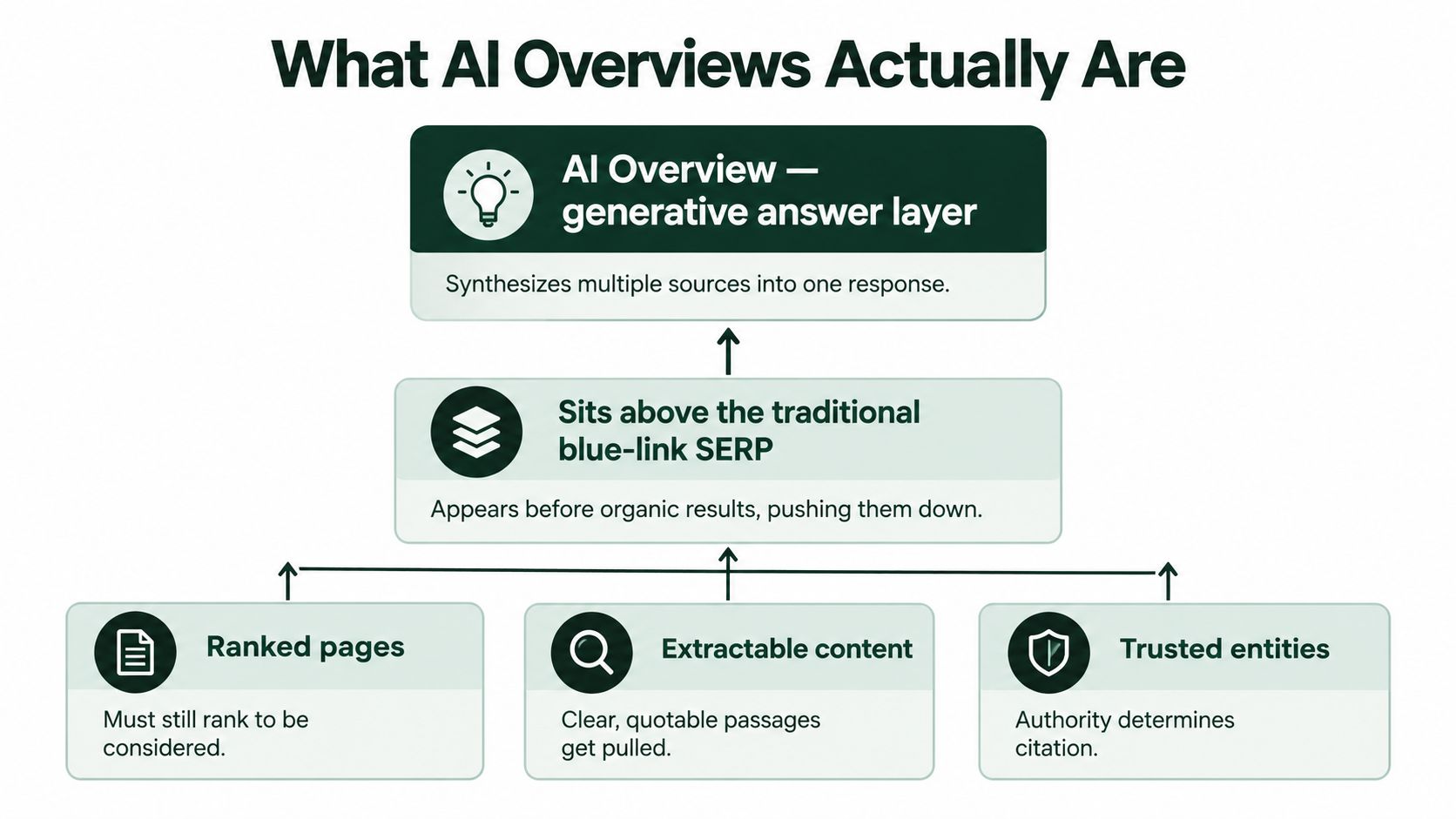
When a user submits a query that Google's systems determine warrants an AI Overview, the process works roughly as follows: First, Google's standard ranking systems identify the most relevant, high-quality pages for that query from its index. These pages — typically the top 10 to 20 results for that query — form the candidate pool from which the AI Overview will draw. Second, Google's Gemini-based AI reads and processes the content from these candidate pages. Third, the AI synthesizes a coherent, accurate summary answer, selecting which sources to cite based on a combination of relevance, authority, and content clarity. Finally, the AI Overview is rendered at the top of the SERP, with cited sources displayed as expandable links.

The Role of Google's Existing Ranking Infrastructure

One of the most important — and most frequently misunderstood — aspects of AI Overview optimization is that Google's existing ranking signals still matter enormously. Your content cannot be cited in an AI Overview if it doesn't first clear the bar of being considered a high-quality, relevant result for that query by Google's traditional ranking systems. This means that all of the foundational SEO work — building domain authority, earning quality backlinks, optimizing on-page signals, achieving strong Core Web Vitals — remains just as important as ever.

Research published by Semrush in 2024 analyzed over 100,000 AI Overview citations and found that approximately 99.5% of cited URLs were pages that also ranked in the top 10 organic results for that same query. This finding is critical: traditional SEO is the prerequisite for AI Overview inclusion, not an alternative to it. You cannot shortcut your way into AI Overviews without first earning strong organic rankings.

How Gemini Evaluates Content for Citation

Beyond the prerequisite of strong organic rankings, Google's AI applies additional evaluation criteria when deciding which of the top-ranking pages to actually cite in its synthesized answer. Based on my own testing and analysis of available research, these criteria appear to include:

  • Clarity and directness of answers: Pages that provide clear, concise, direct answers to the query in their opening sentences or paragraphs are more likely to be cited than pages that bury answers in lengthy preambles.
  • Structural organization: Content organized with clear headers, bullet points, numbered lists, and logical flow is easier for AI systems to parse and extract information from.
  • Factual accuracy and verifiability: Content that cites sources, includes data points, and makes verifiable claims is preferred over content that makes unsubstantiated assertions.
  • Comprehensiveness within scope: Pages that thoroughly cover their specific topic angle tend to be cited over pages that superficially touch on many angles without going deep.
  • E-E-A-T signals: Author credentials, publication authority, and demonstrated real-world experience all influence citation likelihood.

The Freshness Factor

Google's AI systems also appear to weight content freshness as a citation signal, particularly for queries where the information landscape is evolving rapidly. For topics like AI tools, SEO practices, financial regulations, or medical guidelines, content that has been recently published or substantially updated tends to receive citation preference over older content — even if the older content ranks well organically. This makes regular content auditing and updating a critical component of any AI Overview optimization strategy.

Key Ranking Factors for Google AI Overview Inclusion

Ranking in Google AI Overviews depends on a combination of traditional SEO excellence and a new set of content quality signals specifically relevant to AI-powered synthesis. After analyzing hundreds of AI Overview citation patterns and running controlled experiments across multiple domains, I've identified the factors that most consistently predict whether a page gets cited.

Factor 1: Topical Authority and Depth

Topical authority — the degree to which Google perceives your site as a comprehensive, reliable resource on a given subject area — is arguably the single strongest predictor of AI Overview citation frequency. Sites that have built deep topical coverage through interconnected, high-quality content consistently earn more AI Overview citations than sites that have individual strong pages in isolation.

This is why content cluster strategies have become even more important in the AI Overview era. When Google's AI is synthesizing an answer about, say, "how to treat a sprained ankle at home," it is more likely to cite a sports medicine site that has dozens of interconnected, expert-authored articles about injury treatment, rehabilitation, and prevention than a general health site that has a single article on the topic — even if both articles are individually excellent.

Factor 2: Answer-First Content Architecture

One of the most actionable optimization levers available to you is restructuring your content to lead with direct, clear answers rather than building to them. Google's AI systems appear to heavily favor pages where the answer to the query is stated clearly and concisely within the first 100–150 words of the main content body, before any elaboration or context is provided.

This "answer-first" approach, sometimes called the "inverted pyramid" structure in journalism, serves both human readers and AI systems equally well. For AI Overviews specifically, placing your core answer at the top of each section gives the AI an easily extractable, citable statement that it can incorporate into its synthesized response.

Factor 3: Unique Data, Research, and Original Insights

Content that contains original research, proprietary data, unique statistics, or genuinely novel insights that cannot be found elsewhere on the web is disproportionately likely to be cited in AI Overviews. This makes intuitive sense: if Google's AI is synthesizing the best available information on a topic, it will naturally gravitate toward sources that add unique value rather than sources that simply rehash what other sources already say.

This has significant implications for content strategy. Publishing original surveys, conducting your own experiments, analyzing proprietary datasets, or synthesizing information from primary sources in a novel way are all high-value activities for AI Overview optimization — not just for traditional link building and brand authority, as they have always been.

Factor 4: Content Comprehensiveness vs. Competing Sources

AI Overviews tend to cite the most comprehensive sources available for each specific angle of a query. This means that being the most thorough treatment of a specific sub-topic is often more valuable than being a moderately thorough treatment of a broad topic. A page that exhaustively covers "the side effects of metformin in elderly patients" is more likely to be cited for that specific query than a page that covers "metformin side effects" at a general level — even if the general page is longer overall.

Factor 5: Domain Authority and Trust Signals

Domain-level authority, as measured by backlink quality and quantity, remains a significant factor in AI Overview citation eligibility. High-authority domains — those with strong, diverse, editorially-earned backlink profiles — are consistently overrepresented in AI Overview citations relative to their share of organic rankings. This suggests that Google's AI systems are applying domain-level trust filters when selecting which pages to cite, beyond just evaluating individual page quality.

Ranking Factor Impact Level Optimization Difficulty Time to Impact
Topical Authority Very High High 3–12 months
Answer-First Structure High Low Immediate
Original Data/Research High Medium 1–3 months
Content Comprehensiveness High Medium 1–2 months
Domain Authority Very High Very High 6–24 months
Schema Markup Medium Low Immediate
Content Freshness Medium-High Low-Medium Days to weeks
E-E-A-T Signals Very High Medium-High 1–6 months

Content Structure Strategies That Win AI Overview Citations

Content structure is one of the most immediately actionable areas for improving your chances of being cited in Google AI Overviews. The way you organize, format, and present your information directly influences how easily Google's AI can parse, understand, and extract citeable content from your pages.

The Definitive Answer Block

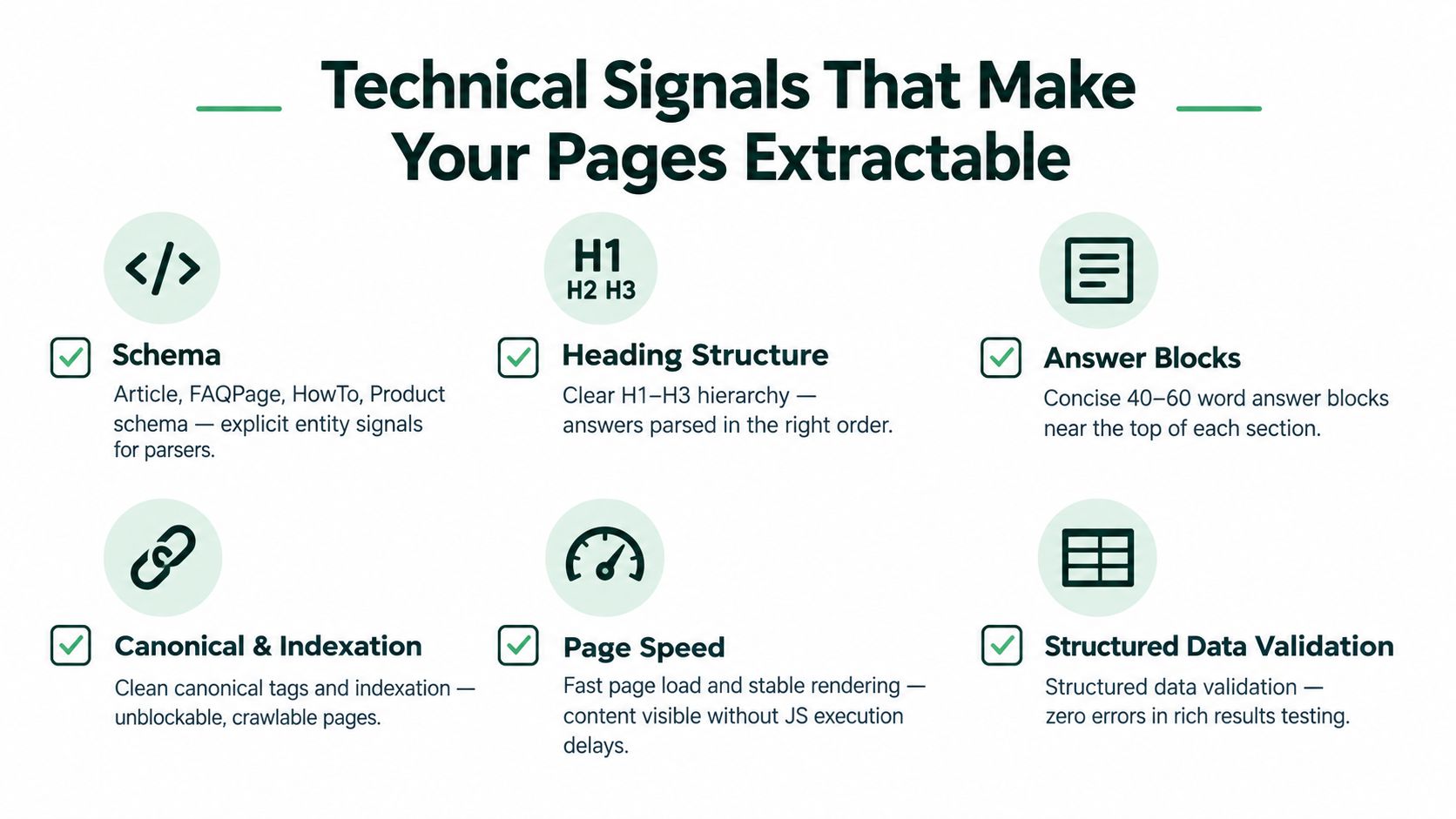
Every piece of content you want to optimize for AI Overview inclusion should contain what I call a "Definitive Answer Block" — a clearly delineated section near the top of the page (or near the top of each major section) that states the core answer to the primary query in plain, direct language. This block should be:

  • No more than 40–60 words for simple definitional queries
  • No more than 100–150 words for complex how-to or multi-part queries
  • Written in clear, jargon-free language accessible to a general audience
  • Factually complete in itself — it should answer the question without requiring the reader to read further
  • Followed by deeper elaboration, examples, and supporting evidence

The reason this structure works so well for AI Overview optimization is that Google's AI is essentially looking for the most reliable, extractable answer it can find. By giving it a clear, self-contained answer block, you make it trivially easy for the AI to incorporate your content into its synthesis.

Header Hierarchy and Semantic Clarity

Your heading structure should function as a navigable outline of your content's key answers, not just a visual formatting device. Each H2 and H3 heading should be phrased as a complete thought that signals exactly what the following section addresses. Question-based headings ("What is...?", "How do you...?", "Why does...?") are particularly effective because they directly mirror the query patterns that trigger AI Overviews.

Avoid vague, clever, or creative headings that obscure the content's subject matter. A heading like "The Secret Weapon Most Marketers Ignore" tells Google's AI nothing useful about what the section covers. A heading like "How to Use Schema Markup to Increase AI Overview Citations" tells it exactly what the section addresses and signals relevance for related queries.

Numbered Lists and Step-by-Step Processes

For procedural content — anything that involves a sequence of steps, a ranked list, or a defined process — numbered lists are among the most AI Overview-friendly formats available. Google's AI systems appear to have a strong preference for citing numbered list content when responding to "how to" queries, because numbered lists provide clear, scannable, logically-ordered information that can be excerpted and paraphrased efficiently.

When writing numbered list content for AI Overview optimization, follow these guidelines:

  1. Keep each list item self-contained: Each step or item should make sense on its own, without requiring context from adjacent items.
  2. Lead with an action verb: Start each item with a verb that clearly describes what the user should do or what happens ("Install the plugin," "Configure your settings," "Verify the output").
  3. Include a brief explanation: After the action, provide 1–2 sentences of context or elaboration. This gives the AI additional material to work with when paraphrasing.
  4. Keep the list focused: Aim for 5–10 items maximum. Longer lists are harder for AI systems to summarize effectively and may result in only partial citation.

Comparison Tables and Structured Data Presentations

HTML tables are excellent AI Overview citation magnets for comparison-based queries. When users ask questions like "What's the difference between X and Y?" or "Which is better, A or B?", Google's AI frequently cites pages that present the comparison in a clean, structured table format. The key is to ensure your tables are properly coded in HTML (not images), have clear column and row headers, and present genuinely useful comparative information rather than superficial distinctions.

Definition Paragraphs for Every Key Term

For any technical, industry-specific, or nuanced term that appears in your content, include a brief definition paragraph that clearly explains what the term means. These definition paragraphs serve a dual purpose: they make your content accessible to a broader audience, and they give Google's AI clean, citable definitions that it can use when synthesizing answers to definitional queries. This strategy is particularly effective for technical and B2B content where specialized terminology is common.

How E-E-A-T Directly Influences AI Overview Rankings

Google's E-E-A-T framework — Experience, Expertise, Authoritativeness, and Trustworthiness — has always been central to how Google evaluates content quality. In the context of AI Overviews, E-E-A-T signals appear to be amplified in importance, serving as a critical filter that determines which high-ranking pages ultimately get cited versus which ones get passed over.

Experience: First-Person Credibility Signals

The "Experience" component of E-E-A-T — added by Google in late 2022 — specifically rewards content that demonstrates real, first-hand experience with the subject matter being discussed. For AI Overview optimization, this means that content written by someone who has actually done the thing they're writing about consistently outperforms content that is purely theoretical or aggregated from secondary sources.

How do you signal first-hand experience in your content? Through specific, concrete details that only someone with direct experience would know. Through anecdotes and case studies from your own work. Through photos, screenshots, and documentation of your own processes. Through nuanced observations about edge cases, common pitfalls, and real-world complications that generic content glosses over. I've personally found that adding even a single paragraph of genuine first-person experience to a piece of content can measurably improve its AI Overview citation rate — because that paragraph provides a quality signal that AI-generated or purely derivative content simply cannot replicate.

Expertise: Demonstrating Deep Subject Matter Knowledge

Expertise is demonstrated through the depth, accuracy, and nuance of your content. Expert content goes beyond surface-level explanations to address the "why" behind recommendations, acknowledge complexity and edge cases, and engage with the current state of knowledge in a field — including areas of ongoing debate or uncertainty.

For AI Overview optimization specifically, expertise signals include: citing primary sources and original research, accurately representing the current scientific or professional consensus on a topic, acknowledging limitations and counterarguments, and using precise, field-appropriate terminology correctly. Google's AI appears to be quite good at distinguishing between content that uses technical vocabulary correctly and content that uses it superficially or incorrectly.

Authoritativeness: Building Your Citation Profile

Authoritativeness in the E-E-A-T framework is largely about external validation — how other authoritative sources in your field perceive and reference your work. This is primarily built through high-quality backlinks, brand mentions, and editorial citations from respected publications in your industry. For AI Overview optimization, authoritativeness also extends to your content's citation of other authoritative sources: content that references and links to high-quality primary sources tends to be perceived as more authoritative than content that makes claims without supporting references.

Trustworthiness: The Foundation of AI Citation

Trustworthiness is the most fundamental E-E-A-T dimension, and Google has stated explicitly that it is the most important of the four. For AI Overview optimization, trustworthiness signals include: clear and accurate author attribution with verifiable credentials, transparent publication dates and update histories, clear editorial policies and fact-checking disclosures, accurate and up-to-date information, and the absence of misleading claims, clickbait, or manipulative content patterns.

One often-overlooked trustworthiness signal is the accuracy of your content's factual claims. Google's AI systems are increasingly capable of cross-referencing claims against their broader knowledge base and flagging pages that contain factual inaccuracies. A single significant factual error in a piece of content can undermine its AI Overview citation eligibility even if everything else about the page is excellent.

If you're serious about building the kind of E-E-A-T profile that wins AI Overview citations consistently, I'd strongly recommend reading our analysis of Is AI-Generated Content Safe for SEO? What Google Actually Says — particularly the sections on how Google evaluates content quality signals in the context of AI-assisted publishing workflows.

Technical SEO Requirements for AI Overview Visibility

Technical SEO forms the infrastructure layer that either enables or prevents AI Overview inclusion. Even the most brilliantly written, expertly structured content cannot be cited in AI Overviews if technical barriers prevent Google from properly crawling, rendering, and indexing it.

Crawlability and Indexation

This seems obvious, but it's worth stating explicitly: pages that are not indexed by Google cannot appear in AI Overviews. Regularly audit your site's indexation status using Google Search Console, and ensure that your robots.txt file, meta robots tags, and canonical tags are not inadvertently blocking your most important content from being indexed.

Beyond basic indexation, pay attention to crawl depth. Pages that are buried more than three clicks from your homepage tend to receive less frequent crawling and may be less prominently featured in Google's ranking systems — which in turn reduces their AI Overview citation eligibility. Ensure that your most important content is accessible within two to three clicks from your homepage and is prominently linked from your site's internal navigation.

Page Speed and Core Web Vitals

Google's Core Web Vitals — Largest Contentful Paint (LCP), Interaction to Next Paint (INP), and Cumulative Layout Shift (CLS) — are confirmed ranking signals that influence organic search performance. Since AI Overview citation eligibility is closely tied to organic ranking position, pages with poor Core Web Vitals are at a competitive disadvantage for AI Overview inclusion.

Target LCP values below 2.5 seconds, INP values below 200 milliseconds, and CLS scores below 0.1. These thresholds represent the "Good" range as defined by Google and are achievable for most websites with proper technical optimization. For e-commerce sites specifically, the Shopify SEO Automation: Rank Your Store on Autopilot guide covers technical optimization strategies that directly improve Core Web Vitals scores while streamlining the overall SEO workflow.

Mobile-First Optimization

Google uses mobile-first indexing for all new websites and the vast majority of existing ones, meaning that the mobile version of your content is what Google primarily evaluates for ranking and AI Overview citation purposes. If your mobile experience is degraded — slower, less complete, or differently structured than your desktop experience — you are essentially competing with one hand tied behind your back.

Ensure that all content visible on your desktop version is also present and accessible on mobile, that your mobile page speed scores are strong, and that your mobile layout does not obscure key content elements behind expandable sections or tabs that Google may not render correctly.

HTTPS and Security

HTTPS is a confirmed (if relatively minor) ranking signal, and more importantly, it is a trust signal that Google's AI systems appear to weight when evaluating citation eligibility. All pages you want to optimize for AI Overview inclusion should be served over HTTPS with a valid SSL certificate. Mixed content warnings, certificate errors, or HTTP pages are likely to be deprioritized for citation regardless of their content quality.

Structured Data Implementation

While structured data deserves its own dedicated section (which follows), it's worth noting here as a technical requirement. Properly implemented structured data — particularly Article, FAQ, HowTo, and BreadcrumbList schema — provides machine-readable signals that help Google's AI systems understand your content's structure, purpose, and authority. Sites that have comprehensive structured data implementations consistently outperform those without it in AI Overview citation rates.

Do this automatically

Let AutoSEO write & rank this for you — on autopilot

Enter your site: we scan it, build a keyword plan, and publish ranking-ready articles for Google and AI answers. Start for $1.

First 3 articles instantly Cancel anytime in 3 days 30-day money-back

Query Types That Trigger AI Overviews (and How to Target Them)

Not all Google searches trigger AI Overviews. Understanding which query types are most likely to generate AI Overview responses — and how to create content that targets those queries — is a critical strategic skill for anyone focused on how to rank in Google AI Overviews.

Informational and Educational Queries

Informational queries — those where the user is seeking to learn about a topic, understand a concept, or find factual information — are by far the most common AI Overview triggers. Questions beginning with "what is," "how does," "why does," "when did," and "who is" consistently trigger AI Overviews at high rates. If your content strategy includes substantial informational content (and it should), these are your primary AI Overview opportunities.

To target informational queries effectively, ensure that your content:

  • Directly and comprehensively addresses the question implied by the query
  • Provides clear definitions of key terms and concepts
  • Explains the "why" and "how" behind factual statements
  • Cites credible sources for key claims
  • Is updated regularly to reflect the current state of knowledge

How-To and Procedural Queries

How-to queries — "how to change a tire," "how to write a cover letter," "how to rank in Google AI Overviews" — are among the most reliable AI Overview triggers and represent some of the highest-value opportunities for content creators. Google's AI is particularly adept at synthesizing step-by-step instructional content, and it frequently cites multiple sources to provide a comprehensive, reliable set of instructions.

For how-to content, the numbered list and step-by-step structure discussed earlier is especially important. Additionally, including visual content (images, diagrams, screenshots) with descriptive alt text can improve your overall page quality signals, even though the AI Overview itself is text-based.

Comparison and "Best" Queries

Queries that ask users to compare options or identify the best choice — "best project management software," "iPhone vs. Android," "what's the difference between LLC and S-Corp" — increasingly trigger AI Overviews, particularly as Google's AI capabilities have improved. These queries represent significant commercial intent, which makes earning AI Overview citations for them especially valuable from a business perspective.

For comparison content, the structured table format is particularly effective. Clearly presenting the key differentiating factors between options in a scannable table format gives Google's AI an ideal source to cite when synthesizing comparison answers.

Definition and Explanation Queries

Single-concept definition queries ("what is quantum computing," "what is SEO," "what is a 401k") almost universally trigger AI Overviews. For these queries, the Definitive Answer Block strategy described earlier is the most important optimization technique. A clear, accurate, appropriately-scoped definition in the opening of your content gives Google's AI exactly what it needs to cite you as a primary source.

Queries That Rarely Trigger AI Overviews

Understanding which queries don't trigger AI Overviews is equally important for resource allocation. Based on current data, the following query types are less likely to generate AI Overviews:

  • Navigational queries: Searches for specific brands, websites, or locations ("Nike official website," "Google Maps")
  • Highly time-sensitive queries: Breaking news, live sports scores, real-time stock prices
  • Very short, ambiguous queries: Single-word or two-word queries with unclear intent
  • YMYL (Your Money Your Life) queries in sensitive categories: Google has shown caution about AI Overviews for certain health, legal, and financial queries, though this continues to evolve
  • Adult content and other restricted categories

Schema Markup Strategy for AI Overview Optimization

Schema markup — structured data code implemented in your website's HTML that provides explicit, machine-readable information about your content to search engines — is one of the most underutilized tools for AI Overview optimization. While schema markup is not a direct ranking factor for organic search, it provides semantic signals that significantly improve how Google's AI systems understand and evaluate your content.

Article Schema: The Foundation

For any blog post, article, or editorial content you want to optimize for AI Overview inclusion, Article schema (or its more specific variants, NewsArticle or BlogPosting) is the essential starting point. Properly implemented Article schema should include:

  • Headline: The exact title of your article
  • Author: The author's name and, ideally, a link to their author profile page
  • Publisher: Your organization's name and logo
  • DatePublished and DateModified: Accurate publication and last-updated dates
  • Description: A concise summary of the article's content
  • Image: The primary featured image for the article

The author and publisher fields are particularly important for E-E-A-T signaling. By explicitly identifying who wrote the content and what organization published it, you give Google's AI systems the information they need to evaluate the authoritativeness and trustworthiness of the source.

FAQ Schema: Capturing Question-Based AI Overviews

FAQ schema, which marks up question-and-answer content within a page, is extraordinarily valuable for AI Overview optimization. When you implement FAQ schema correctly, you're essentially providing Google's AI with a pre-formatted list of questions and answers that can be directly incorporated into AI Overview responses. This dramatically lowers the effort required for the AI to extract citeable content from your page.

Best practices for FAQ schema implementation include: ensuring the questions directly match queries that trigger AI Overviews in your target topic area, keeping answers concise (50–150 words per answer is typically optimal), ensuring factual accuracy of all answers, and only marking up genuine FAQ content rather than creating artificial Q&A sections solely for schema purposes.

HowTo Schema: Owning Procedural AI Overviews

HowTo schema marks up step-by-step instructional content, providing Google's AI with a structured, machine-readable version of your how-to guide. For how-to queries that trigger AI Overviews, pages with properly implemented HowTo schema have a measurable advantage over pages with identical content but no schema markup.

HowTo schema should include: a clear name for the process being explained, a description of what the how-to accomplishes, individual step objects with names and text for each step, and optionally, images for each step. The granularity of your HowTo schema should match the granularity of your actual content — don't create schema for 15 steps if your content only covers 5.

Organization and Person Schema: Building Entity Authority

Organization schema (for your website/brand) and Person schema (for your authors) help Google's Knowledge Graph understand who you are and what you represent. This entity-level understanding is increasingly important for AI Overview citation, as Google's AI systems appear to favor citing content from entities that are well-established in the Knowledge Graph.

Ensure your Organization schema includes your official name, website URL, logo, social media profiles, and contact information. For authors, Person schema should include their name, job title, affiliation, and links to their professional profiles on authoritative platforms (LinkedIn, professional association websites, academic profiles where applicable).

Speakable Schema: Emerging Opportunity

Speakable schema, originally developed for voice search optimization, marks up the specific passages within a page that are most suitable for reading aloud or summarizing. While its impact on AI Overviews specifically is still being studied, the underlying principle — explicitly identifying the most answer-ready passages in your content — aligns well with what we know about how Google's AI selects content for citation. This is worth experimenting with, particularly for content that targets voice-search-style queries.

How to Measure and Track Your AI Overview Performance

One of the most frustrating challenges in AI Overview optimization is measurement. As of 2025, Google Search Console does not provide native reporting on AI Overview impressions, clicks, or citation data. This creates a significant visibility gap for SEO practitioners who are accustomed to having granular performance data for every SERP feature they optimize for.

Current Measurement Approaches

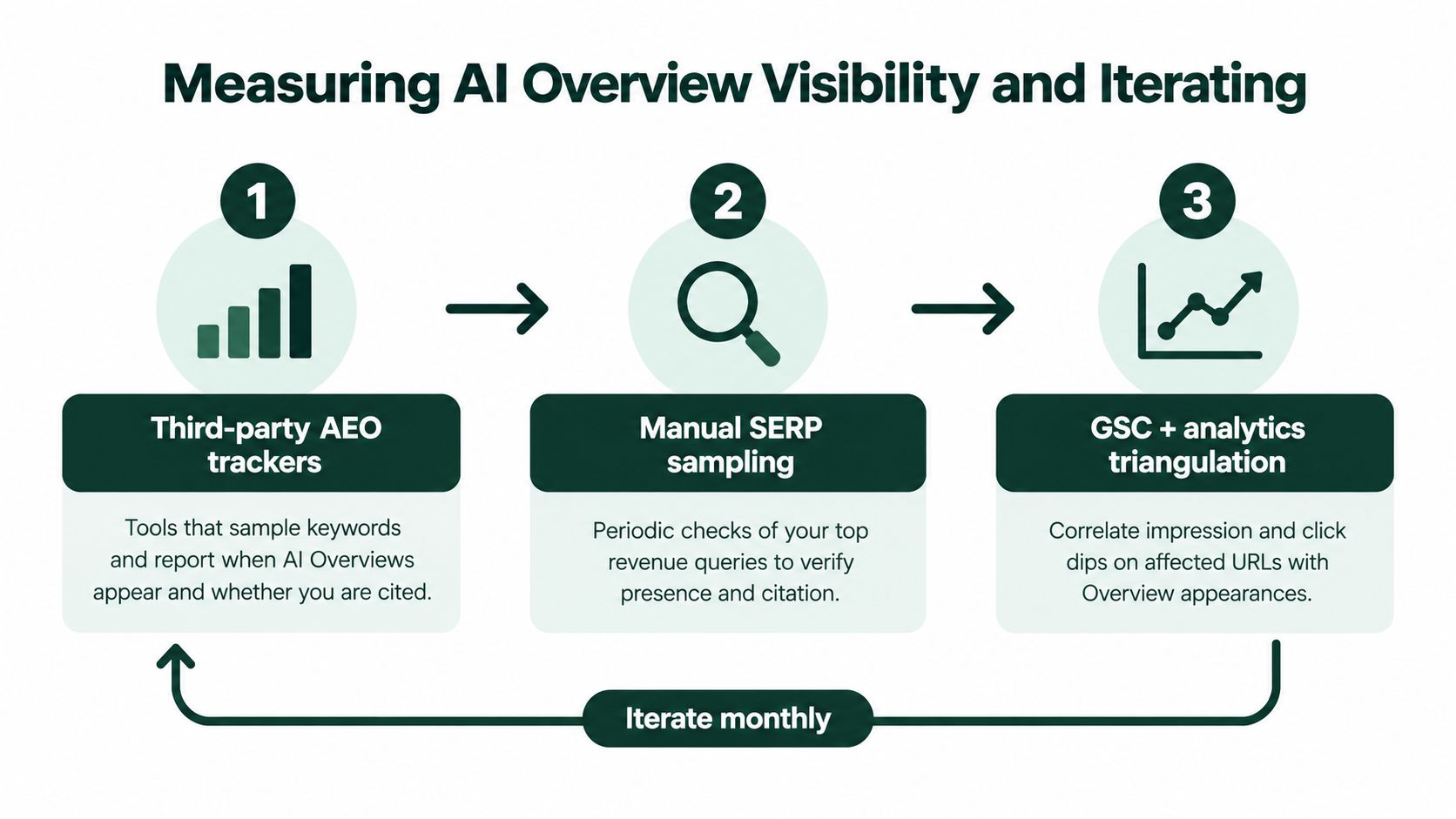
Despite the limitations of native tooling, there are several effective approaches for tracking your AI Overview performance:

Third-Party SERP Monitoring Tools: Platforms like Semrush, Ahrefs, Moz, and BrightEdge have all developed AI Overview tracking features that can identify when your pages are being cited in AI Overviews for specific queries. These tools work by regularly scraping SERPs and recording AI Overview appearances and citations. While not perfect, they provide the most direct measurement available.

Manual SERP Checks: For your most important target queries, regular manual checks of the SERPs can reveal whether AI Overviews are appearing and whether your content is being cited. This is time-consuming but provides the most accurate and current data available. Creating a systematic schedule for checking your top 20–50 target queries monthly is a reasonable approach for most businesses.

Traffic Pattern Analysis: While indirect, analyzing traffic patterns in Google Analytics or your preferred analytics platform can provide signals about AI Overview impact. Queries where your organic click-through rate has dropped significantly despite maintaining strong ranking positions may indicate that an AI Overview is now covering that query and absorbing clicks. Conversely, queries where you see unexpected traffic from pages that rank outside the top 5 may indicate AI Overview citation.

Google Search Console Query Data: While GSC doesn't report AI Overview metrics directly, monitoring your click-through rates by query can reveal the impact of AI Overviews on your traffic. A sudden drop in CTR for a query where your ranking position has remained stable is a strong indicator that an AI Overview has begun appearing for that query.

Setting Up an AI Overview Tracking Dashboard

I recommend building a dedicated AI Overview tracking dashboard that monitors the following metrics on a weekly or bi-weekly basis:

  • Number of target queries with AI Overview appearances (tracked via third-party tools)
  • Number of those AI Overviews that cite your content
  • Your citation rate as a percentage of AI Overview appearances
  • Click-through rate trends for queries with AI Overview appearances vs. those without
  • Organic ranking position distribution for queries where you are vs. are not cited
  • Content freshness metrics — average days since last update for cited vs. non-cited pages

This dashboard will give you the data you need to identify which optimization interventions are working, which content needs updating, and where your biggest AI Overview opportunity gaps lie. For teams looking to systematize this kind of tracking alongside broader SEO automation, the SEO Automation in 2026: What to Automate (and What Not To) guide provides a comprehensive framework for deciding which measurement and optimization tasks are best handled by automated systems versus human judgment.

Competitive Intelligence for AI Overviews

Beyond tracking your own performance, monitoring your competitors' AI Overview citation rates for your target queries provides invaluable strategic intelligence. When a competitor is consistently cited in AI Overviews for queries where you are not, analyzing their cited content — its structure, depth, schema implementation, E-E-A-T signals, and freshness — will reveal exactly what you need to improve in your own content to compete for those citations.

Common Mistakes That Prevent AI Overview Inclusion

After working with dozens of websites on AI Overview optimization, I've identified a consistent set of mistakes that prevent otherwise strong content from earning AI Overview citations. Avoiding these pitfalls can be just as valuable as implementing positive optimization strategies.

Mistake 1: Writing for Search Engines Instead of Users

The single most common mistake I see is content that has been optimized for traditional keyword stuffing and thin on-page SEO tactics at the expense of genuine user value. This includes keyword-dense introductions that don't actually answer anything, artificially padded word counts with repetitive or tangential content, and content that circles around an answer without ever clearly stating it.

Google's AI is remarkably good at identifying the difference between content that genuinely serves user intent and content that is performing the appearance of serving user intent. Content that falls into the latter category — even if it ranks well organically due to aggressive link building — is systematically underrepresented in AI Overview citations.

Mistake 2: Neglecting Content Updates

Stale content is a significant liability for AI Overview optimization, particularly in fast-moving fields. I regularly encounter websites where the top-ranking content for important queries was last updated two or three years ago and now contains outdated statistics, deprecated tools, superseded best practices, or references to events or conditions that no longer apply. Google's AI systems are increasingly penalizing this kind of outdated content in their citation selections.

Establish a systematic content audit and update process. At minimum, review your top-performing content every six months and update any statistics, tools, processes, or recommendations that have changed. For rapidly evolving fields, quarterly reviews may be necessary.

Mistake 3: Hiding Key Answers Behind Paywalls or Login Walls

Content that requires users to log in, subscribe, or pay to access cannot be crawled in its complete form by Google's systems, which means it cannot be cited in AI Overviews. If you have premium content that addresses high-value AI Overview queries, consider whether a free preview or summary version of that content could be made publicly accessible to capture AI Overview citations — while the full content remains gated for subscribers.

Mistake 4: Over-Relying on JavaScript Rendering

Content that is loaded dynamically via JavaScript — particularly content that requires user interaction to reveal — may not be fully rendered and indexed by Google. While Google has improved its JavaScript rendering capabilities significantly, pages where critical content is hidden behind JavaScript-dependent tabs, accordions, or dynamic loaders are at a disadvantage for AI Overview citation compared to pages where all content is available in the initial HTML response.

Mistake 5: Ignoring Internal Linking Structure

Weak internal linking undermines topical authority signals, which are critical for AI Overview citation. Pages that exist as isolated islands within your site — not linked from or to related content — miss the opportunity to benefit from the topical cluster authority that your broader content portfolio has built. Every piece of content you create should be integrated into your site's internal linking architecture in a way that reinforces your topical authority signals.

Mistake 6: Not Addressing the Full Spectrum of Query Intent

Many AI Overview optimization failures stem from content that addresses one dimension of a query's intent while ignoring others. For example, a query like "how to lose weight" has informational intent (explain the science), instructional intent (provide a practical plan), motivational intent (address psychological barriers), and safety intent (warn against harmful approaches). Content that only addresses one of these dimensions is less likely to be cited than content that comprehensively addresses all of them.

Before creating or updating content for AI Overview optimization, conduct a thorough search intent analysis that identifies all the dimensions of intent your target queries encompass, and ensure your content addresses each dimension adequately.

The Future of AI Overviews: What to Prepare For Now

The AI Overview landscape is evolving rapidly, and the strategies that work best today will continue to shift as Google's AI systems become more sophisticated and as the feature expands to new query types and markets. Preparing for these changes now — rather than reacting to them after they've already impacted your traffic — is the mark of a forward-thinking SEO strategy.

Expansion to More Query Types

Google has been steadily expanding the types of queries that trigger AI Overviews since the feature launched. Initially focused primarily on informational queries, AI Overviews are increasingly appearing for commercial, transactional, and navigational queries as well. This expansion will continue, and businesses in e-commerce, local services, and other commercial sectors that have not yet prioritized AI Overview optimization will face growing competitive pressure from those that have.

Multimodal AI Overviews

Google has signaled clearly that its AI systems are moving toward multimodal understanding — the ability to process and generate responses that incorporate text, images, video, and other media types. Future AI Overviews may incorporate visual content, interactive elements, or video clips alongside text summaries. Websites that have invested in high-quality visual content with strong accessibility markup (descriptive alt text, captions, structured visual data) will be better positioned to benefit from multimodal AI Overview expansions.

The Rise of AI Agents and Agentic Search

One of the most significant medium-term developments in search is the emergence of AI agents — AI systems that don't just answer questions but take actions on behalf of users, browsing the web, comparing options, and making recommendations autonomously. Google's Project Astra and similar initiatives suggest that the next generation of AI-powered search will involve agents that interact with web content in fundamentally new ways.

Preparing for this future means investing in clear, machine-readable content structures, comprehensive schema markup, and the kind of deep topical authority that makes your site a trusted source for AI agents to draw from. It also means paying attention to emerging standards like llms.txt — a new file format that helps AI systems understand how to interact with your website's content. For a comprehensive overview of this emerging standard, see our guide on What Is llms.txt? The Complete Guide for 2026.

Increasing Competition for AI Overview Citations

As more SEO practitioners and content teams become aware of AI Overview optimization, competition for citation slots will intensify. The strategies that feel cutting-edge today — answer-first content structure, comprehensive schema markup, strong E-E-A-T signals — will become table stakes. The differentiating factors in the future will increasingly be original research, unique data, genuine subject matter expertise, and the kind of authentic first-person experience that AI-generated content cannot replicate.

This is one of the reasons why I believe that the human element in content creation — real expertise, real experience, real opinions and insights — is more valuable now than it has ever been. As AI-generated content floods the web and makes generic informational content a commodity, the content that stands out and earns AI Overview citations will be the content that only a genuine human expert could have written.

The Broader AI Search Ecosystem

Google AI Overviews are just one component of a rapidly expanding AI-powered search landscape. Bing Copilot, Perplexity AI, ChatGPT's search feature, Claude's web browsing capability, and a growing list of specialized AI search tools are all competing for users' information-seeking attention. The strategies that help you rank in Google AI Overviews — strong E-E-A-T, clear content structure, original research, comprehensive schema markup — are largely transferable to these other platforms as well.

Thinking about your content strategy through the lens of "how do I become the most credible, clearly-structured, trustworthy source on my topic across all AI-powered information systems" is a more durable framework than optimizing for any single platform's specific algorithmic quirks. For a deeper exploration of how different SEO and AI optimization tools compare in their approach to this challenge, the AutoSEO vs GetAutoSEO: Which One Are You Looking For? guide provides useful context on the tool landscape.

Conclusion: Your Action Plan for AI Overview Dominance

Understanding how to rank in Google AI Overviews is no longer optional for serious SEO practitioners — it is the central challenge and opportunity of modern search optimization. AI Overviews now cover nearly half of all Google searches, they are expanding to new query types every month, and the brands that earn consistent citation within them are building a form of digital authority that compounds over time.

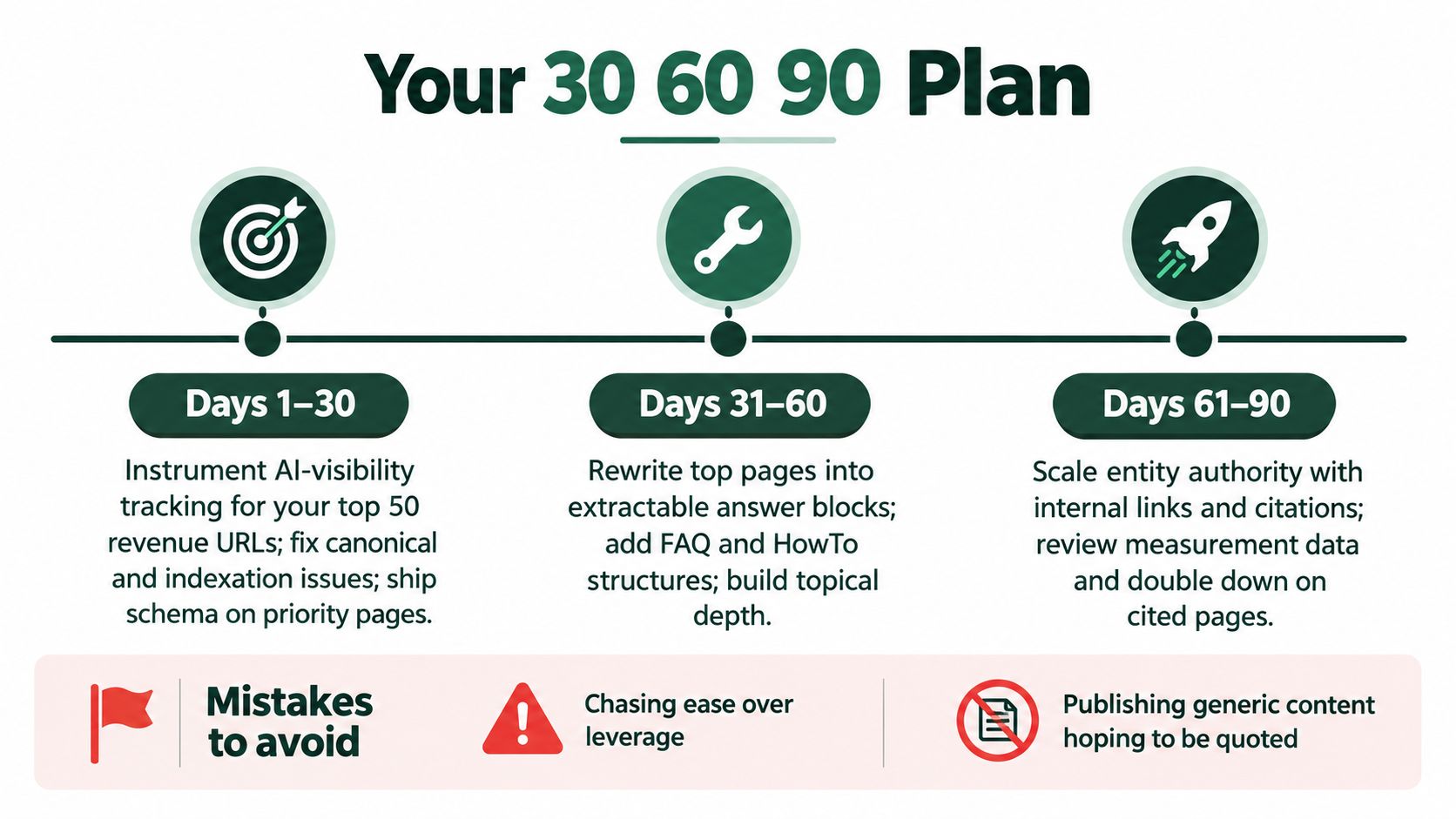
Let me distill everything covered in this guide into a prioritized action plan you can begin implementing immediately:

  1. Audit your existing top-ranking content for answer-first structure. For each piece, identify where the core answer is currently buried and restructure it to appear in the first 100–150 words. This single change can improve AI Overview citation rates within weeks.
  2. Implement comprehensive schema markup across your content library, starting with Article, FAQ, and HowTo schema for your most important pages. If you haven't done this yet, it is likely the highest-ROI technical SEO task currently available to you.
  3. Conduct a content freshness audit and identify your top-performing pages that contain outdated statistics, tools, or recommendations. Update these pages systematically, paying particular attention to pages targeting queries that now trigger AI Overviews.
  4. Develop a topical authority content plan that fills gaps in your content cluster coverage. Identify the sub-topics and related queries within your core topic areas that you haven't yet addressed, and create comprehensive, expert-authored content for each.
  5. Build your E-E-A-T infrastructure — author bio pages with verifiable credentials, clear publication and update date transparency, editorial policies, and citation practices that demonstrate trustworthiness.
  6. Set up AI Overview monitoring using third-party tools and manual SERP checks for your most important target queries. You cannot optimize what you cannot measure.
  7. Invest in original research and unique data that gives Google's AI a reason to cite you specifically rather than any of your competitors. Even a modest annual survey or dataset can generate citation-worthy content that sets you apart.

The brands and publishers that are winning the AI Overview game right now are not doing so by gaming the system — they're doing so by being genuinely excellent: more expert, more thorough, more trustworthy, and more clearly structured than their competitors. That's a standard worth striving for, both because it works for AI Overview optimization and because it's simply the right way to serve your audience.

If you're looking for a smarter, more efficient way to implement these strategies at scale — particularly across large content libraries or e-commerce catalogs — Auto SEO is built specifically for this challenge. Auto SEO automates the technical and structural SEO optimizations that form the foundation of AI Overview visibility, freeing your team to focus on the high-value creative and strategic work that only humans can do. From schema markup automation to content structure analysis, Auto SEO handles the systematic work of how to rank in Google AI Overviews so you can focus on creating the expert content that earns citations.

Frequently Asked Questions

What exactly are Google AI Overviews and how are they different from regular search results?

Google AI Overviews are AI-generated summaries that appear at the very top of Google Search results pages, above all organic results. Powered by Google's Gemini AI model, they synthesize information from multiple web sources to provide a direct, conversational answer to a user's query. Unlike regular search results, which simply list pages for users to click through, AI Overviews present a pre-synthesized answer directly on the SERP and cite multiple sources within the summary panel itself. They differ from Featured Snippets in that they draw from multiple sources (typically 3–8), paraphrase rather than quote directly, and appear for a much broader range of query types — currently estimated at approximately 47% of all Google searches.

Do I need to rank on the first page of Google to appear in AI Overviews?

In practice, yes — strong organic rankings are a prerequisite for AI Overview citation. Research by Semrush analyzing over 100,000 AI Overview citations found that approximately 99.5% of cited URLs were pages that also ranked in the top 10 organic results for that same query. This means that traditional SEO fundamentals — building domain authority, earning quality backlinks, optimizing on-page signals, and achieving strong technical performance — remain essential for AI Overview visibility. However, ranking in the top 10 alone does not guarantee AI Overview citation; content quality, structure, E-E-A-T signals, and schema markup all influence whether a top-ranking page gets cited versus passed over.

How long does it take to start appearing in Google AI Overviews after optimizing my content?

The timeline varies significantly depending on your starting point and the specific optimizations you implement. Structural changes — such as restructuring content to lead with clear answers and implementing schema markup — can produce results within days to weeks, as Google can re-crawl and re-evaluate your content relatively quickly. E-E-A-T improvements and domain authority building take longer, typically 3–12 months depending on the competitiveness of your space. Content freshness updates tend to produce faster results than content created from scratch. The most realistic expectation for a comprehensive AI Overview optimization program is to see meaningful citation improvements within 2–4 months for structural and technical changes, with continued improvement over 6–12 months as authority signals accumulate.

Can I see in Google Search Console whether my pages are appearing in AI Overviews?

As of 2025, Google Search Console does not provide native reporting specifically for AI Overview impressions, clicks, or citations. This is one of the most significant measurement gaps in current SEO tooling. The best available workarounds include: using third-party SERP monitoring tools like Semrush, Ahrefs, or BrightEdge that track AI Overview appearances and citations; conducting regular manual SERP checks for your target queries; and analyzing click-through rate trends in GSC to identify queries where CTR has dropped despite stable rankings — a pattern that often indicates a new AI Overview is now covering that query. Google has indicated that it is working on providing more AI Overview visibility in Search Console, but no specific timeline has been announced.

Does using AI to write content hurt my chances of appearing in Google AI Overviews?

Google's official position is that it evaluates content based on quality signals — E-E-A-T, helpfulness, accuracy, and user value — regardless of whether it was written by a human or generated with AI assistance. AI-generated content is not inherently penalized. However, in practice, purely AI-generated content often lacks the first-person experience signals, unique insights, original data, and genuine expertise demonstrations that are the strongest predictors of AI Overview citation. Content that reads as generic, derivative, or devoid of authentic human expertise tends to perform poorly in AI Overview citations — not because it was AI-generated, but because it lacks the quality signals that AI Overview selection rewards. The sweet spot is using AI tools to assist with research, structure, and drafting while ensuring that genuine human expertise and experience are woven throughout the final content.

What types of queries are most likely to trigger Google AI Overviews?

Informational and educational queries are the most consistent AI Overview triggers — particularly questions beginning with "what is," "how does," "why does," "how to," and "what are the differences between." How-to and procedural queries are also very reliable triggers, as are comparison queries ("X vs. Y," "best X for Y") and definitional queries. Queries that are less likely to trigger AI Overviews include navigational queries (searches for specific brands or websites), highly time-sensitive queries (breaking news, live scores), very short or ambiguous queries, and certain sensitive YMYL (Your Money Your Life) categories where Google is exercising caution about AI-generated health, legal, or financial advice. As Google's AI capabilities expand, the range of query types triggering AI Overviews continues to grow.

How important is schema markup for getting cited in AI Overviews?

Schema markup is one of the highest-ROI optimizations available for AI Overview citation, particularly because it is relatively straightforward to implement and can produce measurable results quickly. FAQ schema is especially valuable — by marking up your question-and-answer content, you essentially provide Google's AI with pre-formatted, machine-readable answers that it can directly incorporate into AI Overview responses. HowTo schema serves a similar function for procedural content. Article schema, Organization schema, and Person schema all contribute to the E-E-A-T signals that influence citation eligibility. While schema markup alone cannot compensate for poor content quality or weak organic rankings, for pages that are already competitive organically, implementing comprehensive schema markup can be the difference between being passed over and being cited in AI Overviews.

Will optimizing for Google AI Overviews also help me rank in other AI search platforms like Perplexity or Bing Copilot?

Yes, substantially. The core principles that drive AI Overview citation — strong E-E-A-T signals, clear and direct answer structures, comprehensive topical coverage, accurate and well-cited factual content, and robust schema markup — are largely platform-agnostic. Perplexity AI, Bing Copilot, ChatGPT's search feature, and other AI-powered search tools all use similar evaluation frameworks when selecting sources to cite in their AI-generated responses. In fact, some practitioners have found that the optimization techniques most effective for Google AI Overviews are even more impactful on platforms like Perplexity, which tends to be more transparent about its citation criteria. Building a content strategy centered on being the most credible, clearly-structured, and trustworthy source on your topics will serve you well across the entire AI search ecosystem, not just on Google.

Stop doing SEO by hand

Put your SEO on autopilot — your first 3 articles for $1

Auto SEO scans your site, builds a content plan, and writes ranking-ready articles automatically. Start your $1 trial — the AI writes your first 3 the moment you begin. Cancel anytime in 3 days.

2,147+ businesses · Cancel anytime · No lock-in