
low keyword competition 16 min 2,809 words

Low Keyword Competition: A Guide to Easy Wins

Low Keyword Competition: A Guide to Easy Wins

The popular advice is simple: find a keyword with a low difficulty score, publish a page, and enjoy an easy win. That advice is incomplete. A term can be easy to rank for because almost nobody wants it, because the search intent is unclear, or because Google answers it before a visitor reaches your page.

Low keyword competition is useful only when ranking is feasible, the page format matches the query, and the resulting visibility matters to your business. This guide treats competition as a broader decision involving intent, SERP strength, content format, historical patterns, and AI citation potential. You'll learn how long-tail behavior changes click efficiency, how to inspect competition beyond a tool score, how to filter opportunities, and how to decide whether a keyword deserves content resources.

Table of Contents

Why Easy Keywords Are Not Always the Right Keywords

An easy keyword isn't automatically a valuable keyword. If no strong site targets a phrase, that may signal an underserved opportunity. It may also signal weak demand, poor commercial intent, or a searcher who wants something your business can't provide.

A new SEO team member often makes the same mistake: sorting a keyword list by the lowest difficulty score and treating the first results as priorities. That reverses the proper order of operations. Business relevance and search intent come before ranking ease. A page that attracts visitors who never need your product may produce a ranking report that looks healthy while contributing little to growth.

Practical rule: Treat a low difficulty score as an invitation to investigate, not as a publishing decision.

The gap between rankability and value

Suppose a SaaS company finds a very easy query about a niche spreadsheet function. The team can probably create a useful explanation, but the query may not connect with the software's audience or buying journey. A more difficult phrase about workflow automation might deserve attention if it attracts qualified prospects and supports a relevant product page.

The trade-off is straightforward:

  • Fast ranking: A weak SERP may let a focused page gain visibility sooner.
  • Thin demand: Specific terms often have fewer searches than broad topics.
  • Qualified traffic: Specificity can reveal a clearer problem and a stronger reason to click.
  • Commercial fit: The keyword must lead naturally to a product, service, subscription, signup, or useful next step.

The low-competition keyword guidance from SEOProfy connects longer, intent-rich phrases with more efficient click behavior. Its reported benchmark is that 10–15-word search phrases receive 1.76 times more clicks than single-word queries, although the value still depends on whether the topic fits your offer.

The right question isn't “Can we rank?” It's “Can we earn meaningful visibility for a query that our page can satisfy better than the current results?”

What Low Keyword Competition Actually Means

Low keyword competition describes a search query where the current results contain relatively few strong, well-aligned pages competing for the same visibility. Think of page one as a gym. Keyword difficulty describes the strength of the lifters already there, while your site's authority, content quality, links, and technical health determine whether you can join the competition.

A low-difficulty SERP may contain forum discussions, thin articles, outdated guides, or pages that mention the topic without answering it directly. A high-difficulty SERP tends to include established brands, thoroughly developed resources, strong backlink profiles, and pages that closely match the expected format.

Many SEO tools represent keyword difficulty on a 0–100 scale, with low-competition thresholds commonly placed around 0–30 or below 20–30, as described by SEOclarity's explanation of keyword difficulty. Those ranges are useful for screening, but they're not universal laws. A low score can still hide powerful domains, strong brand preference, or an SERP dominated by features that reduce organic clicks.
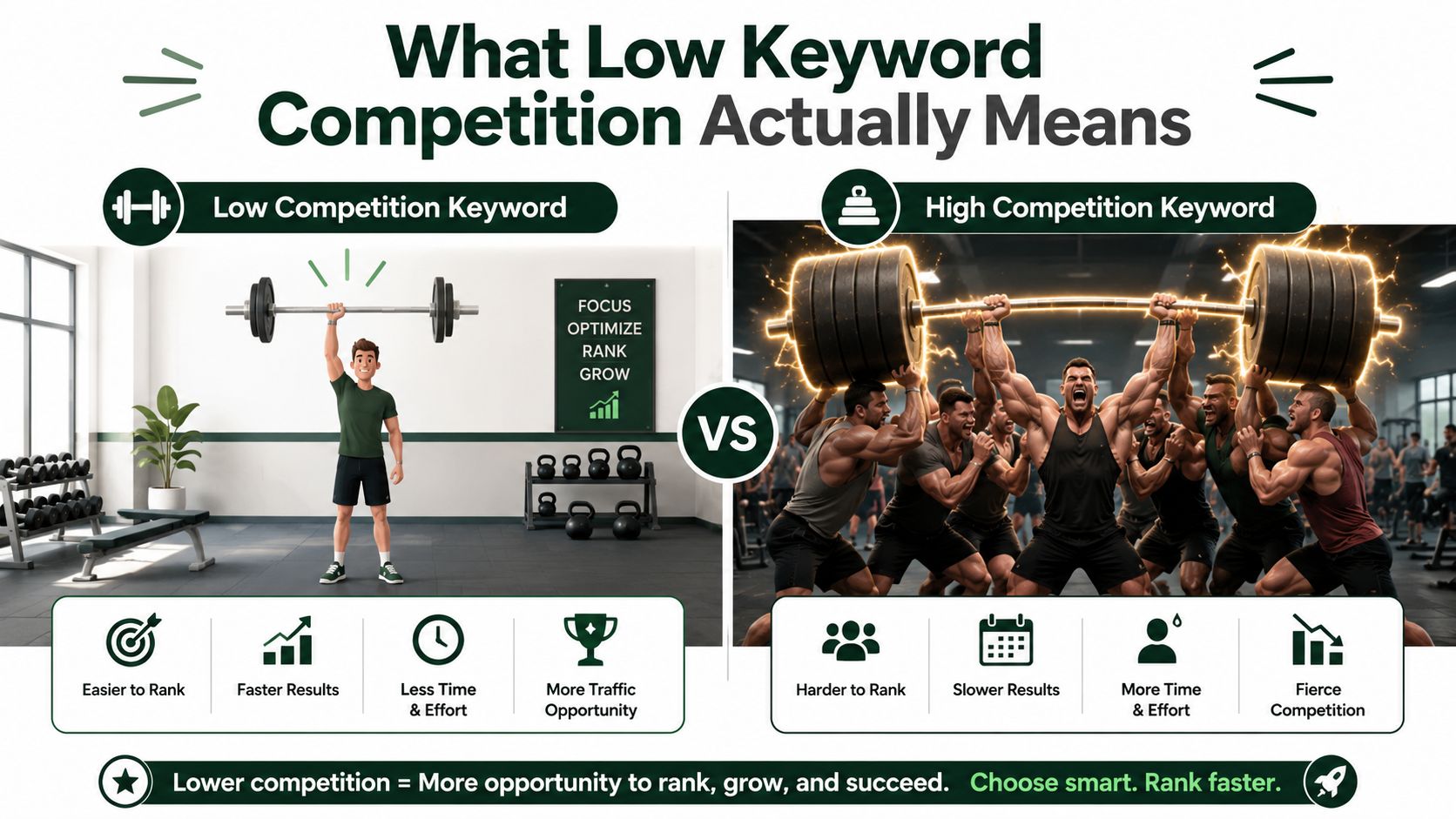
An infographic comparing low keyword competition versus high keyword competition for better SEO and website growth strategy.

Two kinds of competition

Competitive density asks how many capable pages are targeting the query. If the results contain many authoritative pages with detailed coverage, density is high.

Competitive intent asks how well those pages answer what the searcher wants. A SERP can have strong domains but poor intent alignment. For example, a query asking for a specific implementation method might return broad introductory articles. That creates an opening for a page built around the exact task.

Read the results before trusting the metric. Look at the page types, freshness, depth, authorship, examples, and unanswered follow-up questions. Low keyword competition becomes actionable when the results are weak in a way your team can fix.

Why Long-Tail Queries Change the Math

Broad head terms compress many possible needs into a short phrase. “Project management software” could come from a large enterprise buyer, a freelancer, a student, or someone comparing categories. That broad audience attracts many publishers, software directories, review sites, and brands.

Add qualifiers, and the query becomes more useful. “Project management software for small construction teams” identifies a clearer audience, setting, and use case. Fewer pages may target that exact combination, and the searcher's expectations become easier to interpret.

Specificity affects clicks, not only rankings

Long-tail queries are often associated with easier ranking because they narrow the set of relevant competitors. The SEOProfy analysis of low-competition keywords reports that 10–15-word phrases receive 1.76 times more clicks than single-word queries. That figure doesn't mean every longer query will outperform every short query. It does show why specificity can improve click efficiency, not merely reduce difficulty.

Dimension Head Term (1–2 words) Long-Tail (3+ words)
Meaning Broad and open to interpretation Narrower and easier to interpret
SERP Many page types and competitors Smaller pool of closely relevant pages
Intent Often mixed Usually more visible
Content brief Broad topic coverage Focused answer or use case
Business fit May require qualification Can map directly to an audience need

Long-tail research works best when each qualifier carries meaning. Words such as “for agencies,” “with Shopify,” “for small teams,” or “without coding” can reveal constraints that shape the page.

Don't add words just to make a phrase longer. Add them because they describe the user, problem, context, or desired outcome. The searcher's specificity should guide your page format and conversion path.

How Competition Is Really Measured in 2026

A low KD score is a screening clue, not a ranking forecast. Real competition depends on the searcher's intent, the pages already winning, the format Google favors, and whether the opportunity remains useful over time.

Historical data adds a time dimension to that review. DataForSEO's keyword overview and historical data documentation states that its historical keyword dataset reaches back to the beginning of 2019 and can return historical Google keyword data for up to 700 keywords in one request. Teams can therefore compare demand and competition patterns across roughly seven years of history, instead of treating a temporary shift as a durable opportunity.

Read the SERP behind the score

A query with a low score can still be difficult when major marketplaces, established publishers, community platforms, or reference sites control the results. A higher-scoring phrase may be reachable when the ranking pages are thin, outdated, poorly organized, or only loosely matched to the query.

Review four signals:

Signal What It Measures Where to Find It Weight
Tool difficulty Estimated ranking resistance Keyword research platform Screening signal
Page strength Authority, depth, links, and quality Manual SERP review and backlink tools High
Ranking format The page type Google prefers Search results, feature inspection High
Historical stability Whether the opportunity persists Historical SERP and keyword data High

Format is part of competition. A written guide cannot automatically replace a calculator, product comparison, video, forum answer, or template. If Google rewards an interactive tool or a concise answer block, matching the query may require more than publishing another article. The same applies when the results favor demonstrations, comparison tables, or product-led pages.

For a broader evaluation of competing pages, use this guide to Google competition. Record the tool score, then test it against the actual SERP, the expected page format, and the query's potential to earn an AI citation. The easiest keyword to rank for may still have weak business value if its intent does not support the next action.
Do this automatically

Let AutoSEO write & rank this for you — on autopilot

Enter your site: we scan it, build a keyword plan, and publish ranking-ready articles for Google and AI answers. Start for $1.

First 3 articles instantly Cancel anytime during the trial 30-day money-back

A Practical Workflow for Finding the Right Opportunities

The easiest keyword to rank for may still be the wrong target. Start with the business problem and the searcher's next action, then use keyword tools to find queries that fit both.

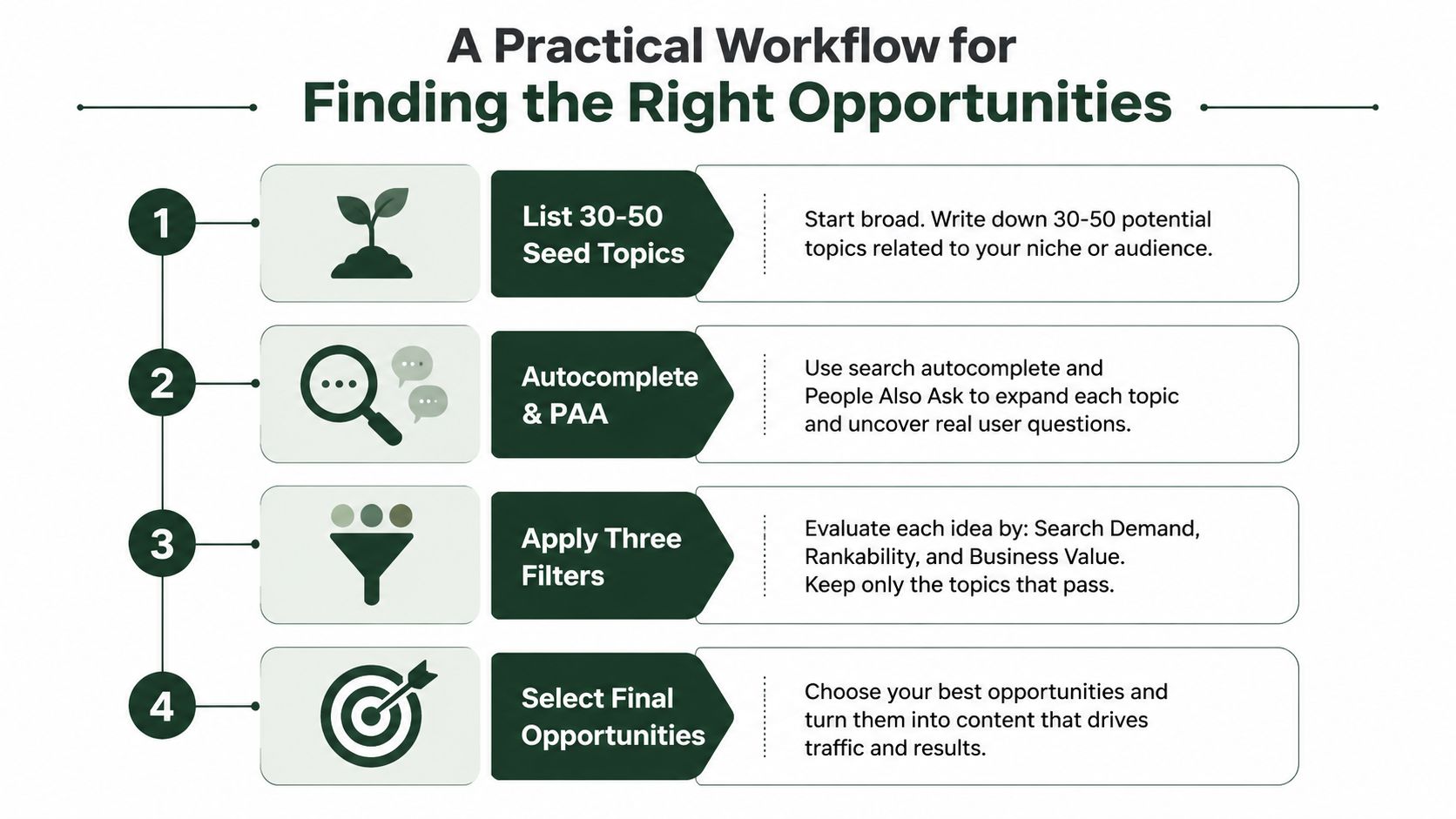
Create a working list of 30–50 seed topics from products, customer problems, support questions, use cases, and audience language. Expand it with autocomplete, People Also Ask, competitor research, Ahrefs, Semrush, or another platform.

A four-step practical workflow infographic for finding SEO content opportunities through research and filtering.

Apply the filters in order

First, test intent. Classify the query as informational, navigational, commercial, or transactional. Ask whether your site can provide the format and answer the searcher expects. A low-difficulty login query has little value if you do not own the named product.

Second, inspect actual competition. Review the top results manually. Record domain strength, page depth, freshness, backlinks, content format, and unanswered questions. Compare these observations with the tool score. Treat the score as a screening signal, not a verdict.

Third, test business relevance. The query should support a realistic outcome, such as attracting a qualified audience, building topical authority, supporting a product decision, or creating a useful internal-link path. Traffic potential and business value are different measures.

Score each candidate from 1 to 5 for intent match, realistic difficulty, and commercial or strategic relevance. Prioritize candidates reaching at least 12 out of 15. This threshold helps organize work. It does not guarantee rankings.

Use a practical collection of SEO competitive analysis tools to speed up research, while keeping human SERP review in the process. A spreadsheet covering keyword, intent, expected format, competing page quality, AI Overview presence, business fit, and score is enough to start.

This video provides another visual reference for the workflow:

The Hidden Competition Layer Most Guides Miss

Keyword tools usually frame competition as a question of reaching the blue-link results. In 2026, visibility has another layer. AI Overviews can answer a query above the organic listings and select sources to cite inside that answer, so your page competes for both rankings and citations.

As noted earlier, the Stackmatix analysis of Google AI Overviews' SEO impact reports click declines of roughly 34.5%–64.4% for affected SERPs. That range does not apply to every query, but the planning risk is clear. For example, someone searching “what is the capital of France” may see the answer in an AI Overview and skip the top-ranking page. A page can therefore hold a strong organic position while receiving fewer visits because the search experience resolves the question before the click.

Evaluate citation potential

Search the keyword before publishing and record whether an AI Overview appears. Review the sources it cites, the points it emphasizes, and the questions it leaves open. Treat the result like a second competitor review: ranking pages compete for position, while concise and trustworthy sources compete for extraction.

A page has a stronger citation case when it offers:

  • Precise answers: State the key response clearly rather than burying it in a long introduction.
  • Source-worthy specificity: Provide original explanations, definitions, comparisons, procedures, or evidence readers can verify.
  • Clear structure: Use descriptive headings, concise sections, lists, tables, and appropriate schema.
  • Topical consistency: Build connected coverage so the page belongs to a recognizable subject area.
  • Intent alignment: Answer the exact question instead of producing a generic article around the keyword.

A low-competition organic term may still face heavy AI competition if authoritative pages already offer concise, extractable answers. A poorly served query may present a citation opening even when its blue-link difficulty score looks less attractive.

Ask two questions before choosing the keyword: can the page rank, and can it become a source an answer system would trust, extract, and cite?

Putting It All Together Into a Decision Framework

A low difficulty score earns a keyword only a place on the shortlist. Before turning it into a brief, test the opportunity through four gates. Each gate filters a different risk, from irrelevant traffic to search results where organic clicks are limited.

The four gates

Gate one, page fit. Can your team create the format the searcher expects? If the SERP favors a calculator but you can publish only a general article, the keyword may not be practical.

Gate two, click access. Does the query show an AI Overview or another feature that captures attention? Check whether your page could earn a citation or offer a clear reason to visit the site.

Gate three, actual difficulty. Do capable competitors look weak in your niche, rather than merely receiving a low tool score? A score around 0–30 on a 0–100 scale works as an initial filter, but manual review determines whether the opportunity is credible, as explained by SEOclarity's keyword difficulty guidance.

Gate four, business outcome. Could the visitor buy, subscribe, request information, use the product, or strengthen a relevant topic cluster? If the term supports none of these outcomes, defer it or skip it.

Gate Question to Ask Pass Criterion Fail Action
Page fit Can we satisfy the expected format? Content type matches the SERP Rework the brief or skip
Click access Can we earn organic or cited visibility? SERP features leave a viable path Add a citation strategy or deprioritize
Difficulty Are capable competitors weak? Manual review supports the tool score Investigate further
Business outcome Does the audience matter to us? Clear strategic or commercial relevance Remove from the priority list

Long-tail queries can produce more efficient clicks. The SEOProfy study reporting 1.76 times more clicks for 10–15-word phrases than single-word queries supports that pattern. Yet an AI Overview can reduce the clicks available for a query, so forecast traffic separately from ranking potential, as discussed in Stackmatix's analysis.

Use High, Medium, or Skip labels instead of a binary yes-or-no decision. For High-priority terms, use a structured SEO content template to build briefs covering intent, format, evidence, internal links, and citation targets. The final choice should reward a useful business outcome, not merely the easiest score to beat.

Quick Dos and Don'ts Before You Publish

Use this checklist during keyword selection, drafting, optimization, and measurement. It's designed to catch the mistakes that a low KD score won't reveal.

Keyword selection

  • Do confirm intent: Search the exact phrase and describe what the user expects before choosing a page type.
  • Do prioritize relevance: Keep terms connected to your audience, offer, expertise, or authority-building plan.
  • Don't chase empty ease: A zero-volume or barely relevant phrase isn't valuable just because its difficulty score is low.
  • Don't trust volume alone: Treat demand as one input alongside SERP quality, intent, and business fit.

Content format

  • Do inspect the top results: Match the dominant format when it clearly satisfies the query.
  • Do add useful specificity: Include examples, steps, comparisons, tools, or decision criteria that answer the actual problem.
  • Don't publish a generic rewrite: Repeating familiar advice won't create a meaningful reason to rank or earn a citation.
  • Don't ignore format mismatch: A text article may underperform when searchers need a tool, template, demonstration, or product comparison.

On-page signals

  • Do write a direct answer: Put the core response where readers and answer systems can find it quickly.
  • Do organize the page: Use descriptive headings, concise paragraphs, lists, tables, relevant links, and suitable schema.
  • Don't over-optimize density: Use the target phrase naturally and cover related concepts without forcing repetition.
  • Don't hide the useful part: Long introductions and vague conclusions make extraction and scanning harder.

Post-publish monitoring

  • Do check rankings and queries: Review impressions, clicks, indexed status, and the terms the page earns.
  • Do watch AI visibility: Look for changes in AI Overview appearances, cited sources, and the page's ability to answer follow-up questions.
  • Don't stop after publication: Refresh the page when the SERP changes, the topic evolves, or competitors answer the query better.
  • Don't treat a ranking as the finish line: Confirm that visibility reaches the right audience and supports a measurable business action.

Start today with three actions: audit existing pages for low-competition queries, build a candidate list from customer language and competitor gaps, and run every serious candidate through the four-gate framework. AutoSEO brings keyword research, content suggestions, technical SEO tasks, publishing workflows, rank tracking, and AI-visibility monitoring into one connected process, so visit AutoSEO to evaluate opportunities and move approved pages from research to measurement.

Related Articles

Check Keywords for Website: Boost Traffic & Rankings Fast

What Does It Mean to Check Keywords for a Website? Checking keywords for a website refers to the process of identifying, analyzing, and evaluating the specific words and phrases that users enter into

3,442 words5 min

SEO Tools for Keyword Research: Top Picks for 2026

Introduction to SEO Tools for Keyword Research Keyword research is a fundamental aspect of search engine optimization (SEO) that helps you identify the terms and phrases your target audience is search

3,440 words5 min

Competition of Google in 2026: Search Rivals Explained

Explore the competition of Google in 2026, from Bing and AI search rivals to browser battles and SEO implications marketers need to know.

3,419 words19 min

Keyword Research: Find High-Traffic Keywords Fast

Definition of Keyword Research Keyword research is the systematic process of identifying, analyzing, and selecting the words and phrases that users enter into search engines to find information, produ

3,294 words5 min

Google Keyword Planner: Free Guide to Master It in 2024

What Is Google Keyword Planner? Google Keyword Planner is a free tool provided by Google Ads that helps users research and analyze keywords for search engine marketing campaigns. It offers detailed da

3,209 words5 min

Seo Keyword Research

What Is SEO Keyword Research? SEO keyword research is the systematic process of identifying, analyzing, and selecting the most relevant and valuable keywords or search terms that users enter into sear

3,202 words5 min

Stop doing SEO by hand

Put your SEO on autopilot — your first 3 articles free

Auto SEO scans your site, builds a content plan, and writes ranking-ready articles automatically. Start your $1 trial — the AI writes your first 3 the moment you begin. Cancel anytime during the trial.

2,147+ businesses · Cancel anytime · No lock-in