An AI content brief generator uses generative AI to translate search intent and competitor data into structured, actionable instructions for content creation. The strongest systems turn that outline into an accountable operating plan, with evidence requirements, owners, approvals, publishing tasks, and performance feedback.
You've probably seen the failure pattern. A writer receives a polished document packed with keywords, suggested headings, and an optimistic word count. The article gets published, yet it says nothing distinctive, contains claims nobody verified, and creates no clear way to learn from the result. The document looked intelligent because it was formatted well. It failed because it treated SEO as a vocabulary exercise.
A useful brief does something harder. It identifies the reader's problem, defines the evidence the page needs, assigns the work, and records the assumptions that should be tested after publication. In 2026, the content brief is an operational plan, not a disposable PDF.
Table of Contents
What Is an AI Content Brief Generator?
A writer opens a new document for “AI content brief generator” and finds a blank page. They have keyword exports, competitor URLs, Search Console data, and a long list of related questions. None of that tells them what the reader needs first, which claims require proof, or how the article should become more useful than the pages already ranking.
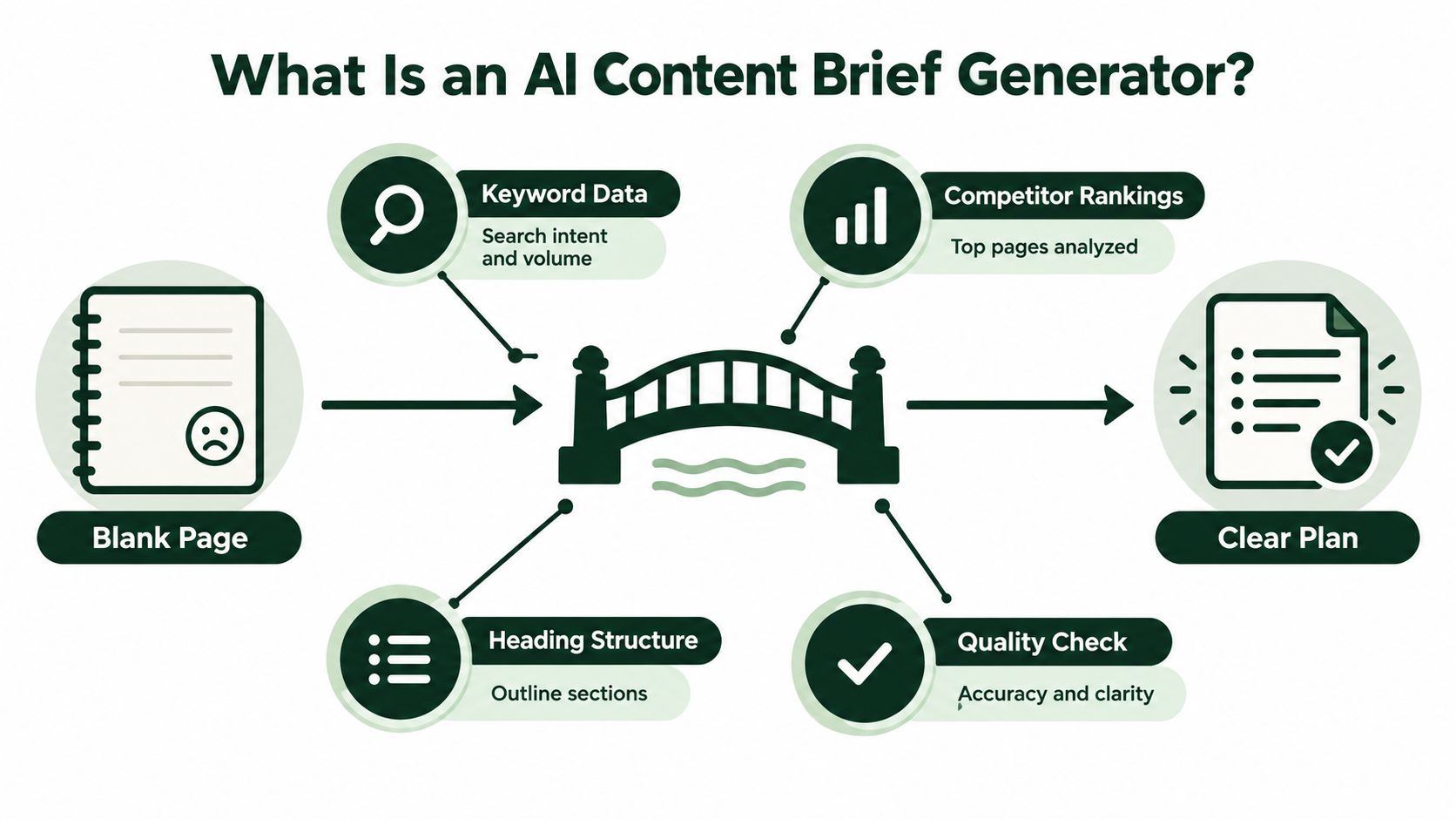
An AI content brief generator acts as the bridge between scattered research and a deliberate editorial plan. It can combine a topic, audience, search intent, competing subtopics, entities, questions, internal-link opportunities, and on-page requirements into one structured document. The writer no longer starts by guessing the outline. They start with a set of decisions.
From keyword list to editorial direction
A basic keyword tool gives you terms. A serious generator should explain the job behind the query. Is the reader comparing solutions, trying to complete a task, evaluating a purchase, or looking for a definition? That distinction changes the outline, tone, examples, calls to action, and evidence standard.
For example, a brief for a commercial query might require product comparisons, limitations, implementation details, and pricing verification. A brief for an educational query might prioritize definitions, practical steps, terminology, and trusted references. The keyword can remain similar while the editorial assignment changes substantially.
The document should guide decisions
A strong output usually includes:
- Audience and problem: Who needs the page, and what decision or task brought them there?
- Intent-led structure: Which headings answer the primary need before secondary questions?
- Differentiation requirements: What original experience, data, commentary, or regional context will prevent a generic summary?
- Evidence controls: Which claims need sources, expert review, current verification, or geographic limits?
- Execution details: Which internal pages should receive links, and what metadata or structured data is justified?
The best brief doesn't promise rankings. It gives a writer and reviewer a shared definition of useful content, then leaves room for human judgment.
How the Technology Works
A content team can feed an AI generator a keyword, competitor pages, and audience questions, then receive a proposed editorial structure. The quality of that output depends on how language models connect context, intent, and evidence, not on keyword volume alone.
The foundation changed in 2017, when transformers introduced a more effective way to model relationships among words through attention, as described in the research paper “Attention Is All You Need”. Later instruction-following models made it practical to ask for structured outputs, such as intent groups, required evidence, audience concerns, and review criteria. IBM's overview of generative AI explains the broader capabilities behind this class of systems.

Why context matters
A generator uses contextual language capabilities to combine inputs rather than copy them. It can connect a topic with the audience's problem, map headings to search intent, group entities by subject coverage, and suggest how related pages fit into site architecture.
A concrete distinction helps. A generator that merges 40 People Also Ask questions into four intent clusters is synthesizing. One that copies the top-ranking H2s is repeating. The first can reveal an editorial opportunity. The second gives a familiar outline with little independent value.
Synthesis still does not verify evidence. A model may recommend a topic because competitor data is incomplete, or turn an untested assumption into confident wording. Treat the output as a working operating plan: publish, measure how readers respond, compare performance with its original assumptions, and revise the next brief accordingly. Human reviewers must set evidence standards, approve claims, and feed real results back into the process.
Core Features of a Modern Generator
A modern generator should function as a quality-control and information-architecture system, not as a keyword-to-outline converter. Google states that AI-assisted content receives no special ranking advantage. Usefulness, originality, relevance, and demonstrated experience, expertise, authoritativeness, and trustworthiness remain the standard in Google's guidance on AI-generated content.
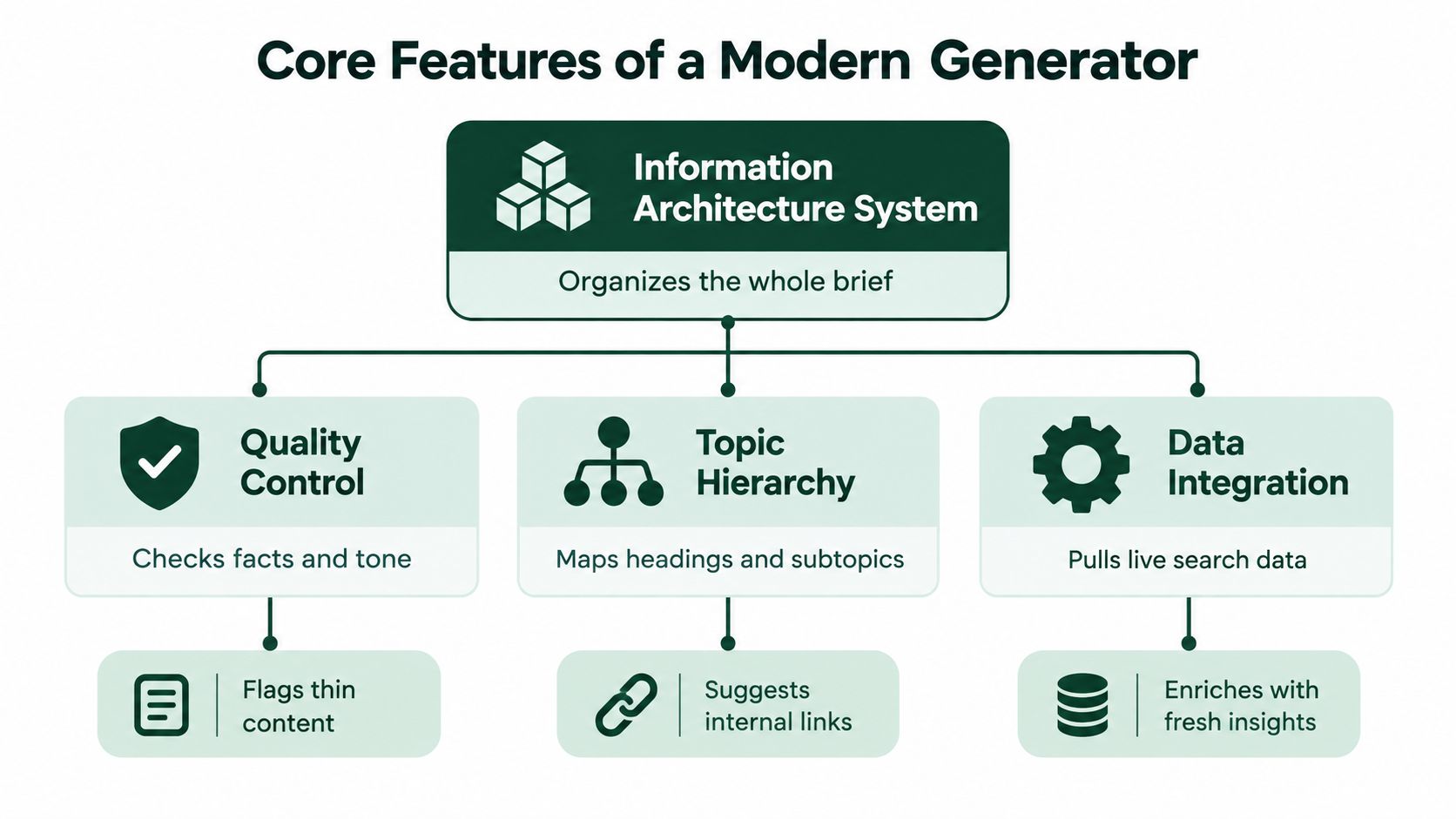
The brief should define the audience problem, decision stage, required terminology, competing subtopics, and unanswered questions. It should also identify commodity sections that add little value and require something more distinctive, such as first-party data, product experience, expert commentary, or region-specific information.
The output needs a hierarchy that helps a writer make sensible trade-offs:
- Primary answer: The essential response should appear early and clearly.
- Supporting coverage: Subtopics should explain, compare, or qualify the main answer.
- Experience signals: The brief should request concrete examples, observations, screenshots, or implementation detail when appropriate.
- Conversion path: The next step should fit the reader's intent rather than interrupting it.
Treat technical fields as instructions, not decoration
A useful brief should specify an accurate title direction, a credible meta description, likely internal-link targets, and structured data that matches visible page content. Internal links should serve navigation and topical relationships, not exist merely to satisfy a count. Schema should help describe eligible content, never disguise unsupported claims.
The brief should also include a claim register. For each material assertion, record the required source, freshness threshold, geographic scope, confidence status, and reviewer. Google recommends manual fact-checking and review of AI-generated content for accuracy and trustworthiness, while structured data must follow feature-specific policies and validation rules in Google's guidance for using generative AI.
Practical rule: If a writer can't tell which sentence needs evidence and who must approve it, the brief isn't production-ready.
A final control is purpose. Record why the page exists, who owns the review, what CMS will receive it, and which assumptions will be measured later. That turns an attractive outline into an auditable editorial instruction set.
The Operational Challenge of AI Briefs
The hardest part isn't generating an outline. It's getting the outline through research, review, production, publishing, and measurement without losing accountability.
Organizations often adopt separate tools for keyword research, competitor analysis, writing, approvals, CMS publishing, and reporting. Each handoff creates room for stale data, duplicated work, unclear ownership, and unrecorded changes. A brief that cannot preserve its assumptions becomes impossible to evaluate later.
The IAB's 2025 research says nearly two-thirds of agencies, brands, and publishers reported significant challenges adopting AI in media campaigns, including tool complexity, data quality and protection, expertise, legal requirements, and fragmentation, as documented in the IAB State of Data 2025 report.
What accountability looks like
A production workflow should connect each recommendation to an action and an owner. It should make uncertainty visible instead of presenting incomplete evidence as fact.
- Data provenance: Show whether a recommendation came from Search Console, competitor analysis, a documented source, or a model inference.
- Ownership: Assign research, writing, subject review, SEO review, and publication tasks to named people.
- Approval history: Preserve the decisions that changed the outline, claims, links, or schema.
- CMS status: Show whether the page is drafted, approved, scheduled, published, or awaiting revision.
- Feedback records: Compare the page's actual performance with the brief's original intent and assumptions.
The workflow should also expose missing inputs. If competitor coverage is incomplete, say so. If conversion evidence is unavailable, don't manufacture a business case. If a medical, financial, technical, or commercial claim lacks current support, route it for review before drafting.
A brief that ends at export is only a planning artifact. A brief that remains connected to execution becomes a testable operating plan.
Fitting the Generator Into AutoSEO
A standalone brief creates another copy-paste task. An integrated workflow turns the brief into a queue of decisions and actions.
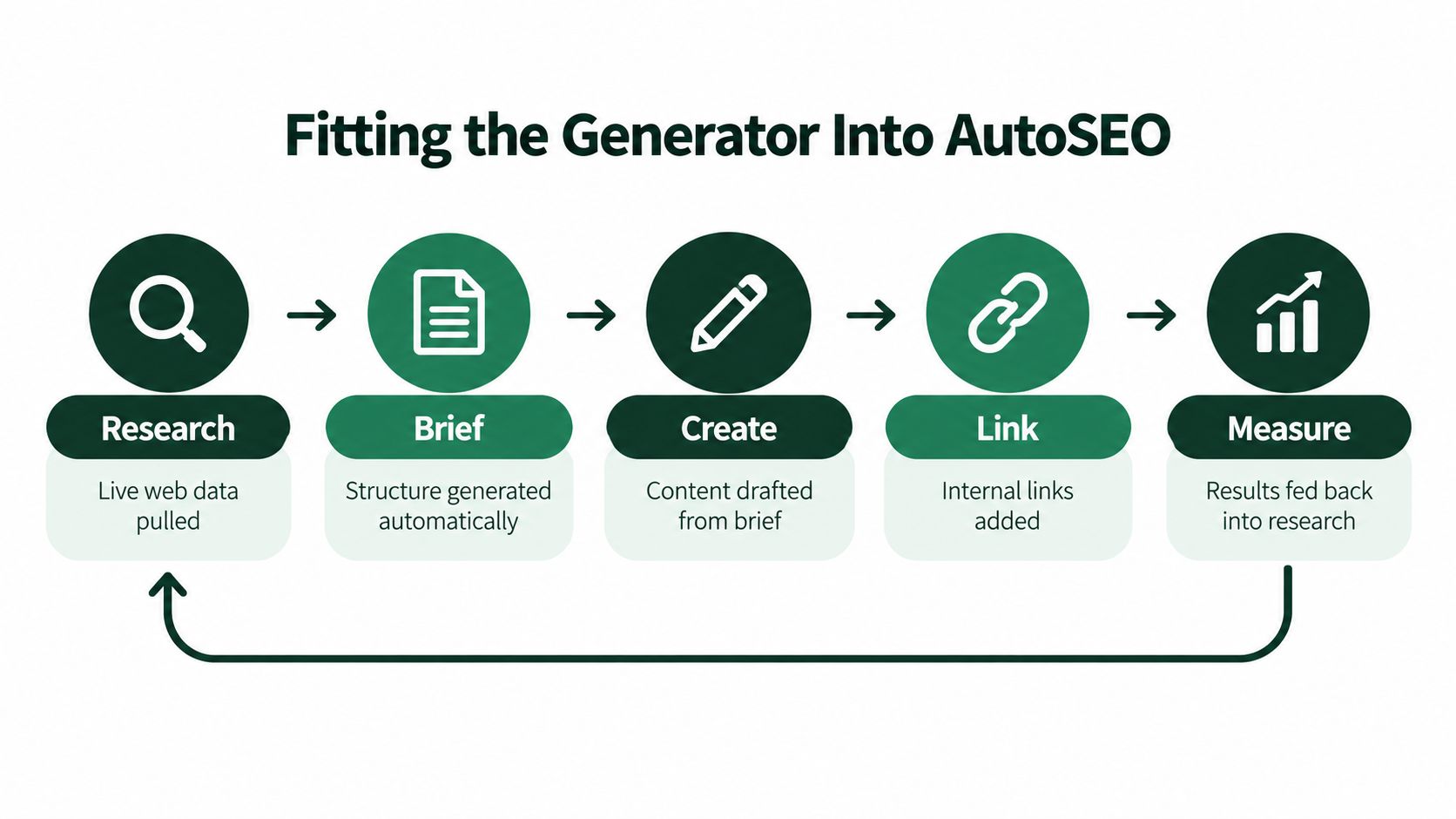
The useful sequence starts with live research. Search Console data, sitemap information, competitor analysis, and demand signals inform the opportunity. The generator then translates that opportunity into an intent-led brief containing headings, entities, evidence requirements, internal links, metadata, schema guidance, and publishing conditions.
The closed loop
An operational system should connect five activities:
- Research: Pull current search and site data, then record confidence and gaps.
- Brief: Convert the opportunity into a structured editorial and technical assignment.
- Create: Draft content against the requirements, with human review for important claims.
- Link and publish: Add contextual internal links, validate schema, and send the approved page to the CMS.
- Measure: Compare rankings, traffic, conversions, and AI-search visibility with the assumptions recorded at planning time.
AutoSEO is one example of this connected approach. Its documented capabilities include AI-assisted briefs and articles, internal-link recommendations, JSON-LD schema, technical SEO task queues, CMS publishing integrations, rank tracking, and AI-visibility monitoring. Use it as an option when you want the brief to remain attached to execution rather than living in a separate document.
The important design choice is approval-first automation. Automate repetitive preparation and implementation, but keep a human decision-maker responsible for accuracy, brand fit, legal risk, and high-impact claims.
A brief earns its value after publication, when the team can compare its assumptions with what readers and search systems actually did.
Evaluating AI Content Brief Tools
Look past the interface. The decisive question is whether the generator connects reliable data to accountable execution.
| Feature |
Why It Matters |
| Search and first-party data connections |
Grounds recommendations in the site's actual visibility and audience signals. |
| Intent classification |
Prevents the tool from treating every query as the same editorial assignment. |
| Competitor and gap analysis |
Identifies missing angles without encouraging imitation. |
| Claim register and source controls |
Gives reviewers a way to verify material assertions before publication. |
| Internal-link recommendations |
Strengthens navigation and topical relationships across the site. |
| Schema guidance and validation |
Reduces the risk of marking up content that the page doesn't visibly support. |
| Human approval workflow |
Assigns responsibility and preserves decisions before publishing. |
| CMS integration |
Removes manual transfer between the brief, draft, and website. |
| Measurement feedback |
Lets the team test whether the brief's assumptions matched outcomes. |
| Uncertainty indicators |
Shows where data is incomplete instead of disguising gaps as certainty. |
Prioritize transparency over decorative AI features. A tool that explains its inputs, flags uncertainty, and preserves review history is more useful than one that produces a longer outline with no accountability.
Real-World Use Cases and Examples
A Shopify operator has a different brief requirement from a B2B SaaS editor. The first may need product-page consistency across a large catalog, while the second needs technical depth and a clear connection between search intent and a buyer's decision stage.
Ecommerce teams
For an ecommerce team, the generator can organize product and category-page requirements around the actual shopping task. A brief might specify the product attributes to verify, the questions buyers ask, the category relationships to strengthen, the internal links to related collections, and the structured data justified by visible page content.
The important safeguard is current information. Product availability, specifications, pricing, delivery terms, and compatibility claims should not pass directly from a model into publication without verification. The generator should mark those fields as review items and route them to the person responsible for catalog accuracy.
B2B SaaS teams
A SaaS company can use briefs to separate educational, commercial, and implementation content. The same technical subject may require a beginner explanation for discovery, a comparison for evaluation, or deployment guidance for an active buyer.
A useful brief asks for product experience without turning the article into a sales script. It can require screenshots, workflow examples, limitations, integration details, and commentary from someone who has used the product. That makes the page more credible than a generic definition assembled from competing summaries.
Agencies and publishers
Agencies need repeatable controls across clients without flattening every brand into one template. The generator should carry client-specific terminology, approval roles, conversion goals, regions, and evidence standards into each assignment.
Publishers also need to consider visibility beyond traditional result pages. Content intended to be cited in AI-generated answers should offer unique, helpful, reliable information, not another interchangeable summary. First-party observations, clearly attributed evidence, original comparisons, and transparent editorial review give systems and readers more useful material to draw from.
Across all three cases, the brief should preserve the reason behind each recommendation. That record allows a team to update the page when the market, product, search intent, or business objective changes.
Conclusion From Brief to Business Impact
The AI content brief generator has moved content planning away from isolated keyword targeting. Its real contribution is the ability to connect audience intent, information architecture, evidence requirements, technical execution, approval, publication, and measurement.
That connection changes the operating question. Don't ask only, “Can this tool create an outline?” Ask whether it can explain why the outline exists, identify what the writer must prove, assign responsibility, and show what happened after publication.
Google's people-first guidance makes the standard clear. AI assistance is acceptable when it supports helpful content, but automation used primarily to manipulate rankings or mass-produce pages without added value creates the wrong incentive. NIST's Generative AI Risk Management Framework profile also treats risk management as a lifecycle activity spanning design, development, use, and evaluation.
A durable content operation therefore has three properties:
- It starts with people: The brief defines the reader's problem before it lists keywords.
- It protects trust: Claims, schema, product details, and expert assertions receive appropriate review.
- It learns after launch: Performance data challenges the assumptions that shaped the original plan.
The winning brief isn't the longest document. It's the one that helps a team publish something useful, verify what matters, and improve the next decision with evidence.
AutoSEO connects AI content briefs with research, content creation, internal linking, CMS publishing, technical SEO tasks, and measurement in one approval-first workflow. Visit AutoSEO to turn your next content opportunity into a plan you can execute and evaluate.