AI-generated content is text, images, audio, video, or code produced wholly or partly by a machine-learning model after a prompt or other instruction. Unlike retrieved content, which is fetched from an existing source, generated content is computed as a new output.
You've asked a writing tool for a product guide, and the draft looks surprisingly ready. It has headings, confident explanations, and a conclusion that sounds like your brand. Before you paste it into your website, though, you need to answer a more useful question than whether a machine wrote it: What needs checking before a customer reads it?
Table of Contents
- A Working Definition of AI Generated Content
- How Generative Models Produce Content
- Where AI Content Shows Up in Everyday Work
- What AI Generated Content Means for SEO
- Detection, Provenance, and Why Disclosure Alone Is Not Enough
- Best Practices for SEO-Safe AI Generated Content
- How an Automated Workflow Ties It All Together
- Quick Answers Before You Publish Your First AI Article
A Working Definition of AI Generated Content
A marketer prepares an article with an AI writing tool. They supply product information, shape the outline, and rewrite the opening. The published piece reflects a workflow involving both a person and a model, so asking only “Was it written by AI?” misses how the content was made.
A useful definition has several layers. In everyday terms, a machine produced or changed some of the material. More precisely, a generative model applies patterns learned during training to create or transform material in response to instructions. For text, it calculates an output piece by piece rather than choosing a finished article.
The formats extend well beyond blog posts. Synthetic data, images, narration, video, and software code can all be generated or transformed by AI.
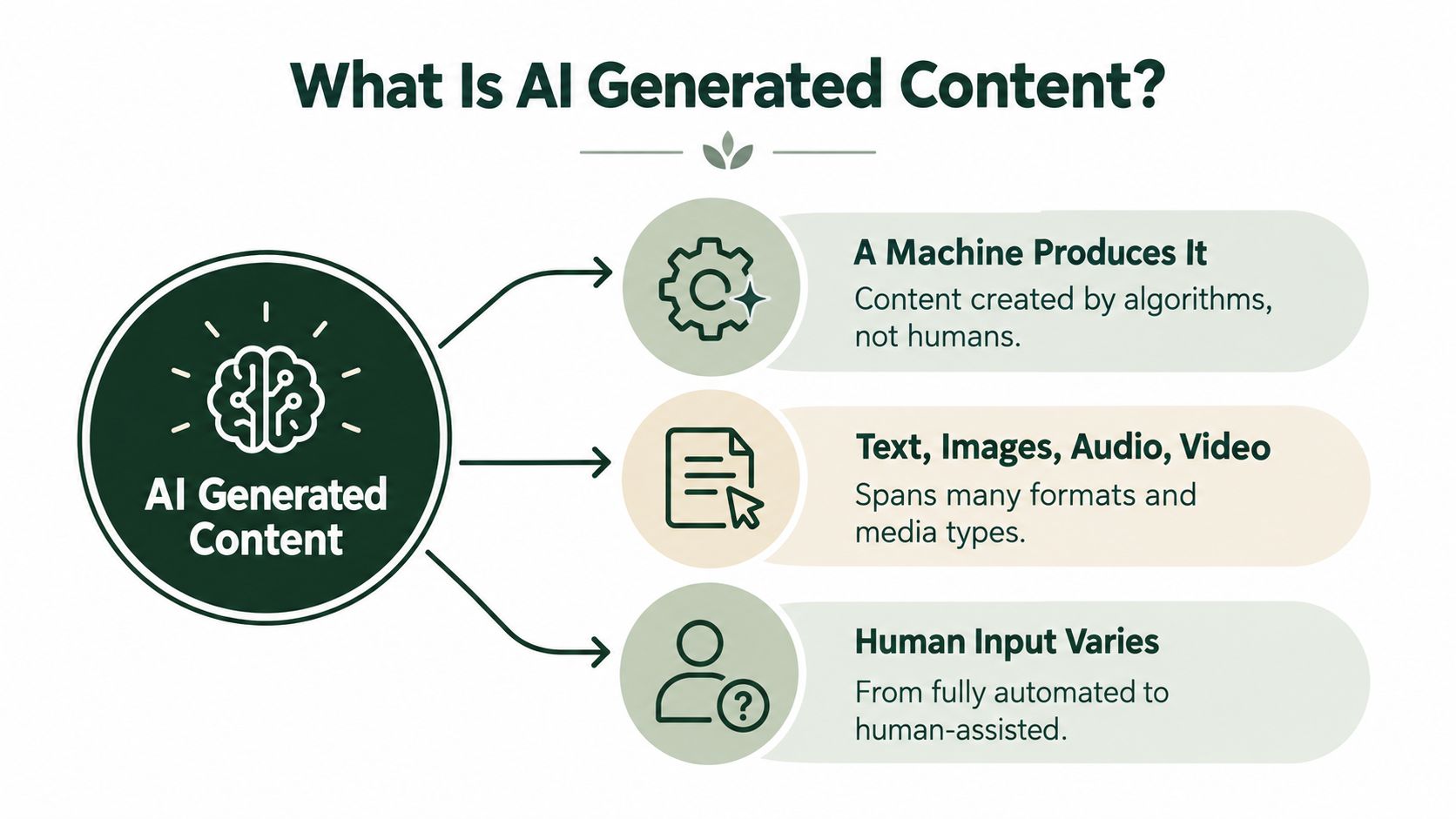
Human involvement changes the workflow
The same label can cover quite different production processes:
- An outline becomes a human-written article. AI helped organize ideas, while a person wrote the published prose.
- A generated draft receives substantial edits. The final article combines model output with human review and judgment.
- A translation is reviewed by a local editor. The model transforms existing material, and the editor checks meaning and suitability.
- A product image is generated from instructions. The visual is synthetic, even when a person directs each revision.
These distinctions help teams document how content was produced and decide what needs review before publication. A guessed percentage of machine involvement reduces a varied workflow to a number that may not explain the work.
Retrieval fetches, generation computes
Retrieval works like asking a librarian to find an existing book. Generation is more like asking someone to compose an explanation using patterns learned from reading.
The resulting explanation may sound convincing without faithfully reproducing any particular source. Fluency shows how well the model formed an answer, not whether evidence supports it.
Working definition: AI-generated content is material a model creates or substantially transforms, even when humans guide, edit, and approve the result.
For publishing teams, the practical question is how the material was made and checked. That workflow-based view is more useful than deciding whether a paragraph sounds mechanical.
How Generative Models Produce Content
A generative model works like a cook who has studied many recipes: it learns patterns in combinations and styles, then assembles an output from your instructions. The analogy explains training, but a model learns statistical relationships, not firsthand experience.
A prompt acts like an order. It tells the model what to produce now, such as a beginner's explanation, product description, or summary of supplied material. Training shapes the learned patterns; the prompt guides their use.

From learned patterns to an output
For text, a model generates a sequence of tokens, which are small pieces of text. Saying it writes one word at a time is a useful starting point, but tokens may be parts of words or whole words.
Transformer-based language models underpin many modern text-generation systems. Other generative systems create images, audio, and video using methods suited to those formats.
Generative AI developed through a series of milestones. Toloka's history of generative AI traces examples including ELIZA in 1966, which used rule-based pattern matching; generative adversarial networks in 2014, which paired competing generators and discriminators; GPT-3 in 2020 with 175 billion parameters; and the November 2022 public launch of ChatGPT.
Why fluent writing can still be wrong
With probabilistic generation, a model selects output based on learned likelihoods. A sentence may fit its context and still make a false claim.
For example, a hypothetical product guide might describe a feature the product does not have. An educational article might include a citation that looks credible but fails to support the claim.
- Fluency needs a readability check. Does the explanation make sense to its intended reader?
- Accuracy needs evidence. Does a trustworthy source support each factual claim?
- Suitability needs judgment. Does the material fit the brand, audience, and subject?
A clearer prompt can guide the assignment, but it cannot verify the result. Publishing is a workflow decision: match the level of human review to the risk of an error, then check the claims, readability, and suitability before release.
Where AI Content Shows Up in Everyday Work
A marketing team may use AI at several points before a reader sees a finished page. One person asks for an outline, a merchandiser revises product descriptions, and an editor requests a translation. The tool is part of the workflow, not a substitute for every role in it.
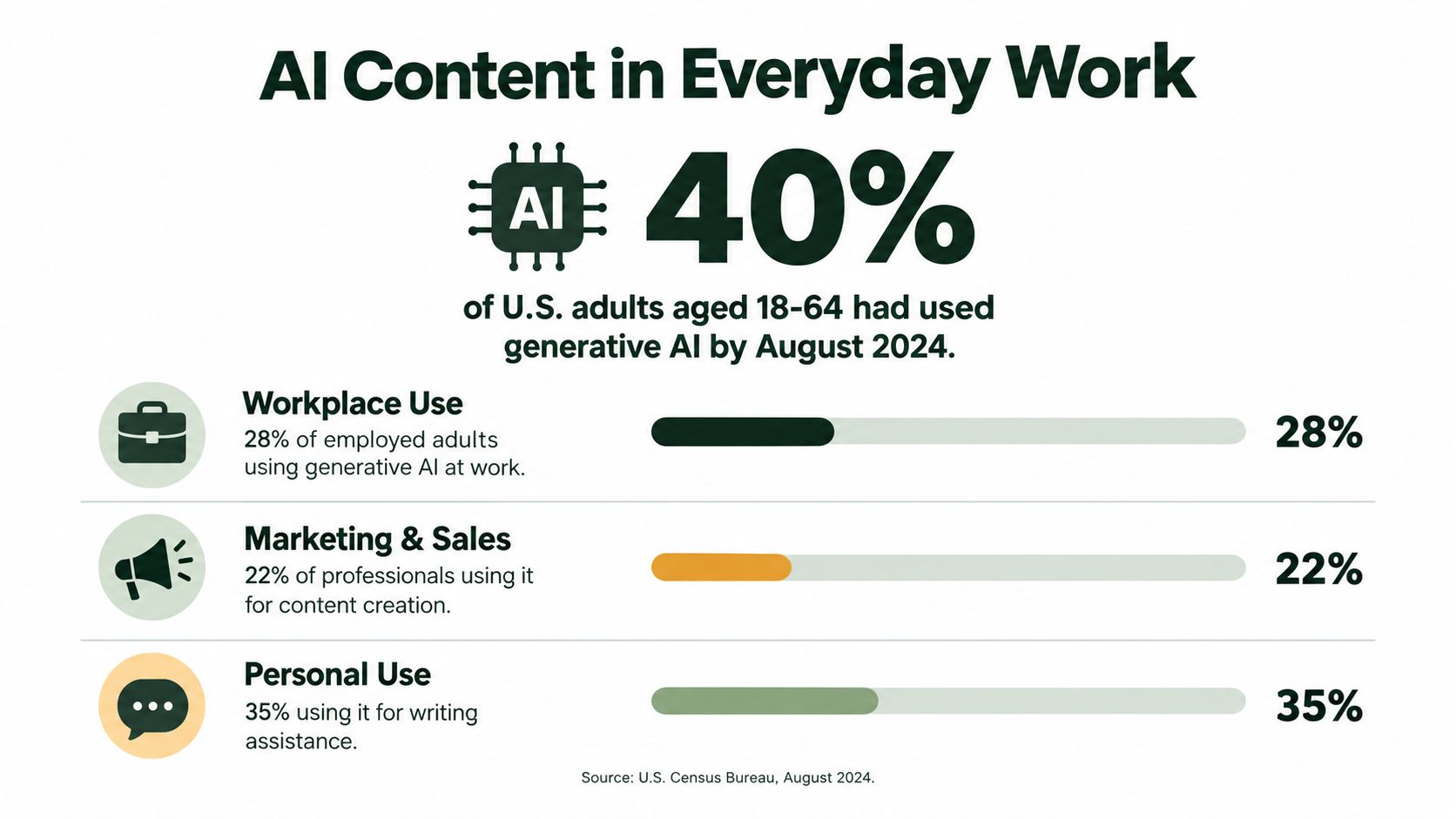
Generative AI use is already widespread. A nationally representative survey found that almost 40% of U.S. adults aged 18–64 had used it to some degree in August 2024. The St. Louis Fed's analysis of generative-AI adoption also reports daily use of 10.6% at work and 6.4% at home.
A useful way to see where AI fits is to follow one asset from idea to publication. At the planning stage, it might suggest topics or outline questions. During production, it could draft article passages, product descriptions, or email copy. Later, it may help edit, summarize, or translate. Before publishing, it could suggest titles, metadata, image alt text, or JSON-LD schema.
Those are possible uses, not a checklist every business follows. A small business might automate metadata while writing product descriptions without AI. The right human check depends on the task: an editor can assess an outline for completeness, while a product specialist needs to compare a description against the approved catalog. Alt text requires a person to inspect the actual image, since a prompt alone cannot confirm what the image shows.
The embedded video provides another perspective on everyday uses.
Usage is not proof of quality. Adoption figures do not establish accuracy, ownership, audience trust, or search performance. A practical content inventory records what the tool did, what the human checked, and which version reached the website. That workflow record makes responsibility clearer than a general statement that a team uses AI.
What AI Generated Content Means for SEO
A store adds an AI-assisted guide to choosing a desk lamp. Whether that page helps with SEO depends on the work behind it: does it answer a real customer question with accurate, useful detail that the store's other pages do not provide?
A generic guide might repeat familiar advice about brightness and style. A stronger page could explain differences among the store's products, show which specifications affect a buyer's choice, and describe limitations using approved product information. The model can help shape the draft; the publishing workflow determines whether the result earns a place on the site.
That makes editorial judgment more important than how polished the prose sounds. Fixing missing evidence or an unanswered customer question matters more than adjusting a mechanical-sounding sentence.
Separate content usefulness from search promises
AI authorship alone cannot predict whether a page will rank. A human reviewer's approval also cannot guarantee a ranking. SEO review works best as a set of practical checks:
- Search intent: Does the page answer the question behind the query?
- Distinct value: Does it offer verified details, useful comparisons, or genuine experience?
- Internal links: Can readers find relevant products and supporting explanations?
- Structured data: Does the markup accurately describe what appears on the page?
- Freshness: Has someone checked details that may have changed?
Treat these as review criteria; rankings still depend on competition and page quality. Keyword coverage can reveal missing concepts, while repeated phrasing adds little value.
Be careful with policy claims
A detector result does not determine search eligibility. Generated explanations of Google's rules also need checking against official guidance. If a publishing decision depends on current policy, consult Google's current documentation directly.
A risk-weighted workflow helps teams decide how much review a page needs. A general explanatory paragraph may need an editorial fact-check. A product comparison involving specifications or limitations calls for review by someone who knows the products. Claims that could mislead customers deserve closer scrutiny before publication. This approach focuses review effort where an error would matter most.
SEO review question: Would this page still deserve publication if you removed the keyword target and judged it only by what it helps a customer understand?
Experience, expertise, author identification, and supporting evidence are useful editorial considerations. Keep personal experience grounded in real observations. A product specialist's documented findings can support a page's authority; an invented first-person account cannot.