You've won an e-commerce account, an existing client wants to expand internationally, and a shop owner is waiting for technical fixes your team can't schedule. Sales has done its job. Now someone has to turn those promises into research, approved content, deployed changes, and a report the client can understand.
White label search engine optimization can close that delivery gap, but only if you treat it as an operating model rather than a logo swap. The key questions are who owns the decisions, who checks the work, what implementation costs, and how you'll prove commercial value when rankings don't translate neatly into clicks.
Table of Contents
The Agency Capacity Problem White Label SEO Solves
Consider a familiar agency week. Your strategist is preparing the new store's search roadmap while the developer handles a launch and the account manager fields questions about international content. The smaller client's performance fixes keep slipping because nobody has an uninterrupted block of production time.
Hiring isn't automatically the right response. You may need technical expertise for a demanding project without having enough ongoing work to support that role. Meanwhile, assigning everything to your strongest generalist risks turning them into the approval bottleneck for every account.
The collaboration you need extends beyond the people in your office.

Buy capacity without surrendering judgment
A fulfillment partner can take responsibility for a defined production queue while your agency keeps commercial priorities and client communication. For the store, that might mean content briefs and category-page recommendations. For international expansion, it might mean specialist review before your agency commits to an implementation plan.
The important boundary is execution versus accountability. Delegating production doesn't remove your obligation to check whether the recommendations fit the client's platform, resources, and business goals.
Practical rule: Outsource work you can specify and review. Don't outsource an undefined promise and expect the provider to make it profitable.
Before accepting more work, separate the capacity problem into concrete needs:
- Specialist coverage: Identify work your team can't confidently deliver, rather than tasks it merely dislikes.
- Production volume: Distinguish a temporary backlog from a recurring workload that might justify hiring.
- Implementation ownership: Confirm whether the partner supplies recommendations, deploys changes, or depends on the client's developer.
- Review capacity: Reserve agency time for quality checks, approvals, and explaining decisions.
White-label delivery works when these responsibilities are explicit. It fails when an agency keeps selling custom retainers while buying standardized packages that don't cover the promises made during discovery.
The partner's invoice is only part of the cost. Account management, revision handling, technical coordination, and reporting interpretation still consume agency time, and they belong in your pricing.
What White Label SEO Really Means
White-label SEO means a provider performs search optimization work while another agency presents the finished service under its own brand. The outsourced work can include research, content, technical optimization, link-building, and reporting. It's an agency-delivery arrangement within the wider outsourced SEO economy, not a separate technical discipline.
A restaurant is a useful analogy. The production partner runs the kitchen; your agency handles the guest relationship, agrees the menu, and presents the bill. But your agency still has to know what the kitchen can prepare, what needs approval, and what happens when the customer requests something outside the agreed menu.
Define the handoff, not just the branding
Translate that analogy into deliverables with acceptance criteria. A keyword strategy should identify page intent and commercial relevance, not merely export search terms. A technical audit should distinguish actionable fixes from observations, and content should arrive with a clear review and publishing process.
For link acquisition, specify acceptable methods and the approval process before outreach begins. A branded report won't protect your reputation if your agency can't explain how the underlying work was performed.
| Arrangement |
Useful working definition |
Contract question |
| White-label delivery |
The agency presents the partner's work under its brand |
Who may communicate with the client? |
| Grey-label collaboration |
The specialist's involvement is visible or acknowledged |
How are roles and responsibility presented? |
| Freelance subcontracting |
An individual delivers a defined task |
Who coordinates the rest of the workflow? |
These labels aren't a substitute for contractual detail. A freelancer can operate invisibly, and a fulfillment company can participate openly. Client-contact permissions, ownership, confidentiality, and delivery scope matter more than the label on the proposal.
Keep the client contract honest
Don't promise that every specialist is an employee if your delivery model uses external providers. Describe your agency's responsibility accurately and address subcontracting disclosures where the client's procurement requirements demand them.
Your service-level agreement should cover response expectations, dependencies, revision boundaries, escalation, and acceptance. It should also distinguish an agency-controlled deadline from a deadline that depends on client approval or developer access.
A useful handoff document includes:
- Inputs: Business goals, approved claims, platform access, brand guidance, and existing constraints.
- Outputs: Deliverable format, required supporting evidence, and completion criteria.
- Permissions: Who can edit, publish, contact the client, or approve additional work.
- Exit arrangements: How files, credentials, task history, and reporting data are returned.
The arrangement should make responsibilities easier to trace, not harder.
Why Reseller SEO Became a Durable Operating Model
Search optimization became harder to package as a narrow, one-off service because the work expanded. The historical progression includes WebCrawler's full-text indexing in 1994, AltaVista in 1995, Google's launch with PageRank in 1998, the Florida update in 2003, Core Web Vitals becoming a ranking factor in 2021, and the addition of experience to E-E-A-T in December 2022, as outlined in this history of SEO's development.
That progression helps explain the staffing problem. Content judgment, technical implementation, authority development, and performance measurement require different skills. An agency can own the strategy without employing every specialist needed to execute it.
An industry compilation of SEO outsourcing statistics estimates the broader SEO services market at approximately $68.1 billion in 2022, projects $129.6 billion by 2030 with estimated annual growth of about 8.3%, and reports that more than 54% of companies outsource some SEO activity, while 78% of small businesses use agencies or consultants.
These are directional figures for SEO services and outsourcing, not a measurement of white-label revenue. They support the commercial logic of external fulfillment, but they don't establish that every agency should become a reseller.
A large outsourcing market doesn't make a weak delivery process viable. The agency still has to earn its margin through judgment, coordination, and accountability.
The practical attraction is flexibility. An agency can retain a trusted relationship while buying the specialist work a particular account requires. That's more defensible than selling identical deliverables to clients with different constraints.
Match the arrangement to the buyer
As a practical fit judgment, white-label fulfillment is easier to manage when the client wants a single accountable agency and accepts a documented production process. Web development clients needing ongoing optimization, or marketing clients needing specialist execution, can fit that arrangement.
Clients with sensitive procurement rules, complex internal approvals, or requirements for direct specialist access may need an openly collaborative model instead.
Evaluate fit through the work itself:
- Repeatable requirements: The partner can deliver against a stable specification.
- Accessible reviewers: The client can approve claims and supply subject expertise.
- Available implementation: Someone has authority and capacity to deploy recommendations.
- Transparent constraints: The agency can explain what's excluded without weakening the relationship.
Without these conditions, outsourcing may only move the backlog outside your office.
Service Models Resellers Should Compare
Buying a fully managed service is different from buying software, even if both arrive with a branded dashboard. Compare the operating responsibility first. Otherwise, you may price a low-touch retainer and discover that your team still has to brief writers, review audits, manage developers, and construct the client narrative.
The staffing comparison below illustrates the capacity trade-off, but external fulfillment still needs agency oversight.
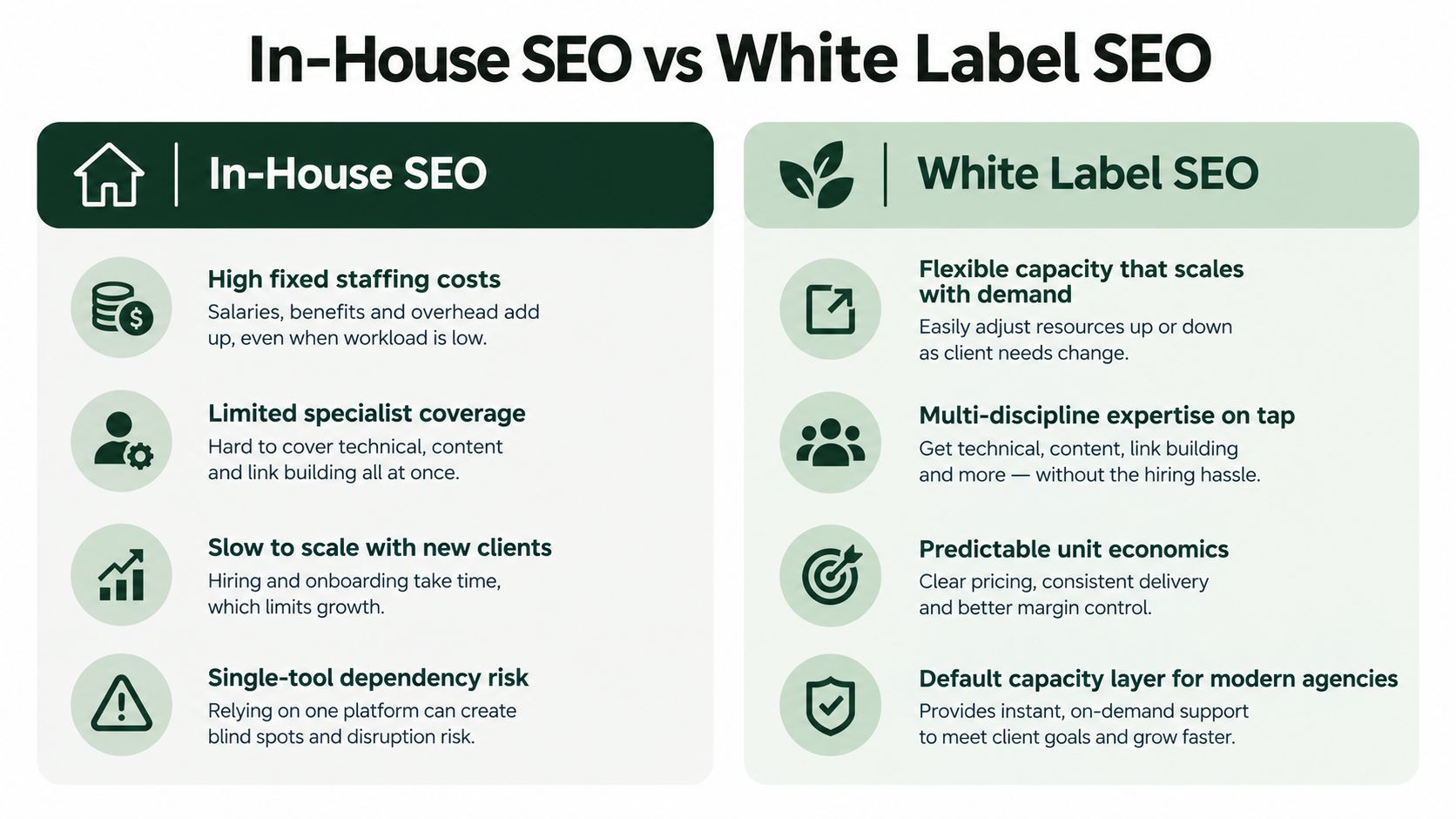
White Label SEO Service Models Compared
| Model |
Best For |
Agency Workload |
Typical Margin |
| Fully managed fulfillment |
Recurring accounts needing broad execution |
Client management, strategic approval, quality review |
Depends on provider scope and retained management effort |
| Project-based or a la carte |
Defined audits, content batches, or specialist fixes |
Briefing, coordination, acceptance, integration |
Sensitive to revisions and scope changes |
| Dedicated capacity seats |
Agencies with a steady production queue |
Task allocation, prioritization, supervision |
Depends on utilization and management overhead |
| Platform-only access |
Agencies retaining their production team |
Strategy, review, implementation, client reporting |
Depends on internal labor and software costs |
Fully managed fulfillment is appropriate when you need a partner to coordinate execution, not just supply isolated assets. Ask whether technical implementation is included and whether the provider prepares the report's interpretation. A dashboard export isn't the same as a client-ready explanation.
Project-based purchasing fits a bounded requirement, such as a migration review or content brief batch. It gives you flexibility, but your agency becomes the integrator. If separate suppliers handle research, writing, and implementation, someone must reconcile conflicting recommendations.
Price the work your agency retains
Dedicated capacity can suit a consistent backlog, provided your team can brief and supervise it. Unused availability creates cost without delivery, while vague task allocation makes performance difficult to assess. Agree specialist coverage and continuity arrangements rather than assuming a named seat can handle every discipline.
Platform-only access is a different purchase. Your agency keeps production responsibility and uses automation to reduce manual handoffs. It won't solve a missing reviewer, inaccessible developer, or unclear client strategy.
Margin check: Calculate client fees minus fulfillment, software, review, account management, and rework. A markup on the supplier invoice isn't your retained margin.
Request a sample deliverable and trace it through your actual workflow. Who reviews it, who publishes it, who verifies it, and who explains the outcome? The model that answers those questions cleanly is more useful than the cheapest package.
A reseller platform should support controlled delivery across client accounts, not merely generate attractive PDFs. During a demonstration, ask the vendor to move a task from diagnosis through approval, deployment, and verification. The gaps in that sequence matter more than the number of dashboard widgets.
Evaluate the operational controls
Use a short checklist tied to actual agency responsibilities:
- Multi-site management and permissions: Keep client work separated and restrict access according to each person's role.
- Centralized billing: Make account costs visible enough to reconcile against your retained fees.
- Branded reporting and exports: Check presentation, underlying data access, and what remains available after cancellation.
- Integration access: Verify API or webhook options and whether CMS publishing supports approval before deployment.
- Task history: Require evidence of what changed, who approved it, and how completion was checked.
Publishing access deserves particular scrutiny. A draft queue and an unrestricted live-site connection carry different risks. Test permissions using the same roles your agency and client will use.
Turn Core Web Vitals into engineering work
Google's Core Web Vitals guidance defines performance thresholds of LCP no more than 2.5 seconds, INP below 200 milliseconds, and CLS below 0.1, with field observations used in Search Console's Poor, Needs Improvement, and Good groupings.
Treat these as remediation inputs, not a decorative health score. Group affected URLs by template and device, then identify the business importance of each template. Prioritize Poor product, category, and landing-page groups where the client has implementation capacity.
A useful ticket states the affected template, observed symptom, suspected cause, responsible implementer, and verification method. Oversized images may delay LCP; excessive JavaScript may increase INP; unstable image or advertising dimensions may increase CLS. These are diagnoses to investigate, not automatic conclusions from a metric alone.
Search Console's field dataset is sampled and limited to indexed URLs. Combine it with crawl diagnostics and controlled post-deployment tests rather than presenting it as a complete site inventory.
Acceptance criterion: An audit item is ready for delivery when the implementer can act on it and the reviewer can verify the result.
The embedded video is available as an additional viewing resource.
Ask vendors to demonstrate a reopened task as well as a completed one. Failed deployments, incomplete fixes, and disputed recommendations need an escalation path. Automation should preserve that evidence, not hide it behind a green status indicator.
Why Rank-Only Reports Are No Longer Enough
A ranking screenshot doesn't establish business value. Search interfaces can change the opportunity to earn a click even when a client maintains a strong position. That makes rank-only reporting an incomplete basis for renewal conversations.
A 2025 Pew Research study covering more than 900 U.S. adults and over 68,000 Google searches found traditional-result clicks on 15% of visits without an AI summary versus 8% with one, while 1% clicked a link inside the AI summary, according to Search Engine Journal's coverage of the Pew findings.
The client conversation needs to connect visibility to commercial outcomes, not stop at position changes.

Separate visibility from attributable outcomes
Create distinct reporting views for rankings and impressions, qualified clicks, key events and revenue, and AI citations or mentions. A citation can demonstrate observed presence without establishing that someone visited the site or purchased. Don't assign revenue to it without supporting measurement.
Last-click reporting also has limits. Google Analytics' explanation of data-driven attribution describes an account-specific model using converting and non-converting paths to estimate how touchpoints affect the probability of a key event.
Use that distinction to assess discovery content that contributes before the final visit. Modelled attribution is an estimate from the client's observed paths, not a universal benchmark or proof of causality.
Put the measurement contract in the proposal
Agree the reporting definitions before performance becomes contentious:
- Commercial outcome: Define a qualified enquiry, purchase, or other key event.
- Attribution settings: Record the model, lookback window, consent treatment, and reporting period.
- Segmentation: Separate markets and devices where those differences affect interpretation.
- AI observation method: Document tested queries, observation dates, and the distinction between a mention and a citation.
Connect Search Console landing-page and query analysis with conversion reporting, but explain the limits rather than implying a complete user-level join.
When traffic falls, investigate query mix, impressions, click behavior, deployed changes, and conversion quality. Search-interface changes are a plausible explanation, not an automatic excuse. Your report should identify the evidence, acknowledge uncertainty, and name the next action.
How AutoSEO Maps to a Reseller Workflow
The platform fits the software-supported delivery model, rather than replacing the agency's strategic responsibility. Its connected workflow uses Google Search Console, sitemap data, competitor analysis, and DataForSEO demand signals for planning, then moves into AI-generated briefs and articles.
Publishing integrations include Shopify, WordPress, Webflow, Wix, custom sites, and webhooks. The technical audit supplies a prioritized queue spanning indexation, redirects, titles, schema, speed, and internal linking gaps. An agency should test that queue against a real client's implementation constraints.
Assess fit through an approval cycle
Multi-site management, centralized billing, volume pricing, team seats, and agency-plan white-label reports address reseller administration. Approval-first workflows give the agency a review point before publishing, while included AI-visibility monitoring adds observations alongside conventional search tracking.
Use a trial to check:
- Editorial control: Can reviewers correct unsupported claims and preserve client-specific expertise?
- Delivery evidence: Can the team trace approved work through publication and measurement?
- Procurement requirements: Do the platform's documented controls satisfy the client's actual requirements?
Its stated security posture includes GDPR alignment and TLS encryption, with SOC certification work in progress rather than completed. Request supporting documentation where procurement requires it.
Judge this option alongside managed fulfillment and internal delivery. Software can coordinate work; your agency still owns the decisions and acceptance criteria.
Choosing Your Delivery Model with Confidence
Choose fully outsourced fulfillment when you need specialist execution and have enough agency capacity to review it. Keep production in-house with platform support when your team's main problem is manual coordination. Use a hybrid when strategy and client knowledge should stay close to the account but execution requires additional coverage.
Before committing, check:
- Scope clarity: Deliverables, dependencies, revision limits, and implementation ownership are explicit.
- Evidence access: You can inspect work and export meaningful reporting data.
- Commercial fit: Retained fees cover the agency workload, not just the provider invoice.
- Exit readiness: Client assets and task history remain accessible.
Opaque reports, ranking guarantees, unexplained link methods, and dependence on inaccessible tooling are reasons to pause. Start with a bounded engagement, review the actual handoffs, and expand only when delivery meets your acceptance criteria.
Anchor renewal discussions in business outcomes and verified progress, not ranking screenshots alone.
AutoSEO offers connected research, content production, technical task management, publishing, and measurement, with white-label reports available for agency delivery. Visit AutoSEO to assess its agency workflow against a real client account, including your approval process, reporting requirements, and implementation responsibilities.