
AI content generator ~19 min 3,748 words

10 AI SEO Content Generator Tools: Features and Pricing

10 AI SEO Content Generator Tools: Features and Pricing

A content team can have a full backlog of keyword briefs, half-finished drafts, and approved outlines, yet still publish slowly. Articles sit in shared documents while someone waits to format metadata, add internal links, prepare schema, upload images, and copy everything into the CMS. By the time a page goes live, the opportunity may have changed.

An AI SEO content generator can reduce that delay, but tools differ sharply in what they automate. Some are excellent research and briefing systems. Others focus on drafting, on-page optimization, brand governance, publishing, or measurement. A long-form writer alone won't solve a CMS bottleneck, and a powerful SEO editor won't replace a reliable approval process.

This comparison judges ten tools by their place in a real workflow. I'm looking at research, drafting, optimization, publishing, measurement, CMS fit, pricing friction, and team suitability. The practical question isn't which platform has the longest feature list. It's which tool removes the bottleneck your website faces without creating a new review or integration problem.

Table of Contents

1. AutoSEO

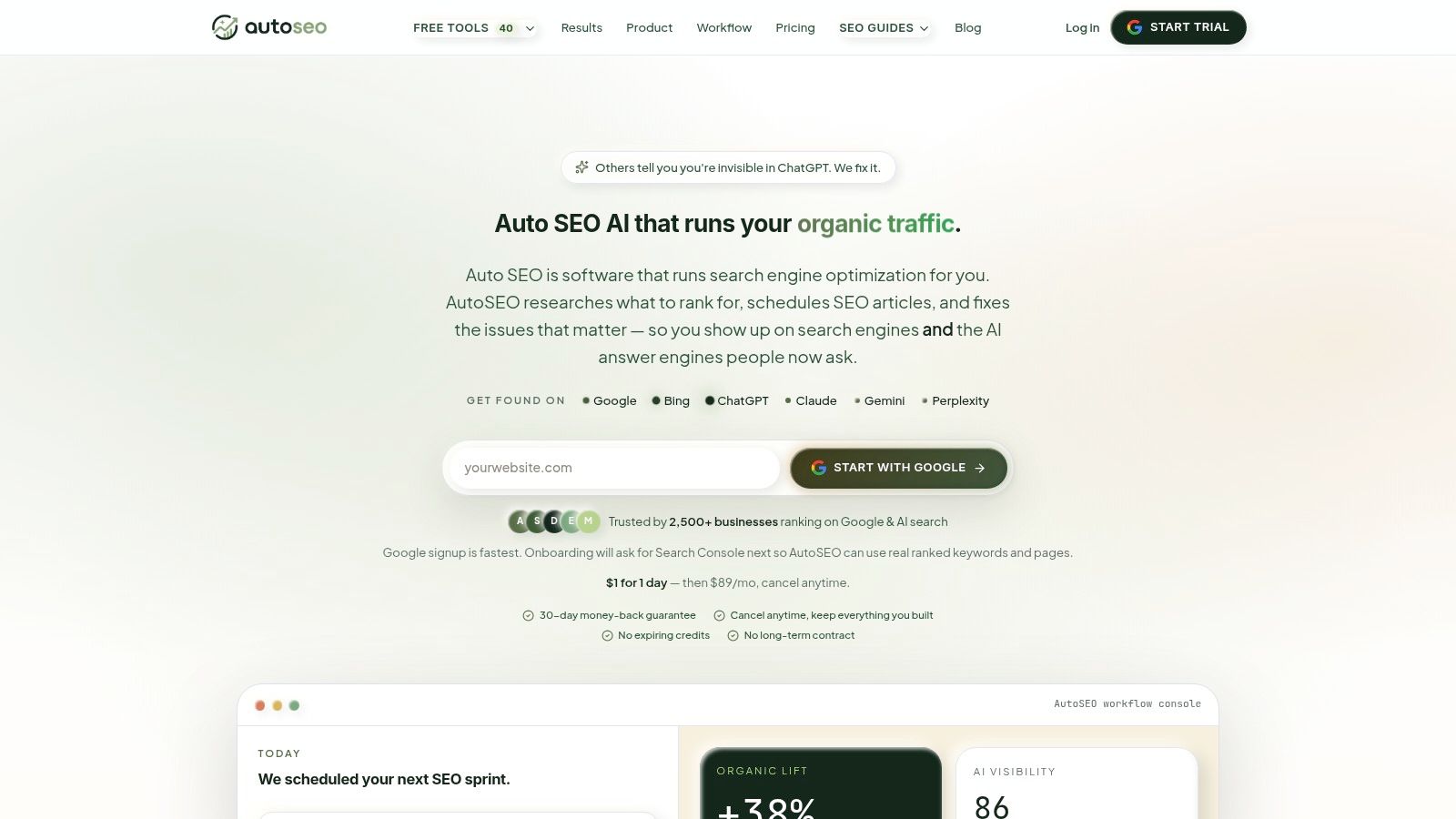
AutoSEO fits websites where the bottleneck sits between SEO research and published, measured work. It connects keyword research, briefs, article generation, technical tasks, CMS publishing, and performance tracking in one workflow. Inputs can include Google Search Console, sitemap data, competitor signals, and DataForSEO, then become prioritized content or technical actions.

Use the writing layer to prepare titles, metadata, internal links, and JSON-LD schema. AutoSEO can publish or schedule content for WordPress, Shopify, Webflow, Wix, Ghost, Framer, Next.js, and custom sites through webhooks. That reduces repetitive CMS work for teams spending more time on copy-paste tasks than editorial decisions.

Where AutoSEO fits best

AutoSEO suits small e-commerce teams, SaaS marketers, publishers, and agencies that need execution without combining several specialist tools. A generalist can review a proposed task, edit the draft, then approve, publish, or schedule it. Technical SEO, content production, and measurement remain connected instead of passing between separate systems.

The measurement layer tracks AI visibility across ChatGPT, Claude, Gemini, Perplexity, and Google AI Overviews. That matters as search presentation changes. Semrush found AI Overviews on 6.49% of tracked queries in January 2025, 24.61% in July, and 15.69% in November, so coverage can shift rather than follow a stable replacement pattern (Semrush's AI Overviews analysis).

Practical rule: Use AutoSEO to turn a visibility gap into a task, not simply to generate another article.

Rankings still depend on competition, authority, links, technical health, and the quality of the offer. Per-site billing can become expensive across multiple domains. AutoSEO currently supports up to five languages across approximately thirteen markets, so larger international programs may need extra planning.

AutoSEO offers a $1 one-day trial. Public plan references list Starter at $49 per month, Pro commonly at $89 per site per month, and an Agency example at $199 per month for five sites. Annual billing can save up to approximately 35%. Check the live plan page before buying because limits and packaging can change.

Visit AutoSEO when the main need is moving from research to approved publication and measurement.
AutoSEO

2. Scalenut

Scalenut works well for teams that want a guided path from keyword planning to a long-form draft. Its Cruise Mode approach connects research, clustering, content planning, writing, and optimization, so a marketer doesn't need to build the process manually from separate documents.

The practical implementation is straightforward. Start with a target topic, review the keyword cluster, generate the brief, and use the editor to expand the article. Before publishing, check the suggested terms against the actual intent of the query. A tool can identify related language, but it can't decide whether the page should educate, compare products, or drive a transaction without human judgment.

Best use and limitation

Scalenut is a good choice for SMBs and agencies with repeatable editorial production. Internal linking and content audits can extend the workflow beyond a first draft, while AI visibility tracking supports monitoring across generative search systems. The guided experience is especially useful for a generalist who understands marketing but doesn't want to configure every SEO step manually.

The limitation is cost predictability. Some plan details and quotas appear dynamically, and add-ons such as deeper optimization capabilities can raise the total cost for larger sites. Compare article limits, keyword research allowances, audit access, and AI visibility coverage before choosing a plan.

Scalenut also fits better as a research, drafting, and optimization layer than as a complete publishing operating system. Confirm the CMS workflow your team needs before committing. If the process still requires exporting a document, cleaning formatting, and manually adding metadata in WordPress or Shopify, the platform may improve writing speed without removing the final bottleneck.

Explore Scalenut for guided SEO production from topic discovery through optimization.

3. Frase

Frase is built around a clear research-to-brief-to-draft sequence. It uses SERP-backed research to shape a brief, then hands that brief to an AI writer. The editor provides SEO and GEO scores while you work, which makes it easier to identify missing coverage before an article reaches the CMS.

That workflow suits a content manager who already has a publishing process but wants more consistency in research and optimization. For a new page, I'd use Frase to inspect competing coverage, define the required sections, draft within the editor, and then add original evidence or first-hand detail before export.

A useful maintenance loop

Frase is also stronger than a one-time article generator because Content Guard can monitor pages and suggest fixes when performance or coverage slips. That supports a create, monitor, and update cycle instead of treating publication as the finish line.

Publishing integrations include WordPress, Webflow, Sanity, Wix, and FraseCMS. Check whether your preferred integration preserves metadata, formatting, images, links, and schema as expected. A direct connection is valuable only if it reduces cleanup work for editors.

The main limitation appears at team scale. Multi-site and multi-seat workflows may require higher tiers, and pay-as-you-go overages can complicate forecasting if the account enables them. Frase is best for teams that value research quality and maintenance but don't need a broad technical SEO task system inside the same product.

See Frase's research and optimization workflow before testing it on an existing page and a new article. The two tests reveal whether its recommendations help both creation and refresh work.

4. Surfer

Surfer is a strong option when the writer already has a draft and needs practical on-page guidance. Its Content Editor provides live recommendations and a Content Score, while Surfer AI and the Surfy writing assistant can help create outlines, drafts, and revisions. The workflow feels closer to an SEO editor than a general-purpose chatbot.

Use it for a page that targets a defined search intent. Build or import the draft, review the suggested coverage, remove irrelevant terms, and use the optimization tools selectively. Chasing a score can make an article awkward, so the editor should guide decisions rather than dictate every sentence.

Where it earns its place

Surfer also includes one-click optimization, internal-link recommendations, content audits, and AI visibility tracking across systems including ChatGPT, Perplexity, Google AI Overviews, and Gemini. That combination makes it useful for an SEO team that wants creation and refresh work in one environment.

The platform suits agencies and larger teams that need controls such as SSO or API access. New users may find the number of settings and recommendations difficult at first. Establish an editorial standard before giving writers unrestricted access to optimization prompts.

Pricing friction comes from the document and credit model. High-volume teams may need upgrades, and advanced features can be difficult to compare without mapping expected article production to plan limits. Test a typical article, a page refresh, and an internal-linking task before deciding whether the usage allowance matches your publishing calendar.

Review Surfer's SEO content workflow if on-page optimization is your main constraint.

5. MarketMuse

MarketMuse is better suited to strategic content planning than to quick, inexpensive blog generation. Its topic modeling, competitive analysis, personalized difficulty and authority metrics, SERP X-ray views, and structured briefs help teams decide what deserves production and what should be improved first.

That distinction matters for a large site. A content manager can inventory existing pages, identify topic gaps, compare competing coverage, and create a brief that gives writers a clear topical direction. The output is most valuable when several pages need to work together, not when someone needs a quick draft for a single low-risk keyword.

Strategic depth versus ease of adoption

MarketMuse supports different brief types, strategy documents, site inventory, and tracked topics at scale. It can help an editorial operation avoid publishing isolated articles that compete with one another or leave important subtopics unsupported.

The downside is the learning curve. Smaller teams may need time to understand the metrics and convert the research into an executable editorial plan. Paid pricing is sales-led and requires a demo, which makes it harder to compare directly with self-serve products.

MarketMuse also isn't the obvious choice for direct CMS publishing or hands-off execution. Pair it with a writing and publishing workflow if your team needs content to move automatically from brief to live page. Choose it when strategic prioritization and topical depth are worth more than fast onboarding.

Evaluate MarketMuse if your site has a large content library and the bigger problem is deciding what to create, consolidate, or refresh.

6. Semrush Content Toolkit

Semrush Content Toolkit, formerly ContentShake AI, makes the most sense for teams already using Semrush research and competitor data. It brings topic discovery, SEO briefs, AI drafting, brand voice guidance, and optimization into the wider Semrush environment.

The implementation advantage is shared data. A marketer can move from keyword and competitor research into a content brief without exporting findings into another platform. That reduces setup time for teams that already track rankings, inspect competitors, and manage keyword portfolios in Semrush.

Check the limits before production

The entry point can appeal to small teams testing AI-assisted content, but the plan needs close inspection. Article caps, SEO boosts, and the boundary between Content Toolkit and broader Semrush add-ons affect the actual cost of a publishing program.

Advanced visibility and AEO workflows may require additional Semrush products. That makes the tool less attractive if your priority is one subscription that handles research, writing, CMS publishing, and AI citation measurement. It is more compelling when Semrush already serves as the research and tracking foundation.

Use it first on a topic where you know the competitors and search intent. Compare the generated brief with the data your team normally uses, then check whether the draft requires substantial restructuring. If the research integration saves more time than the editing process consumes, the product may fit. If not, a dedicated end-to-end platform may be more efficient.

See the Semrush Content Toolkit plans and map every allowance to your expected monthly output.
SEO content setup

Plan and publish SEO content with AutoSEO

Enter your site to scan it and build a keyword plan. Review your articles and connect your site for publishing. $39/mo per website.

Review before publishing Cancel anytime 30-day money-back

7. Jasper

Jasper is primarily a brand and marketing workflow platform, not a specialist SEO research suite. Its Canvas editor, agents, Brand Voices, Audiences, and Knowledge assets help teams produce consistent copy across blog posts, campaigns, landing pages, and other channels.

That makes it useful when the main risk is off-brand writing. Add approved product information, audience details, terminology, and tone guidance, then use the system to generate a draft that needs less rewriting before editorial review. Teams can connect workflows through Google Sheets, Webflow, Zapier, Make, and APIs on Business plans.

The SEO trade-off

Jasper's collaboration and governance features are strong for marketing departments with several contributors. Enterprise controls include administration and SOC 2 references in the supplied product information. Those controls matter when multiple people generate content and the business needs consistent review rules.

SEO depth is the limitation. Jasper may need to be paired with a dedicated keyword research, SERP analysis, or optimization tool. Business features can also use credits, so usage-based costs should be included in the budget rather than treated as an afterthought.

Choose Jasper for brand governance and cross-channel production. Don't choose it as your only tool if the team needs detailed content scoring, technical audits, internal-link recommendations, or direct measurement of organic outcomes.

Explore Jasper's marketing writing platform if consistency, collaboration, and approval controls matter more than built-in SEO analysis.

Jasper

8. Writesonic

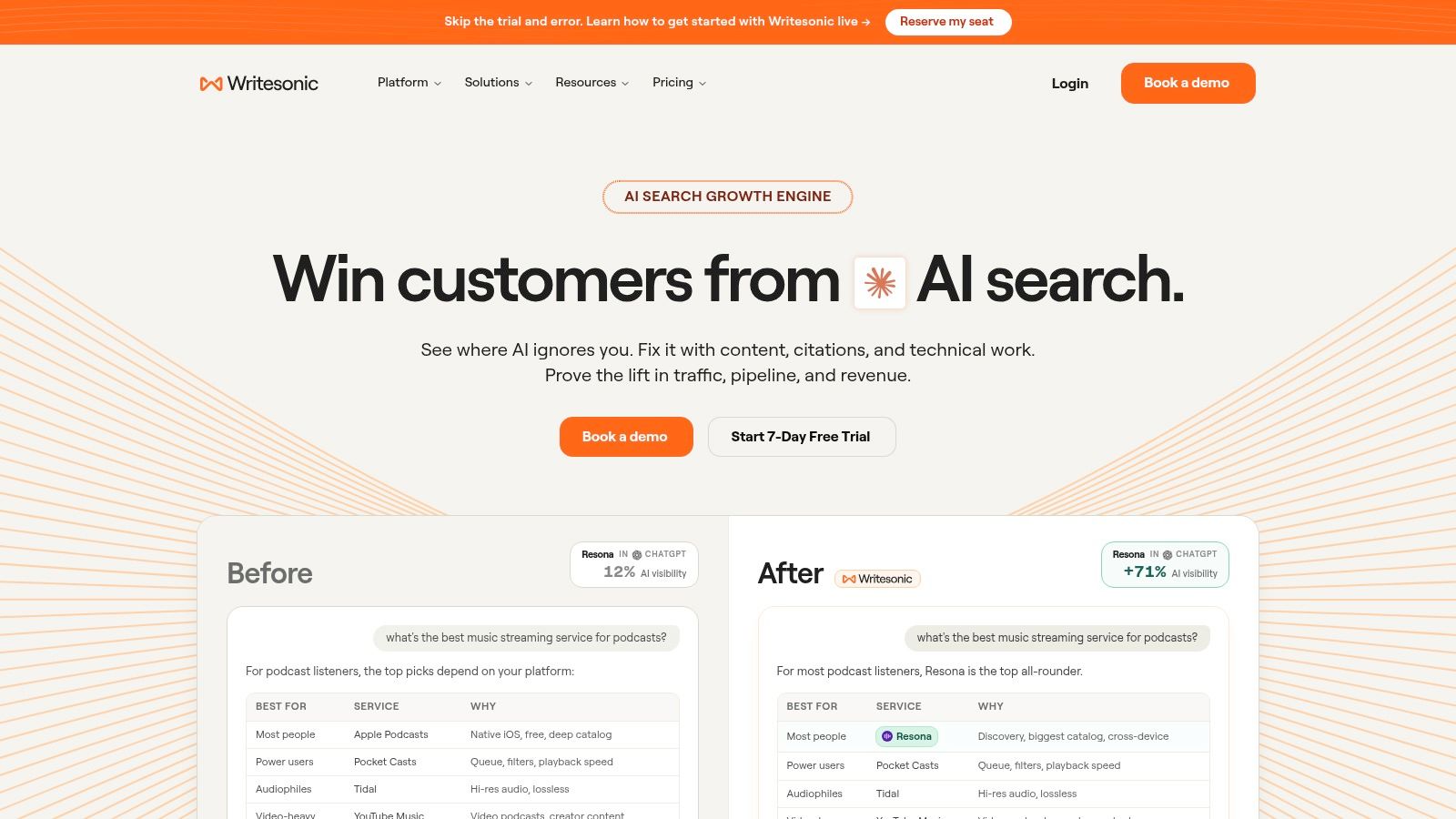
Writesonic combines article generation with optimization, site auditing, and GEO or AEO monitoring. It is aimed at teams that want to create content and then track brand mentions across AI assistants without adding a separate visibility product.

The AI Article Writer includes strategy and optimization components, while higher-tier workflows connect Google Search Console, Google Analytics 4, WordPress, and an API. Site audits can surface issues and propose AI-assisted fixes, which gives the platform a wider role than a basic article writer.

Useful coverage, tiered access

Writesonic is attractive when a team wants content creation and generative search monitoring in one product. Prompt and brand-mention tracking can help reveal whether pages are visible beyond conventional rankings. That measurement is increasingly relevant because independent research found that only approximately 1% of Overview visits produced clicks to cited sources, making citation and brand visibility useful signals alongside referral traffic (the 2026 browsing study).

The limitation is tier access. Advanced GEO features, Google AI Overview coverage, audits, prompts, and article allowances can vary by plan. Pricing information may be easier to understand in documentation than on the main marketing pages, so list the exact features required before comparing it with alternatives.

Use Writesonic for a test that includes one new article, one existing-page audit, and one visibility-monitoring setup. That will show whether the product helps your full workflow or mainly accelerates drafting.

Check Writesonic's AI writing and GEO tools before selecting a tier.

9. NEURONwriter

NEURONwriter is a practical choice for freelancers, small agencies, and website owners who want SEO drafting and semantic guidance without an enterprise platform. Its editor uses entity and topic recommendations to support new articles and existing-page improvements.

The workflow is simple. Create a project, enter the target query, review the semantic suggestions, and draft or update the page in the editor. A plagiarism checker, templates, and additional integrations become more relevant as the plan increases.

Budget control without broad automation

The clearest advantage is plan transparency. Monthly analysis quotas and AI credits are easier to understand than usage models that hide important limits behind several add-ons. That helps a freelancer estimate work across client projects.

NEURONwriter doesn't offer the same level of governance, technical remediation, CMS automation, or AI visibility measurement as broader platforms. It is an editor and optimization assistant, not a complete SEO operations console. Someone still needs to manage research priorities, publishing, internal-link architecture, and post-publication measurement.

For a small WordPress site or agency, that trade-off may be sensible. You get a focused workspace for content without paying for enterprise functions you won't use. For a multi-site team seeking approval queues and automated publishing, the manual steps may outweigh the lower entry cost.

Try NEURONwriter when the requirement is affordable content optimization rather than an all-in-one system.

10. Content at Scale

Content at Scale, now presented as RankWell, focuses on long-form generation. Its appeal is a one-pass workflow that combines research and optimization into a substantial draft, aimed at teams producing many SEO articles.

This approach works best when the subject is well defined, the source material is available, and the team has a strong review process. Start with one article rather than a large batch. Check factual accuracy, intent alignment, originality, metadata, links, and the amount of human rewriting needed before judging production value.

Fast drafts still need editorial control

Content at Scale emphasizes topical authority and original output, but the platform's standard pricing isn't fully transparent on its public site. That makes it harder to forecast costs for a regular publishing schedule. Its editor also offers less granular on-page control than tools built primarily around live optimization.

The product provides a $15 seven-day trial that produces one fully optimized article, according to the supplied plan information. That is a useful test because the key question isn't whether the system can produce text. It's whether the draft contains enough accurate, useful, and distinctive material to justify the review time.

Use the trial on a page that matters to the business, not a disposable topic. Compare the draft against your existing editorial standard and calculate the manual work required before publication.

Review Content at Scale if high-volume long-form generation is the bottleneck.

Top 10 AI SEO Content Generators, Feature Comparison

Product Core features Quality (β˜…) Value & Price (πŸ’°) Target (πŸ‘₯) Unique selling points (✨)
AutoSEO πŸ† Closed-loop: GSC-first keyword research, AI briefs & articles, prioritized technical fixes, direct CMS publishing, AI-visibility β˜…β˜…β˜…β˜…β˜† πŸ’° $49–$199+/mo per site; $1 trial πŸ‘₯ SMB e‑commerce, marketing generalists, agencies ✨ Integrated AI-visibility, CMS automation, 40 free SEO tools
Scalenut Keyword planning & clustering, long-form AI (Cruise Mode), internal linking, AI visibility β˜…β˜…β˜…β˜… πŸ’° Mid, tiered; add‑ons may apply πŸ‘₯ SMBs, agencies, content teams ✨ Guided flows for end-to-end writeβ†’publish
Frase SERP-backed briefs β†’ AI drafts, live SEO/GEO scoring, Content Guard monitoring, CMS publishing β˜…β˜…β˜…β˜… πŸ’° $, team tiers, higher cost for multi-site πŸ‘₯ Content teams, publishers, agencies ✨ SERP-first briefs + monitoring/update loop
Surfer (Surfer AI) Live content editor & score, AI drafts, 1‑click optimization, internal linking, audits β˜…β˜…β˜…β˜… πŸ’° $–$$, doc/credit model for volume πŸ‘₯ SEO/content teams wanting SERP guidance ✨ Real-time content guidelines + optimization tools
MarketMuse Topic modeling, personalized difficulty metrics, SERP X‑ray, site inventory at scale β˜…β˜…β˜…β˜…β˜… πŸ’° $$, sales-led / enterprise pricing πŸ‘₯ Large editorial teams, enterprise SEO ✨ Deep topical research & strategy at scale
Semrush Content Toolkit Data-driven briefs, AI drafting/optimization, integrates with Semrush datasets β˜…β˜…β˜…β˜… πŸ’° $, great if already on Semrush; article caps/boosts πŸ‘₯ Teams using Semrush, agencies ✨ Tight integration with Semrush keyword & competitor data
Jasper Brand-focused AI writing, Canvas editor, brand voices, agents & governance β˜…β˜…β˜…β˜… πŸ’° $, usage credits on higher tiers πŸ‘₯ Marketing teams, brand editors ✨ Strong governance & on‑brand controls
Writesonic AI article writer + optimization, GEO/AEO tracking, site audits, GSC/GA4/WordPress β˜…β˜…β˜…β˜… πŸ’° $–$, documented quotas; advanced GEO on higher tiers πŸ‘₯ Teams needing creation + AI-visibility ✨ Combined content + GEO tracking in one SKU
NEURONwriter SEO-tuned AI writer, entity/semantic cues, project analyses with clear quotas β˜…β˜…β˜…β˜… πŸ’° $, budget-friendly, generous analyses πŸ‘₯ Freelancers, small agencies ✨ Affordable tiering with practical editor & quotas
Content at Scale Long-form research-driven writer, topical authority focus, fast high-volume output β˜…β˜…β˜…β˜… πŸ’° $, $15 for 7‑day trial (one optimized article) πŸ‘₯ High-volume publishers, content factories ✨ One-pass publishable long-form drafts for scale

Matching the Tool to Your Publishing Workflow

The right choice depends on where work stops moving. If keyword research is weak, start with MarketMuse, Semrush Content Toolkit, Scalenut, Frase, or AutoSEO. If writers have good ideas but spend too long structuring and drafting, Frase, Surfer, Writesonic, NEURONwriter, and Content at Scale offer more direct support.

For brand-heavy teams, Jasper may solve a different problem. It helps control language, approved knowledge, collaboration, and governance across marketing channels. It isn't a substitute for a specialist SEO data layer, so pair it with the tool that handles your research and measurement needs.

Publishing is the dividing line many comparisons miss. A draft that still requires manual formatting, metadata entry, link insertion, schema preparation, and CMS upload may save writing time without improving time to market. AutoSEO is the clearest fit when WordPress, Shopify, Webflow, Wix, Ghost, Framer, Next.js, or webhook publishing needs to sit beside research and measurement. Frase and Writesonic also support selected publishing or site integrations, but confirm exactly what reaches the CMS and what still needs manual cleanup.

Measurement should shape the decision as well. Google says AI-generated content receives no special ranking advantage, and content made primarily to manipulate rankings can violate spam policies. Its guidance recommends fact-checking and human review, including titles, meta descriptions, structured data, and image alt text (Google's guidance on generative AI content). That makes approval gates more important than article volume.

A useful test is not β€œHow many pages can this tool create?” It's β€œCan my team verify, publish, and measure the pages without adding hidden work?”

Shortlist two or three platforms that match your bottleneck. Test each on one real page using your own Search Console data, not a generic demonstration keyword. Compare the brief, draft, factual corrections, internal links, metadata, schema, CMS output, and post-publication reporting.

Check export options and plan limits before committing. Review article quotas, AI credits, seats, domains, audit allowances, API access, publishing integrations, and overage rules. Also test what happens when a draft is uncertain. A responsible workflow should let you narrow the topic, add first-party evidence, route the page to a specialist, or delay publication.

The strongest tool is the one that improves the entire operating cycle. Research should produce a defensible priority. Drafting should create a useful starting point. Optimization should improve clarity without forcing awkward keyword use. Publishing should remove avoidable copy-paste work. Measurement should show whether the page generated incremental value, not merely whether another URL went live.

Use the available trials to validate the fit on your own site. AutoSEO offers a $1 one-day trial, while Content at Scale offers a $15 seven-day trial for one fully optimized article, based on the supplied product details. Treat either trial as a workflow experiment. Keep the page under review, record every manual correction, and choose the platform that leaves your team with better decisions and fewer unfinished tasks.


AutoSEO connects keyword research, AI-assisted SEO articles, metadata, schema, internal links, technical fixes, CMS publishing, and AI visibility measurement in one approval-first workflow. If you want to test whether an AI SEO content generator can remove your publishing bottleneck rather than create more editing work, visit AutoSEO and run the workflow on a real page.

Related Articles

Stop doing SEO by hand

Build your SEO content plan with AutoSEO

Scan your site, build a keyword plan, and AutoSEO writes your plan's articles. Review the drafts and connect your site for publishing. $39/mo per website, cancel anytime, 30-day money-back guarantee.

$39/mo per website Β· Cancel anytime Β· 30-day money-back guarantee