You search your main product term and see the same domains everywhere. One is a direct rival. Another is a marketplace. A third is a publisher that doesn't sell anything similar, yet it captures the click before your commercial page appears. If you put all three into one competitor spreadsheet, your next SEO decisions will be based on a category error.
The practical answer to how to find competitor websites isn't to collect the longest possible list. It's to identify which domains compete for customers, which compete for search attention, which educate your audience, and which sources appear in AI-generated answers. That classification turns scattered observations into a monitoring set your team can use.
Table of Contents
Why Most Competitor Lists Fail Before You Start
The common mistake is treating every ranking website as a business competitor. A publisher may rank for a problem-oriented query without selling your solution. A marketplace may sell substitutable products to the same buyer. A directory may influence discovery but never compete for the transaction itself.
Start by defining the search environment before opening a tool. Write down the customer problem, product category, target geography, language, and intent. Separate non-branded commercial queries from informational questions, because branded searches mostly surface companies you already know.

Build the candidate set from several directions
Collect seed domains from customer interviews, industry directories, public filings, marketplace listings, and Google results. Then expand each seed with targeted operators:
- Site coverage:
site:domain.com reveals indexed pages and the breadth of a domain's visible content.
- Title patterns:
site:domain.com intitle:keyword isolates pages that explicitly target a topic.
- URL structures:
site:domain.com inurl:category can expose product, service, or editorial sections.
- Documents:
site:domain.com filetype:pdf often surfaces guides, reports, brochures, and downloadable resources.
Compare the domains that recur across your query set. A site appearing for one broad informational phrase is a weak candidate. A domain recurring across relevant commercial queries, product comparisons, and problem-aware searches deserves closer review.
Practical rule: Ranking visibility is evidence of search competition, not proof of business substitution.
This workflow also prevents a second failure, confusing traffic scale with relevance. A high-visibility review site may deserve monitoring as a citation or referral competitor, while a smaller specialist with strong product overlap may deserve direct attention. Keep those roles separate from the start.
Using Search Operators to Map the Competitive Landscape
Google remains a practical discovery layer because it accounted for approximately 89.7% of worldwide search-engine market share in March 2025, according to StatCounter's worldwide search-engine market-share data. That reach makes search-result analysis broadly useful, but only when you search like a researcher rather than a customer casually checking one phrase.
Build a fixed query set around your business. Include core product terms, service categories, comparison phrases, use cases, and questions describing the customer problem. For each query, record organic domains, paid placements, recurring appearances, page type, and the apparent intent of the result.
Use operators to inspect structure, not just rankings
A plain keyword search tells you who appears. Operators help explain what those domains have built.
site:example.com shows the content Google has indexed, although it isn't a complete crawl. Add intitle: to find pages organized around a topic, or inurl: to isolate sections such as guides, services, products, or resources. filetype:pdf can uncover sales collateral and downloadable assets that don't appear prominently in the main navigation.
Search operators also help reveal whether a competitor has depth in a subject or only a single page that happens to rank. Compare the number and type of pages returned for the same topic across several domains. Look for product pages, comparison pages, FAQs, documentation, and research assets. Those patterns tell you more than a single position in a result page.
Repeat the search across markets
Run the same non-branded queries across multiple locations, languages, and devices where your business operates. Results change with geography and language, and a domain that dominates one market may be absent in another. Branded searches should remain a separate view because they tend to confirm known brands rather than reveal emerging specialists.
Record marketplace sellers, publishers, directories, and specialist sites instead of deleting them. Label them by role. The emerging domain you dismiss today may become a material search competitor later, while a major publisher may remain important only for educational visibility.
Benchmarking Traffic to Separate Rivals from Noise
Finding domains is the easy part. Deciding which ones deserve regular attention requires context about audience reach, engagement, geography, and acquisition channels.
Similarweb's benchmarking documentation describes comparing a target domain with an industry and adding up to four competitor domains. The comparison can include monthly visits, percentage change, pages per visit, average visit duration, bounce rate, traffic share, and marketing channels. These measures don't prove that a domain is your commercial rival, but they help distinguish a visible specialist from a site with incidental rankings.
Compare the methods by what they reveal
| Method |
Best use |
Main limitation |
| Search operators |
Discover recurring domains and content architecture |
Rankings vary by location, device, and personalization |
| Traffic benchmarking |
Compare scale, engagement, geography, and channels |
Estimates aren't first-party analytics |
| Entity classification |
Separate true substitutes from adjacent sites |
Requires review and a useful labeling system |
Similarweb's industry-analysis workflow can identify domains ranked by traffic share, which may uncover publishers, marketplaces, directories, review sites, and educational resources your team didn't initially consider. Those domains compete for audience and search visits, even when they don't sell the same product.
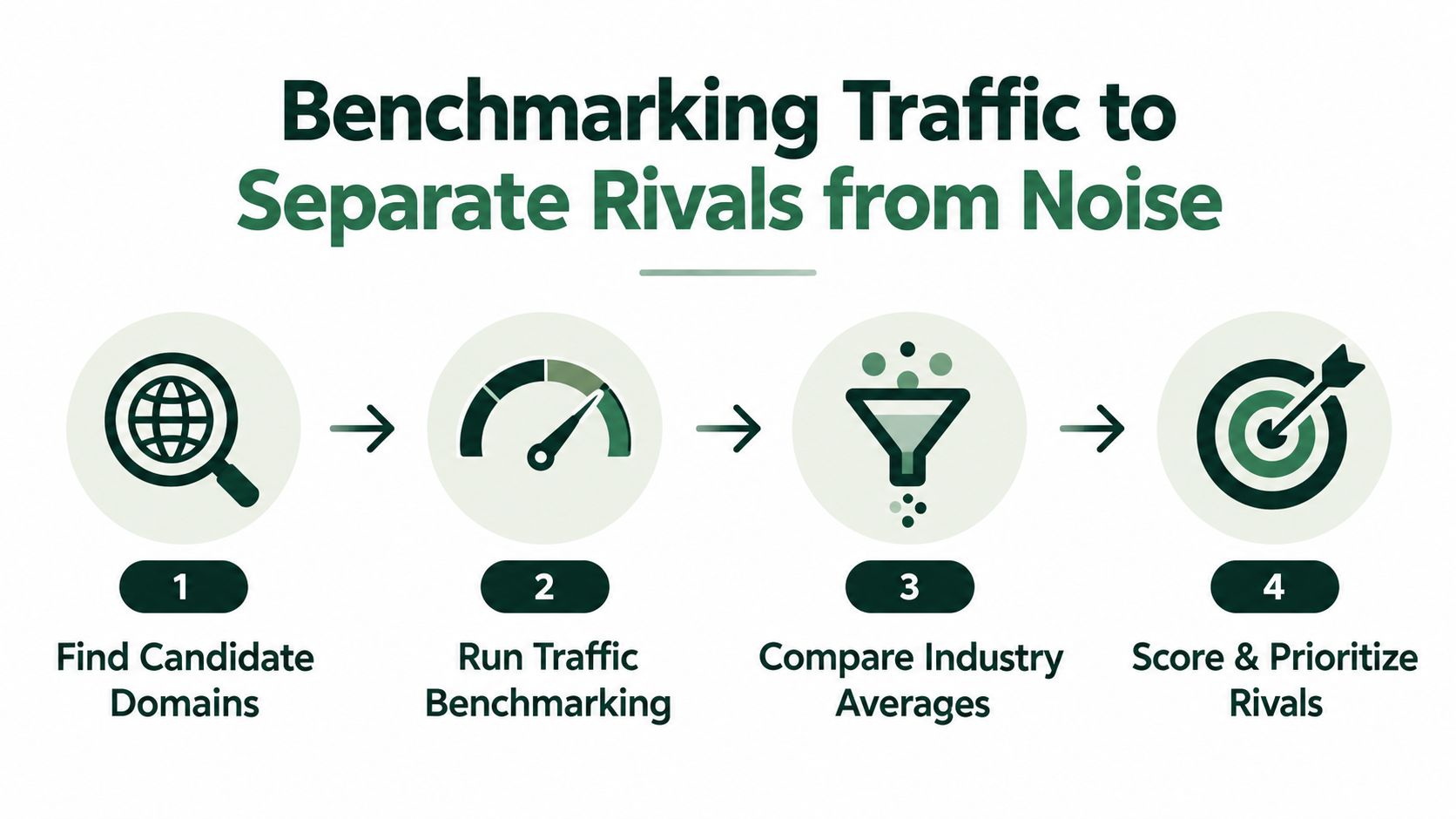
Use traffic data as a comparative signal. Don't treat an estimated visit count as equivalent to analytics from the site itself. A domain with broad reach but weak product overlap may belong in an awareness or citation watchlist. A domain with moderate reach, strong transaction overlap, and recurring commercial visibility may deserve more attention.
Choose the method that fits your resources
A small team can start with manual SERP collection and a spreadsheet. Add benchmarking when the candidate list becomes too large to prioritize by inspection. Larger programs should move toward entity classification, where each domain receives a repeatable score based on observable web cues, audience language, product terminology, pricing pages, conversion paths, and geographic signals.
The best workflow combines all three. Search discovers candidates, benchmarking adds context, and classification determines whether the candidate belongs in your direct, search, educational, marketplace, or citation set.
Classifying Competitors with a Practical Scoring System
A raw domain list becomes useful only after you define what “competitor” means for your business. Score every candidate across product overlap, audience overlap, transaction overlap, and SERP overlap, using a 0-to-2 scale for each dimension.
- Product overlap: Does the domain sell a solution that can replace yours? Give two points for a close substitute, one for an adjacent offer, and zero when it doesn't sell a relevant solution.
- Audience overlap: Does it target the same buyer, role, industry, or customer problem? A publisher may score highly here without being a product rival.
- Transaction overlap: Can the visitor complete a comparable purchase, enquiry, booking, or sign-up there?
- SERP overlap: Does the domain repeatedly appear for the queries that matter to your acquisition funnel?
Document the evidence beside each score. Record the relevant query, page type, offer, audience language, and geography. That makes the classification defensible when someone asks why a domain was included or removed.
Read the patterns instead of chasing one total
Direct business competitors usually score strongly across all four dimensions. A publisher often scores high for audience and SERP overlap but low for product and transaction overlap. A marketplace may score strongly on transaction overlap while offering many products and a different customer experience. A directory can influence discovery while remaining weak on direct substitution.
Set your inclusion threshold before reviewing candidates. If you change the threshold whenever an interesting domain appears, the monitoring set will expand until it becomes unmanageable. Keep separate labels for direct competitor, search competitor, marketplace, publisher, directory, affiliate, agency, supplier, and adjacent vendor.
A shared keyword proves topical similarity. It doesn't prove that two companies compete for the same purchase.
Review false positives regularly. The web-based competitor-analysis framework supports treating discovery as an entity-classification problem, using reproducible web features and manual review rather than assuming automated scores are ground truth. Market changes, domain migrations, acquisitions, and regional catalogs can make yesterday's classification stale.
Turning Discoveries Into Prioritized Actions
Discovery creates value only when it changes what your team does next. The useful output isn't an unranked list of domains. It's a queue of opportunities connected to pages, search intent, business value, and implementation effort.
Start with three layers of evidence:
- Keyword overlap: Which queries do you and the candidate both target, and where is the candidate stronger?
- Page-level conversion: Does the competing page offer a clear product path, comparison, calculator, enquiry form, trial, or other next step?
- AI citation presence: Is the domain mentioned or used as a source in generated answers, even when its traditional ranking is limited?

Score the opportunity, not just the rival
For each gap, note commercial intent, content quality, technical advantages, conversion strength, expected impact, and implementation effort. A weak competitor page targeting a highly relevant service query may outrank a stronger competitor's broad educational article in your priority list. The highest-ranking domain isn't automatically the most strategically important one.
Choose work that combines meaningful intent with a credible path to improvement. That might mean updating an existing service page, creating a comparison page, fixing internal links, improving structured answers, or producing a more useful resource. Don't copy the competitor's wording or layout. Identify the user need they serve and find a clearer, more complete way to serve it.
A closed-loop workflow keeps research from becoming a permanent spreadsheet exercise. AutoSEO can connect competitor discovery with keyword prioritization, content production, technical tasks, CMS publishing, rank tracking, and AI-visibility monitoring. That kind of connection matters because a finding has limited value until someone assigns it, publishes the change, and measures the result.
Use this review rhythm:
- Weekly: Remove false positives, check new domains, and review newly visible pages.
- During planning: Select opportunities using intent, expected impact, and effort.
- After execution: Compare rankings, traffic signals, conversions, and citation presence against the original baseline.
The decision matrix should produce a short list of actions, not another research project.
Rethinking Competition in the Age of AI Overviews
Traditional rankings no longer describe the whole competitive environment. A source can influence the answer a user sees without occupying the most prominent conventional result, so a domain's role must include more than its blue-link position.
A Pew-based analysis reported by The Indian Express examined more than 900 US users and found that users clicked a traditional result in 8% of searches showing an AI Overview, compared with 15% when no Overview appeared. The figures change the question from “Who ranks above us?” to “Who receives attention, gets cited, and shapes the answer?”
Track three competitor roles
Transactional competitors appear for product, service, pricing, and comparison terms. Their pages compete for action, so evaluate offer clarity, proof, friction, and conversion paths.
Educational competitors answer problem-aware questions. They may be publishers, specialists, or communities. Their influence often begins before a buyer is ready to choose a vendor, making their topic coverage and explanations relevant to your content plan.
Citation competitors supply information that AI systems use in generated answers. They may overlap with the first two groups, but not always. Record which domains are ranked, mentioned, cited, or used as supporting sources for important questions.
This classification prevents a common strategic mistake. A site that doesn't sell your product may still shape demand, define terminology, answer objections, or become the source an assistant presents to the user. Your response shouldn't be to imitate every publisher. It should be to create clear, trustworthy pages that answer the underlying question and connect naturally to your solution.
Review AI visibility alongside keyword overlap and page-level conversion. The Search Engine Journal analysis of AI Overview click behavior also summarizes the 8% versus 15% click rates, reinforcing why citation presence deserves its own monitoring field rather than being treated as a side effect of rankings.
Your Next Steps for Smarter Competitor Intelligence
Start with one market, one language, and a defined set of customer problems. Search non-branded commercial and informational queries, collect recurring domains, and label each one by role before you spend time analyzing its content.
A practical first pass looks like this:
- Collect candidates: Use Google results, customer conversations, directories, marketplace listings, and site operators.
- Classify domains: Score product, audience, transaction, and SERP overlap from zero to two.
- Set the threshold: Remove candidates that don't meet your documented inclusion rule.
- Separate roles: Maintain distinct views for direct rivals, search competitors, publishers, marketplaces, and citation sources.
- Build the queue: Rank opportunities by intent, content gap, expected impact, and implementation effort.
- Measure the outcome: Track rankings, indexed pages, traffic signals, conversions, and AI mentions after publication.
Don't wait for a perfect competitive database. A smaller, well-labeled monitoring set will produce better decisions than a large list filled with publishers and adjacent sites. Re-run the same query set across relevant locations and languages so emerging domains and regional differences don't disappear from your view.
AutoSEO can turn this process into an approval-first workflow by connecting competitor analysis, keyword prioritization, AI-generated briefs and articles, technical SEO tasks, CMS publishing, rank tracking, and AI-visibility monitoring. That gives a small team one place to move from competitor evidence to published work and measured results.

If you want to replace scattered competitor spreadsheets with a workflow that prioritizes gaps, publishes approved improvements, and tracks both search and AI visibility, explore AutoSEO. Start by classifying the domains already appearing for your most valuable queries, then use the platform to turn the strongest opportunities into measurable SEO work.