
competitor analysis for marketing 15 min 2,779 words

Competitor Analysis for Marketing: A Stepwise Playbook

Competitor Analysis for Marketing: A Stepwise Playbook

Most advice about competitor analysis for marketing starts with the wrong deliverable: a spreadsheet listing rivals, keywords, prices, and channels. A fuller spreadsheet isn't automatically a better strategy. If nobody has to make a decision from the analysis, the document becomes shelf-ware, no matter how polished the charts look.

Competitor analysis has deep strategic roots, from Sun Tzu's The Art of War in the fifth century BCE to formal business strategy in the mid-20th century and the development of frameworks such as Porter's Five Forces during the 1960s and 1970s. Its modern marketing role is practical: identify positioning gaps, understand market pressure, and decide where to spend limited resources. The history and evolution of competitive analysis shows why this discipline is broader than a short-term growth tactic.

The playbook below treats research as a prioritization filter. It moves from objective setting and rival selection through tool choice, keyword and content audits, AI visibility checks, durability scoring, task creation, and an operating cadence. The standard is simple: every important finding should change what the team does next.

Table of Contents

Why Most Competitor Analyses End Up as Shelf-Ware

A competitor report usually fails before the first crawl. The team collects information without attaching it to a business choice, then presents observations as if they were recommendations. Traffic estimates, ranking exports, screenshots, and message comparisons may all be accurate, but accuracy alone doesn't tell leadership which page to build, which segment to defend, or which threat to ignore.

Competitor analysis became a major commercial discipline for a reason. Independent market research estimates the competitive intelligence market at approximately $50.87 billion in 2024, with a projection of $122.77 billion by 2033 and a 9.1% CAGR, while a 2025 industry statistic says 90% of Fortune 500 firms use competitive intelligence. These figures are reported in competitive analysis market statistics, and they point to broad adoption, not proof that every individual report creates value.
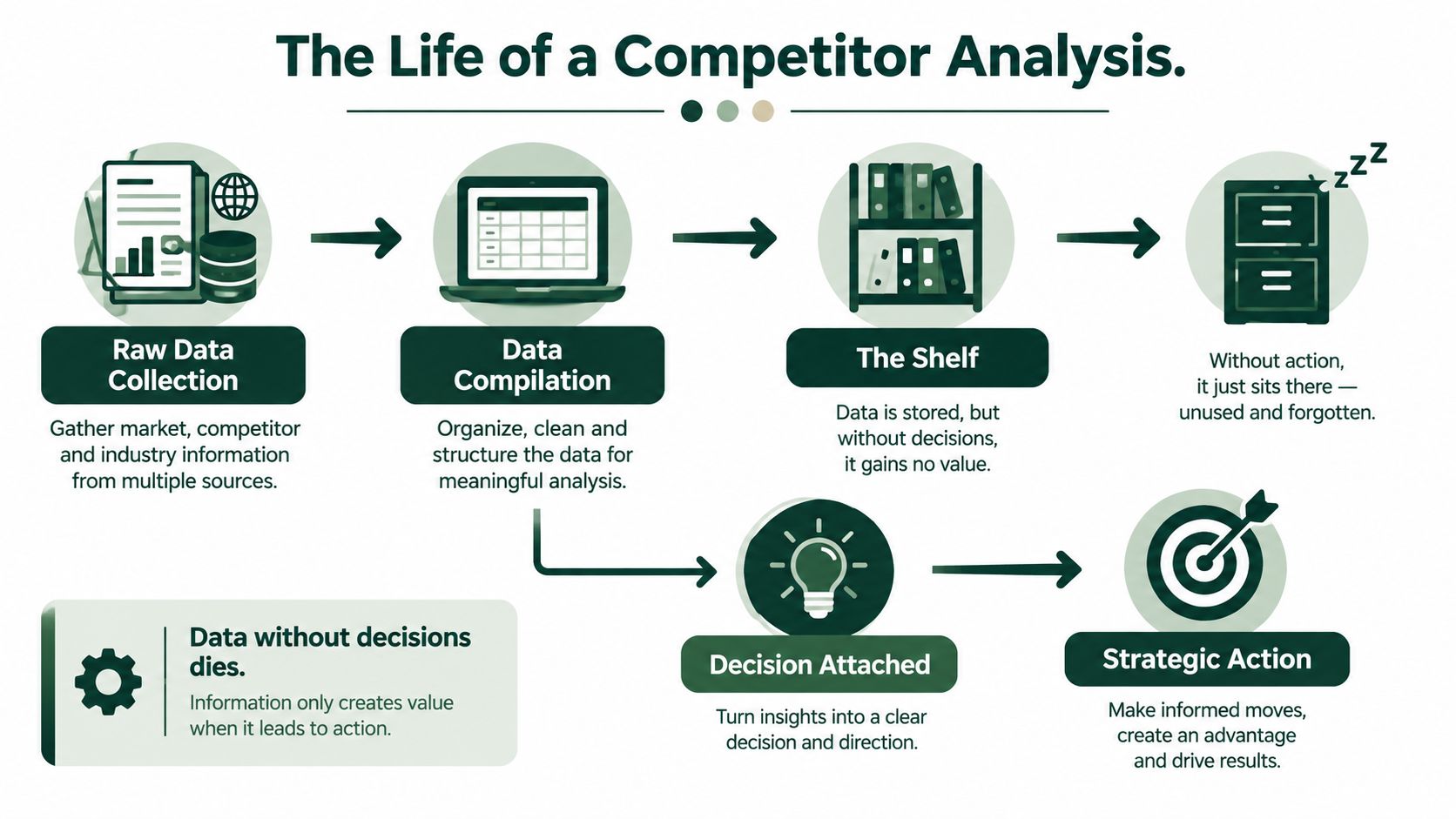
A diagram illustrating the lifecycle of a competitor analysis from raw data collection to strategic business action.

The report is not the product

The useful output is a ranked set of decisions. A SaaS team might need to defend category visibility against a better-funded rival. An e-commerce team might need to decide whether a comparison page, product bundle, or technical fix deserves the next sprint. A brand entering a new niche may need evidence that demand exists before it builds an entire content vertical.

Use the analysis to answer questions such as:

  • What should we fund next?
  • Which competitor advantage can we realistically weaken?
  • Which apparent gap has no commercial value?
  • What must we monitor because it could change our plan?

The common shortcuts are familiar. Teams chase every keyword gap, copy a competitor's content without a distinct point of view, and turn AI visibility checks into another dashboard ritual. None of those activities is useless by definition. They become wasteful when the team can't state the decision attached to them.

A practical resource such as Wispra's framework for how to beat rivals in search results is most useful when its observations feed a campaign brief or technical backlog. The same principle applies to this entire process. Collect less, interpret consistently, and make the task queue visible to the people who control budget and production.

Set the Objective and Shortlist the Right Rivals

Start with the decision, not the competitor list. “Analyze the market” is too broad to guide collection. “Find the strongest alternative to our product for buyers searching comparison terms” gives the team a boundary, a buyer context, and a reason to compare.

Write one sentence before opening a tool:

Decision statement: We need to decide whether to defend category visibility, enter a sub-niche, counter a launch, improve conversion messaging, or replace an underperforming channel.

That sentence determines what evidence matters. A team defending share of voice needs SERP and content evidence. A team preparing for a product launch needs positioning, pricing, proof, reviews, and sales messaging. A team entering a new segment needs substitute analysis and customer language, not just a list of high-traffic domains.

Build tiers, then cut aggressively

Classify rivals into three groups. Direct competitors sell a similar offer to a similar audience. Indirect competitors solve the same problem through a different product or process. Aspirational benchmarks demonstrate a capability or market position you may want to reach, even if they aren't competing for the same immediate buyer.

Competitor Tier Definition Include When Exclude When
Direct Similar offer and buyer audience Their pages, ads, reviews, or sales process overlap with your target decision Their geography, segment, or business model makes comparison misleading
Indirect Different offer that satisfies the same underlying need Buyers may substitute them instead of choosing you They solve a loosely related problem with no evidence of shared consideration
Aspirational A model for positioning, distribution, product experience, or content You're studying a capability your team may need to develop Their scale or audience makes the benchmark impossible to operationalize

Don't let traffic decide inclusion by itself. A large publisher may rank for your terms but never sell to your audience. A global brand may appear dominant while operating in a market you can't serve. Exclude rivals whose geography, pricing model, customer type, or purchase journey makes the comparison distort priorities.

For each included competitor, write a second sentence: “We're studying this rival to learn whether its advantage comes from product fit, positioning, distribution, proof, technical execution, or brand demand.” Keep the core dataset limited to the most relevant rivals. Guidance from Silva Marketing's Prescott competitor intelligence guide is helpful here because it treats competitor research as a structured business activity rather than an undirected collection exercise.

Choose Your Data Sources and Tool Stack

No single platform measures competitive reality. Traffic tools estimate direction, keyword tools expose search visibility, crawlers reveal technical patterns, and review or AI checks show how the market describes a brand outside its own website. Treat each source according to its reliability instead of merging every metric into a fake master score.

Traffic and channel tools such as Similarweb or Semrush can show whether a rival appears to depend on organic search, referrals, paid activity, direct demand, or social distribution. These estimates are useful for spotting patterns, but they aren't a substitute for your own first-party data. For your site, Google Search Console is the stronger source for actual query and page performance. Teams that need a practical starting point can use this Google Search Console keyword research workflow.

Match the stack to the decision

Audit Layer Primary Tools Solo Stack Agency Stack
Traffic and share of voice Similarweb, Semrush Manual channel review plus one market research platform Multiple market views, client dashboards, and recurring exports
Keywords and SERP features Ahrefs, Semrush, manual SERP checks Google Search Console, a rank tracker, and manual checks Rank tracking, SERP feature monitoring, and segmented competitor sets
Content and backlinks Ahrefs, Semrush, Wayback Machine Manual URL inventory and one backlink tool Historical content comparisons, link intersection reports, and editorial classification
Technical SEO Screaming Frog, site crawlers Screaming Frog with a focused crawl Scheduled crawls, issue segmentation, and change monitoring
Social and AI visibility Social listening tools, Otterly, Profound, Semrush AI SEO toolkit Manual prompt tests and review checks Prompt libraries, platform comparisons, mention tracking, and centralized reporting

A solo marketer often needs only a clean spreadsheet, Search Console, manual SERP checks, the Wayback Machine, and one paid SEO platform. That combination can answer many prioritization questions without creating maintenance overhead. An agency handling several brands may justify crawlers, backlink databases, AI visibility software, client reporting, and historical storage because consistency across accounts is part of the service.

Use qualitative labels when the source is directional. “Strong referral pattern” is more honest than presenting an estimated traffic share as audited fact. Likewise, an AI platform's answer can vary by prompt and time, so record the exact prompt, date, cited domains, sentiment, and answer context rather than treating one response as a permanent visibility score.
Do this automatically

Let AutoSEO write & rank this for you — on autopilot

Enter your site: we scan it, build a keyword plan, and publish ranking-ready articles for Google and AI answers. Start for $1.

First 3 articles instantly Cancel anytime during the trial 30-day money-back

Run Keyword, Content, Technical, and AI Visibility Audits

Run four audits in parallel, but keep the capture format consistent. The objective isn't to produce four impressive reports. It's to create comparable evidence that can be scored against the business decision.

Keyword and content evidence

For each rival, export a manageable set of important organic terms, then separate them into three groups:

  • Shared terms: You and the competitor already appear for the same intent, so the question is whether you can improve relevance, authority, or conversion.
  • Missing terms: The competitor has visibility and you don't, but the term still fits your offer and audience.
  • Misleading terms: The competitor ranks because of a different business model, audience, or intent. These aren't opportunities just because they appear in an export.

For content, capture the URL, format, publication or update date, internal link pattern, evidence of proof, and a one-line summary of the page's hook. Word count can provide context, but it doesn't establish quality. A shorter page with original evidence and a clear buying path may be more valuable than a long guide assembled to cover a keyword.

For a more commercially focused view, resources such as Crescade's approach to stealing market share with competitor keywords can help distinguish search opportunities from a raw list of rival terms. The critical step is still yours: confirm intent and buyer fit before assigning a page.

Technical and AI visibility evidence

Crawl competitor sites carefully and compare patterns against your own. Look for indexation signals, redirects, title construction, structured data, internal linking, templates, and performance issues. Use a focused technical SEO audit workflow to turn the same checks onto your site, because a competitor's weakness matters only if you can exploit it without overlooking your own barriers.

AI visibility deserves its own lens. Test ChatGPT, Perplexity, and Gemini with buying-intent prompts that reflect real customer language. Record whether each brand appears, whether the answer cites the brand or third-party sources, the sentiment attached to it, and which competing brands appear alongside it. AI search now belongs in the competitive set because buyers can form an opinion before visiting a website.

Competitor Keyword Gaps, Top 10 Content Depth Note Technical SEO Delta AI Citation Rate
Rival A Relevant missing intents only Depth, proof, freshness, and conversion path Difference versus your site Record consistently by prompt set
Rival B Shared and untapped themes Format and topical coverage Templates, schema, links, and performance Note mentions, citations, and sentiment
Rival C Commercial terms to validate Update pattern and audience fit Prioritized technical differences Compare platforms and prompt categories

Don't call an AI audit complete because a brand appears in one answer. Compare repeated prompts, platforms, and source patterns. The output should be one workbook with separate tabs for keywords, content, technical signals, and AI visibility, plus a summary column that states the decision each finding could influence.

Separate Real Advantages from Noise

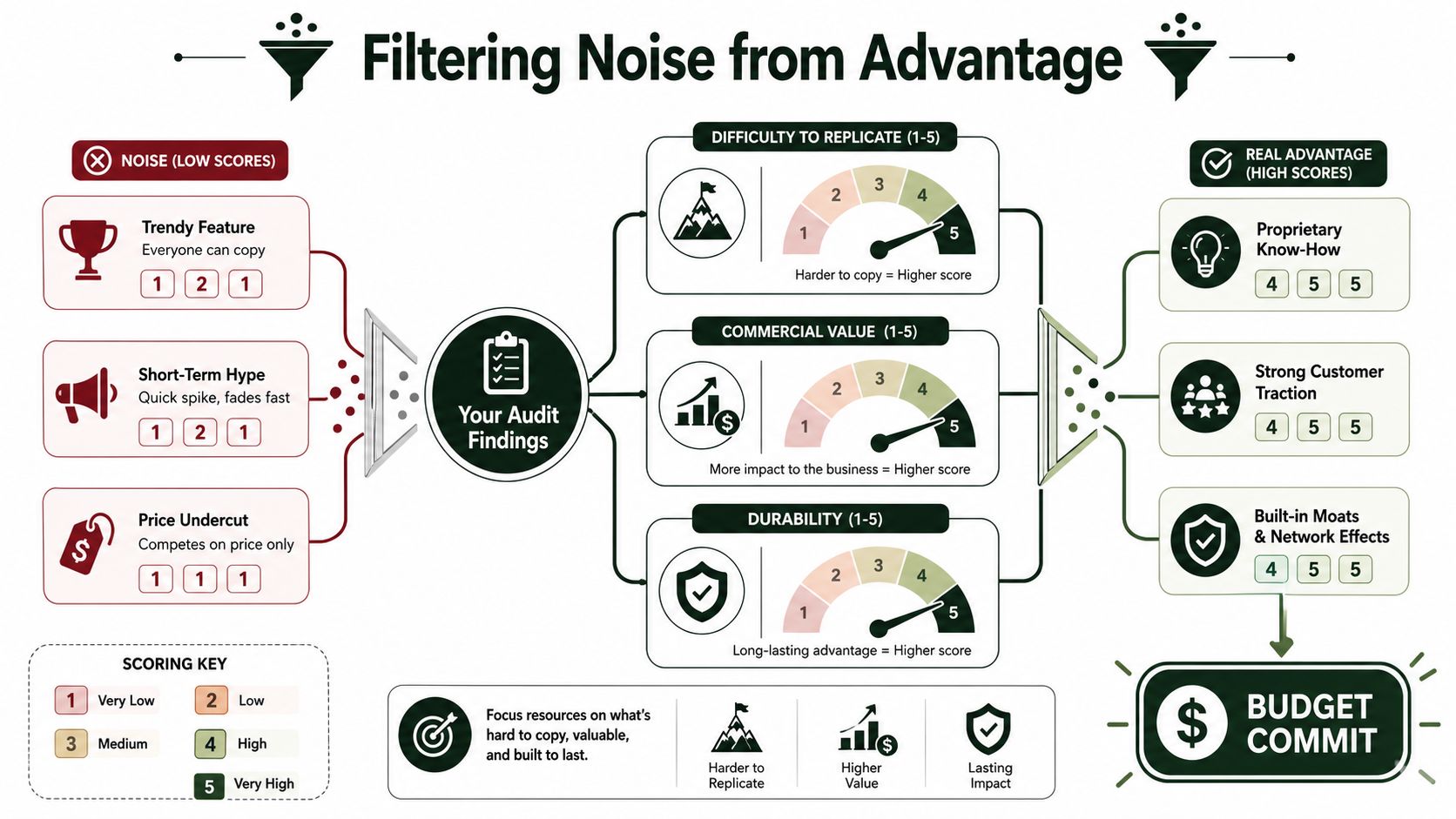
A gap is not automatically an opportunity. Before committing budget, test whether the finding is difficult to replicate, commercially valuable, and durable. These criteria prevent teams from confusing visible activity with a defensible advantage.

Use a simple scoring model. Rate each axis from 1 to 5, then multiply the three ratings to create a priority score. The scale is a decision aid, not a scientific measurement. Apply it consistently and document why each rating earned its value.

An infographic titled Filtering Noise from Advantage, illustrating how to evaluate business audit findings for competitive strategy.

Ask what survives imitation

A competitor's long guide may look like a major content moat. If its visibility depends on weak intent alignment and your team can publish a more useful resource quickly, the advantage may be vulnerable. By contrast, years of brand mentions, trusted reviews, partnerships, or distribution relationships may be difficult to reproduce even if the competitor's website looks ordinary.

Score findings on:

  • Difficulty to replicate: Can your team match the capability, asset, relationship, or proof without disproportionate effort?
  • Commercial value: Does the opportunity connect to a buying decision, qualified demand, retention, or a meaningful positioning problem?
  • Durability: Will the advantage or opportunity remain relevant after a minor algorithm change, campaign, or product update?

Practical rule: Skip a gap when it has weak buyer relevance, weak differentiation, and no plausible path to distribution.

A low score doesn't mean “never.” It means “don't put it ahead of work that can change the business.” A small schema correction may still be worth shipping because the effort is negligible. A large content campaign with no differentiated angle should wait, even if the keyword export makes it look urgent.

Look for quiet advantages too. A sudden visibility increase may come from a partnership, a review ecosystem, a strong sales channel, or a product attribute that content alone can't reproduce. If you only inspect keywords, you'll misdiagnose the cause and invest in the wrong response.

Turn Findings into a Prioritized Task Queue

The analysis becomes useful when every chosen finding becomes an executable task. Move findings that clear your scoring threshold into a board with an owner, format, target keyword or AI prompt, due date, dependencies, and success metric. Leadership should review this queue, not a deck full of unranked observations.

Use three delivery horizons

Quick wins are low-friction changes such as improving a title, strengthening internal links, adding relevant schema, clarifying comparison copy, or updating a page that already serves the right intent. The brief should state the current problem, the competitor signal, the exact change, and the measurement point.

Campaigns require coordinated production. A comparison hub, content cluster, customer proof program, or category landing-page set needs a lead, a sequence, and a clear differentiation argument. Don't assign “create content around competitor gaps.” Assign a defined set of pages, audiences, claims, sources, and internal links.

Strategic bets change the operating model. They may involve a new content vertical, a product-led education program, a partner channel, or a sustained effort to earn third-party mentions that support both organic discovery and AI citations. These bets need an explicit reason to exist and a review point where the team can stop, adapt, or expand them.

Each task should stand on its own. A writer shouldn't have to reopen the entire research file to understand the audience, search intent, competitive weakness, desired proof, format, and call to action. A developer needs the same clarity for technical work.

A connected workflow can shorten the handoff. AutoSEO is one option that combines competitor and keyword research with briefs, generated content, internal links, schema, CMS publishing, technical task prioritization, rank tracking, and AI visibility monitoring. Whether you use it or separate tools, the operating principle is the same: research should feed production and measurement without losing the human approval step. For financial evaluation, this SEO and ROI framework helps connect tasks to business outcomes rather than activity counts.

Build a Repeatable Cadence That Actually Changes Decisions

A one-time competitor review is a snapshot. A useful program has a rhythm that matches the speed of the decisions it supports.

Use a 30-60-90 day cadence:

  • Weekly: Spend a short review cycle on competitor pricing changes, launches, major page changes, unusual messaging shifts, and new third-party coverage. Escalate only signals that could affect an active priority.
  • Monthly: Compare the current gap view with the previous period. Update keyword, content, technical, review, and AI visibility findings only where the change can alter the task queue.
  • Quarterly: Revisit the competitor set, rescore opportunities, retire stale tasks, and rewrite the roadmap around durable shifts rather than every new SERP feature.

Keep the artifacts small. Produce a one-page difference memo, a refreshed task board, and two campaign briefs that are ready for execution. The memo should answer what changed, why it matters, what the team will do, and what it won't do.

The most common failure modes are predictable: expanding the scope to twenty rivals, building dashboards nobody opens, assigning analysis to nobody, and chasing each new search feature without a commercial reason. A cadence works only when the next planning meeting shows a visible change in the roadmap because of competitor evidence.


AutoSEO connects competitor gap discovery with content briefs, technical SEO tasks, publishing, rank measurement, and AI visibility monitoring in one approval-first workflow. If you want your next competitor review to produce an executable queue rather than another static report, visit AutoSEO and evaluate the workflow for your site.

Related Articles

Stop doing SEO by hand

Put your SEO on autopilot — your first 3 articles free

Auto SEO scans your site, builds a content plan, and writes ranking-ready articles automatically. Start your $1 trial — the AI writes your first 3 the moment you begin. Cancel anytime during the trial.

2,147+ businesses · Cancel anytime · No lock-in