Your team is tracking the companies everyone recognizes. You compare their product pages, pricing, and blog posts, then wonder why the analysis hasn't produced a clear SEO decision. Meanwhile, a specialist publisher you barely noticed keeps appearing for the searches that matter most to your customers.
That situation is common because business competitors and search competitors aren't always the same. A direct rival may have a similar product but little visibility for your priority queries. A niche review site, educational publisher, marketplace, or comparison page may occupy the results that influence your buyers.
A useful competitor analysis framework starts with query-level reality. It identifies the domains that repeatedly appear for your commercial and informational searches, examines the capabilities behind their visibility, and converts the gaps into a scored task queue. It also considers visibility in AI-generated answers, where a brand can be mentioned or cited before a searcher visits a traditional result.
The process below moves from basic concepts to practical execution. You'll learn how to define the framework, measure its core pillars, discover genuine SERP rivals, prioritize content, authority, and technical fixes, and keep the system active through regular monitoring.
Table of Contents
What a Competitor Analysis Framework Really Is
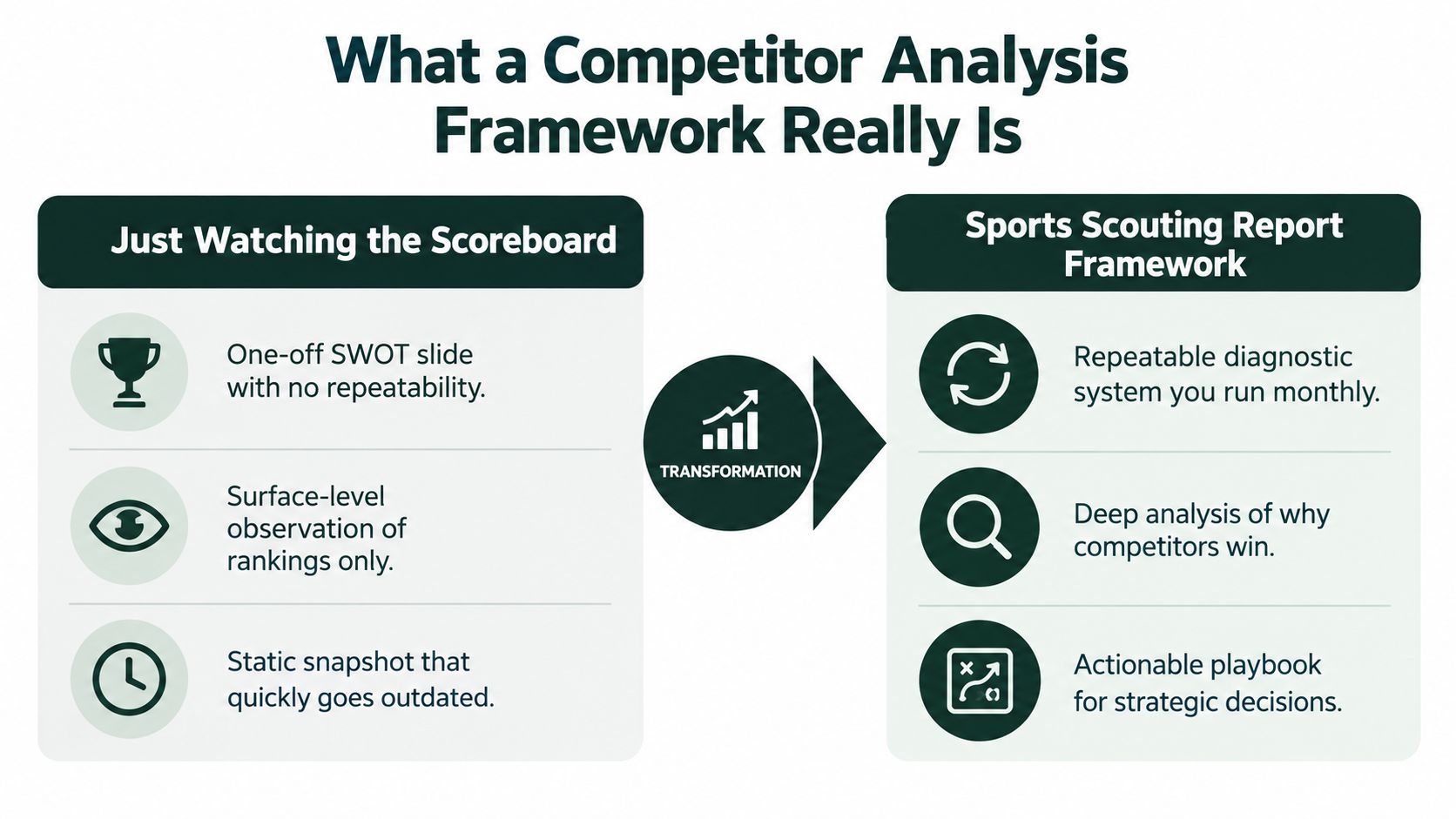
A scoreboard tells you who is ahead. A scouting report helps you understand how they're winning, what they're likely to do next, and which weaknesses your team can exploit.
That distinction separates a useful competitor analysis framework from a one-off SWOT slide. A framework is a repeatable diagnostic system. It gives your team the same questions, evidence sources, metrics, owners, and decision rules each time you review a competitor.
Competitive intelligence has a long history, with roots often traced to military decision-making around 500 B.C., and it has developed from informal surveillance into structured management processes involving benchmarking, environmental analysis, Big Data, AI, predictive analytics, and automation. That history matters because modern SEO analysis shouldn't be treated as a presentation assembled once per planning cycle. Search conditions change, competitors publish, pages gain links, and AI systems produce new associations.
Start with the diagnostic questions
A strong framework asks what a rival is trying to achieve, what it's doing now, what it believes about the market, and what it can execute. Porter's competitive strategy model describes these elements as future goals, current strategy, assumptions, and capabilities. Together, they turn scattered observations into a consistent investigation.
For SEO, each element has observable signals:
- Future goals: New hiring patterns, product launches, new market pages, or shifts in the topics a competitor publishes.
- Current strategy: Pricing language, channel choices, page templates, internal linking, and the balance between educational and commercial content.
- Assumptions: The audience a competitor appears to prioritize, the problems it emphasizes, and the claims repeated across its messaging.
- Capabilities: Publishing depth, delivery speed, technical execution, referring domains, structured data, and the ability to refresh pages.
A rival may rank well because it has deep content and strong authority, but its messaging may still assume an outdated customer need. That combination creates a different opportunity from a competitor that has weak technical foundations but a compelling product angle.
Practical rule: Don't record only what a competitor owns. Record the observable reason it may own it.
Your working document should therefore connect evidence to action. A ranking difference becomes useful only when you can classify it as a content, authority, technical, intent, or visibility gap. Teams looking for more guidance on turning observations into actionable competitor insights can use that distinction to keep research tied to decisions rather than documentation.
The Five Pillars You Need to Measure
A comparison becomes actionable when every observation fits into a measurement panel. For SEO, five pillars reveal different causes of competitive visibility.
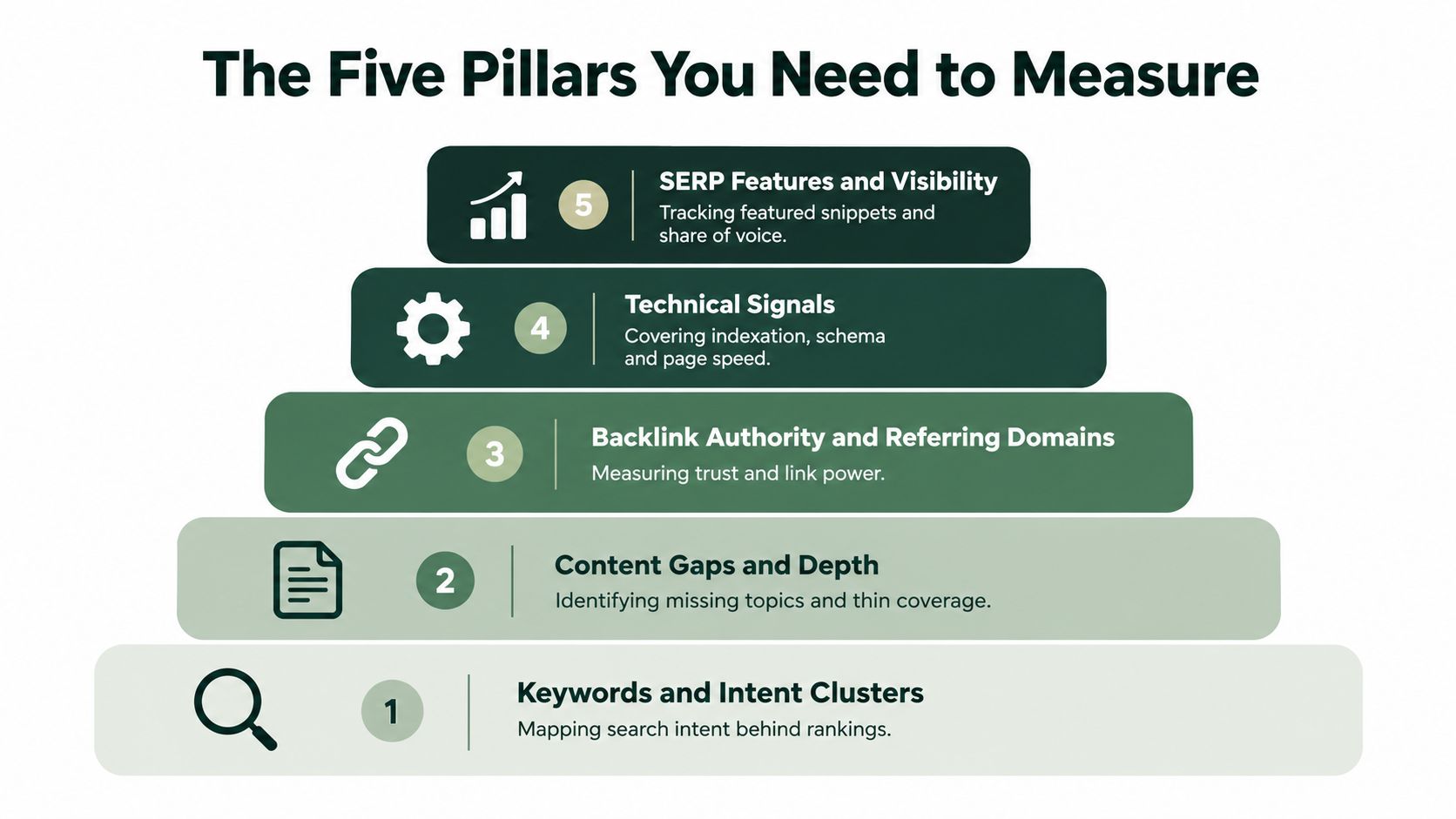
Keywords and intent clusters
Begin with the queries where customers research problems, compare solutions, and decide what to buy. Group them by intent rather than treating every keyword as an isolated row.
For example, an online store selling office chairs might separate “best ergonomic office chair” from “ergonomic chair for tall person” and “buy ergonomic office chair.” The first may reward comparison content, the second needs detailed product guidance, and the third likely requires a category or product page.
Collect the ranking domain, page type, search intent, and your current position for each query. This exposes an intent gap. You may rank for broad educational terms while competitors own the commercial cluster that leads closer to revenue.
Content gaps and depth
A content gap isn't just a missing keyword. It can mean your site lacks an entire page type, fails to answer a critical question, or covers a topic without the depth visible on competing pages.
For the office-chair example, a rival may have a buying guide, sizing explanation, comparison table, and maintenance guide while your site has only product descriptions. The remedy isn't automatically “publish more.” It may be a focused buying guide, a better category introduction, or supporting pages linked to the commercial destination.
Review top pages, headings, unique subtopics, media, product information, freshness, and internal links. Compare like with like. A product page shouldn't be judged against a long-form guide just because both rank for a related phrase.
Backlink authority and referring domains
Links help explain why a page can compete even when another page appears equally relevant. Record the linking domains, the pages receiving links, the context of those links, and whether the sources are relevant to the query cluster.
This reveals an authority gap. Your content may be strong, but competitor pages may have endorsements from publishers, associations, review sites, or industry resources that your page lacks. The appropriate response could involve digital PR, partner outreach, original research, expert contributions, or stronger assets worth referencing.
Technical signals
Technical analysis checks whether search engines can access, understand, and confidently serve the page. Compare indexation patterns, canonical handling, redirects, schema, page speed, mobile usability, internal links, and template consistency.
A technical gap often looks less dramatic than a ranking gap, but it can affect many pages at once. If a rival's category template provides clear product, review, breadcrumb, and organization signals while yours leaves important relationships ambiguous, the remediation belongs in the technical queue rather than the content calendar.
SERP features and visibility
Traditional rankings don't show the whole search experience. Record featured snippets, image results, video placements, product results, local elements, discussions, and other visible result formats relevant to the query.
Also monitor whether your brand or competitors appear in AI-generated answers and which pages or third-party sources receive citations. A site can hold a conventional ranking while losing attention to a richer result or an AI response that summarizes the buying decision.
Cause and effect: A competitor's capabilities explain what it can execute. Its assumptions explain why it chooses certain topics and messages. Your framework should connect both, not treat visibility as a mysterious score.
These pillars prevent vanity comparisons. Instead of saying “the competitor has more traffic,” you can say, “this rival owns the commercial intent cluster through category pages, receives links from relevant publishers, and captures a product-focused SERP feature.” That statement points toward a specific response.
How to Find Your True Search Competitors
Begin with a spreadsheet of named rivals. That list can still help with product positioning, but it shouldn't define your SEO competitive set.
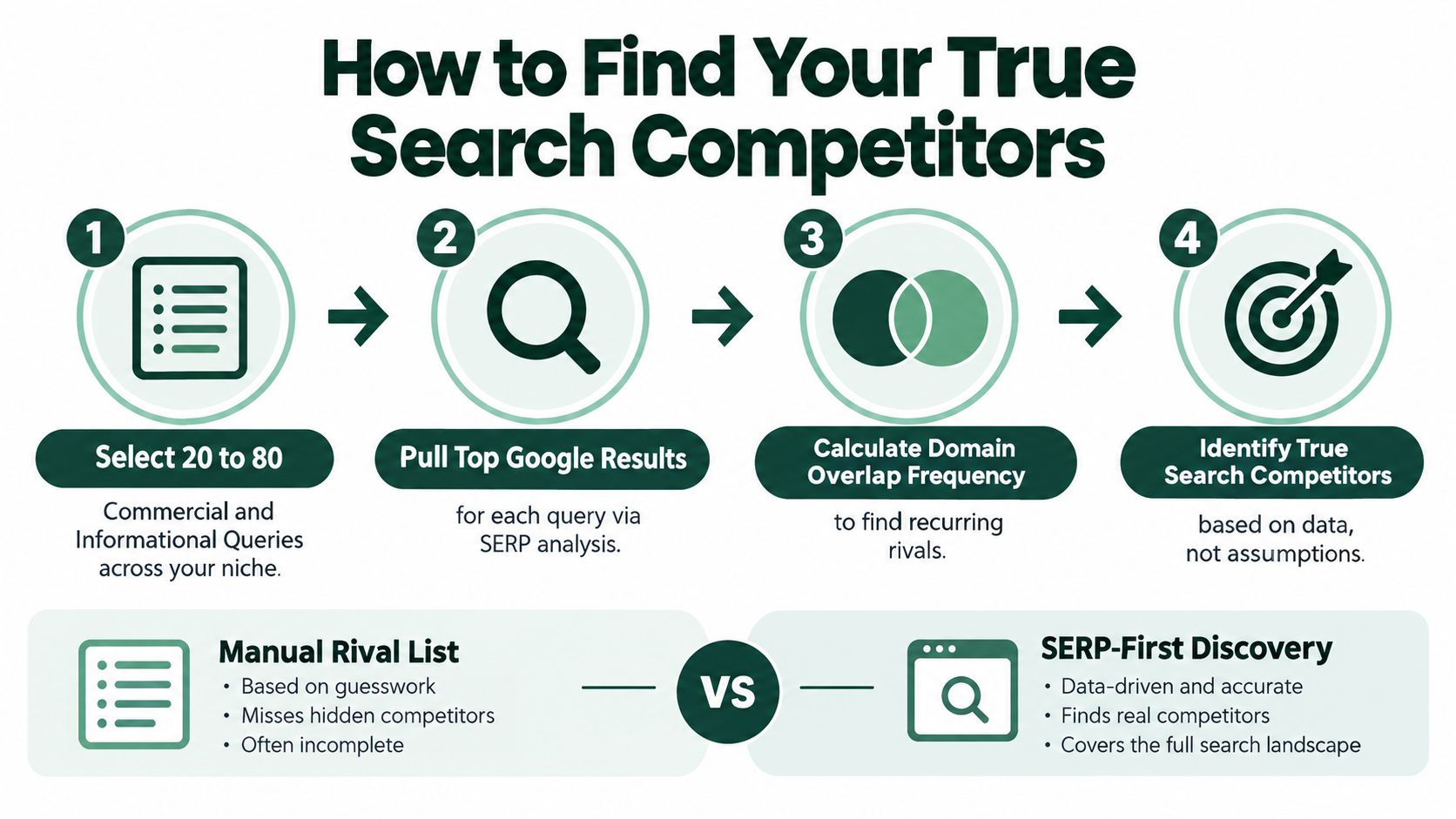
Search results provide a more reliable starting point because they show which domains compete for the exact attention you're trying to earn. A direct business rival may sell an almost identical service yet never appear for your target queries. A niche publisher may repeatedly rank because it satisfies the searcher's intent more effectively.
Build the query set first
Select 20 to 80 commercial and informational queries for the initial discovery panel, as recommended in the 2026 SERP-focused competitor analysis framework. Include queries that represent different customer questions, not variations of one phrase.
For a project-management SaaS company, the set might include:
- Problem queries: “how to manage projects across teams”
- Category queries: “project management software”
- Comparison queries: “project management alternatives”
- Commercial queries: “project management platform for agencies”
Pull the top results for each query through SERP analysis. Then count how often each domain appears across the panel. The recurring domains are your true search competitors.
Separate overlap from relevance
A domain that appears once may be incidental. A domain that appears repeatedly across the same intent cluster deserves investigation. Look for both keyword overlap and intent overlap. Two sites may rank for the same phrase while serving different purposes, whereas a site ranking across several related commercial queries may represent a deeper competitive threat.
Use Google Search Console to identify queries already generating impressions for your site, sitemap data to understand your page inventory, and DataForSEO demand signals alongside SERP analysis to expand the discovery set. Keep the collection method consistent so your comparisons remain meaningful.
For teams working with large product catalogs, browser-based collection can support manual review of visible competitor information. A guide to eCommerce data scraping Chrome extensions can help you understand the practical limits and workflows around that type of research. Use collected data as an input for validation, not as a substitute for interpreting intent and page quality.
Classify the gap before assigning work
Once you've selected a focused group of recurring domains, compare their top-ranking pages with yours. The audit should produce distinct gap classes:
- Content gaps: The competitor has a relevant page or topic you don't cover. Create, expand, or restructure content.
- Backlink gaps: The competitor earns links from domains that don't reference your equivalent page. Plan outreach or asset development.
- Technical gaps: Your page has indexation, schema, speed, internal-linking, or rendering issues. Send it to the technical queue.
You can also use this SEO competitive analysis tools guide to evaluate which parts of the collection and comparison process should be handled through software. The important decision is not how many rivals you can list. It's whether the selected domains repeatedly compete for the queries your business needs.
Scoring and Prioritizing What to Fix First
A gap list isn't a strategy. Without prioritization, the loudest stakeholder or easiest task usually wins, even when a less visible fix could support a more valuable customer journey.
Use a simple scoring matrix with three inputs: intent value, expected impact, and feasibility. You can score each input using your team's chosen scale, as long as you apply the same rule to every task. The exact scale matters less than the discipline of defining what each score means.
Start with the business question
Ask what the query represents. A commercial query connected to a product or service deserves a different priority from an informational query that has no clear path toward a relevant offer. That doesn't make informational content unimportant. It means the task's role in the journey should be explicit.
Then estimate expected impact from evidence:
- Does the competitor appear repeatedly across the cluster?
- Does the query trigger a prominent SERP feature?
- Does the competitor's page attract links or support several related intents?
- Is your page already close to competing, or would it require a new content type?
- Could the fix improve a template or group of pages rather than one URL?
Feasibility covers effort, dependencies, approval requirements, and implementation risk. A focused schema correction may be easier to deliver than a new research-led guide requiring product, legal, and editorial input.
Use the gap type to choose the action
| Gap Type |
Impact Signal |
Effort Level |
Priority Action |
| Content gap |
A recurring rival owns a valuable intent cluster and your site has no suitable page |
Medium |
Create a page designed for the query's intent, then connect it to the relevant commercial destination |
| Authority gap |
Competing pages have relevant referring domains and your equivalent page lacks comparable support |
Medium to high |
Identify link-worthy assets and pursue relevant editorial, partner, or industry opportunities |
| Technical gap |
Several pages share indexation, schema, speed, or internal-linking weaknesses |
Low to medium |
Fix the template or technical condition, validate the change, and monitor affected URLs |
| SERP visibility gap |
Competitors occupy featured or enhanced result formats while your page is present but less prominent |
Medium |
Restructure content, improve answer clarity, and match the format supported by the query |
| AI visibility gap |
Competitors are mentioned or cited in relevant AI answers and your brand is absent |
Variable |
Audit the pages and third-party sources associated with the answer, then strengthen useful, consistent evidence |
The strategic context comes from Porter's Five Forces, introduced by Michael Porter in 1979 and widely applied as a way to examine rivalry, new entrants, buyers, suppliers, and substitutes. The framework helps teams ask where industry pressure may erode profitability and where defensive action matters, rather than optimizing rankings in isolation. For example, if buyers can compare many similar offers and substitutes are easy to find, a content gap around differentiation may deserve more attention than a minor ranking movement.
Decision rule: Prioritize the task that combines meaningful intent, credible competitive evidence, and a delivery path your team can execute.
A scored queue should end with an owner, a proposed change, a dependency note, and a measurement plan. That turns competitor analysis into a planning system rather than a report that expires when the meeting ends.
Templates and Processes for Ongoing Monitoring
A competitor analysis framework stays useful only when someone can run it without rebuilding the spreadsheet from scratch. Keep the operating template narrow enough for regular use, but detailed enough to preserve context.
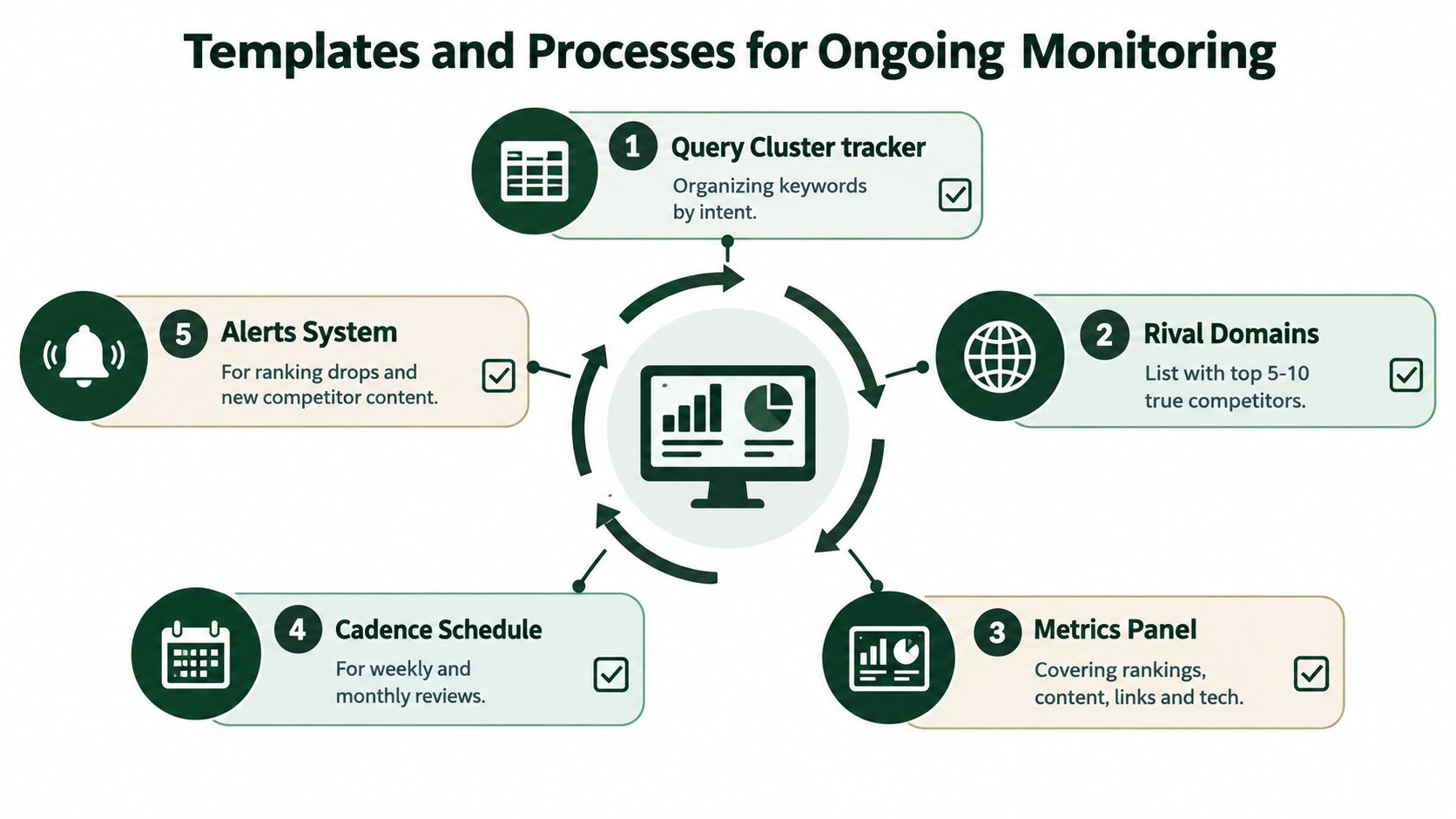
Your tracking sheet should contain:
- Query cluster: The phrase group, intent type, target page, and business purpose.
- Rival domains: The domains that recur in the SERP panel and the page types they use.
- Metrics panel: Rankings, top pages, keyword coverage, referring domains, SERP features, technical signals, and AI mentions or citations.
- Gap record: Content, authority, technical, SERP format, or AI visibility classification.
- Ownership: Responsible person, proposed action, status, approval requirement, and review date.
Give the system a practical rhythm
A weekly review should focus on exceptions. Check alerts for new competitor pages, meaningful ranking changes, new referring domains, lost visibility, altered titles, and changes in AI answer citations. Assign each alert a disposition: investigate, create a task, ignore with a reason, or monitor.
A monthly review can examine the full query panel, refresh the recurring-domain list, revisit top pages, and recalculate task scores. Include a short question for every cluster: What changed, why might it have changed, and what should we do next?
Automation can detect changes, but people still need to validate intent and business relevance. An alert that identifies a competitor page doesn't prove the page deserves replication. The analyst should check whether the page satisfies the query, supports the competitor's positioning, and exposes a gap your team can address.
For teams comparing software options, competitor monitoring software can help centralize alerts and recurring reviews. AutoSEO is one option that combines competitor gap analysis, technical tasks, publishing workflows, rank tracking, and monitoring for visibility across AI assistants and search features.
Add an approval loop
Every automated recommendation should move through a lightweight approval path:
- Detect: Capture the SERP, competitor, page, or citation change.
- Validate: Confirm the result is relevant to the query cluster and not a temporary anomaly.
- Score: Apply intent value, expected impact, and feasibility.
- Approve: Assign the task to content, outreach, development, or strategy.
- Publish or fix: Complete the approved change.
- Measure: Record the subsequent visibility and implementation result.
This loop reflects the wider development of competitive intelligence into continuous systems rather than one-time analysis. It also protects your team from reacting to every competitor move. Monitoring should create focus, not anxiety.
Putting Your Framework Into Action
A practical competitor analysis framework follows a clear progression. Define what the framework measures, examine the five SEO pillars, discover rivals from recurring SERP appearances, classify each gap, score the work, and monitor the results. The key shift is from asking “Who are our competitors?” to asking “Which domains compete for this query cluster, and why?”
Run the process on one priority cluster this week. Pull the relevant queries, identify recurring domains, compare the pages, and select one task with strong intent value and a realistic delivery path. A structured SEO content brief can turn a chosen content gap into an executable page plan, while guidance on a scale content creation framework 2026 can help teams organize production as the queue grows.
Small, prioritized improvements compound because each review gives your team better evidence for the next decision. Treat the framework as a living intelligence process, not a static competitor list.
AutoSEO brings competitor gap analysis, content planning, technical SEO tasks, publishing, rank tracking, and AI-visibility monitoring into one approval-first workflow. Visit AutoSEO to connect your query-level competitor research with a prioritized queue your team can execute and measure.