Target one primary keyword per page, supported by 3 to 5 closely related secondary terms that share the same search intent. That's the answer most site owners need, and it's the answer most outdated SEO advice still avoids.
The popular version of this question asks for a magic number. That's the wrong frame, because modern search doesn't reward pages for stuffing in more phrases, it rewards pages for being unmistakably about one topic and its related intent cluster.
Table of Contents
Why Counting Keywords Is the Wrong Question
SEO advice still gets stuck on a spreadsheet mindset, as if ranking depends on how many terms you can squeeze into a page before it looks spammy. That approach made more sense when engines leaned heavily on exact-match signals, but it's a weak model for semantic search.
A better page is not the one with the highest keyword count. It's the one with the clearest answer to a single search intent.
The data backs that up. A large-scale SEO analysis found that the average keyword is about 1.9 words long, 94.74% of keywords receive 10 or fewer monthly searches, and about 27% have zero recorded search volume. It also found that keywords with 5 or more words are searched roughly 10 times less often than 1- to 3-word phrases, which is why a narrow page focus plus a related cluster makes more sense than chasing a pile of broad terms (analysis on keyword length and search demand).
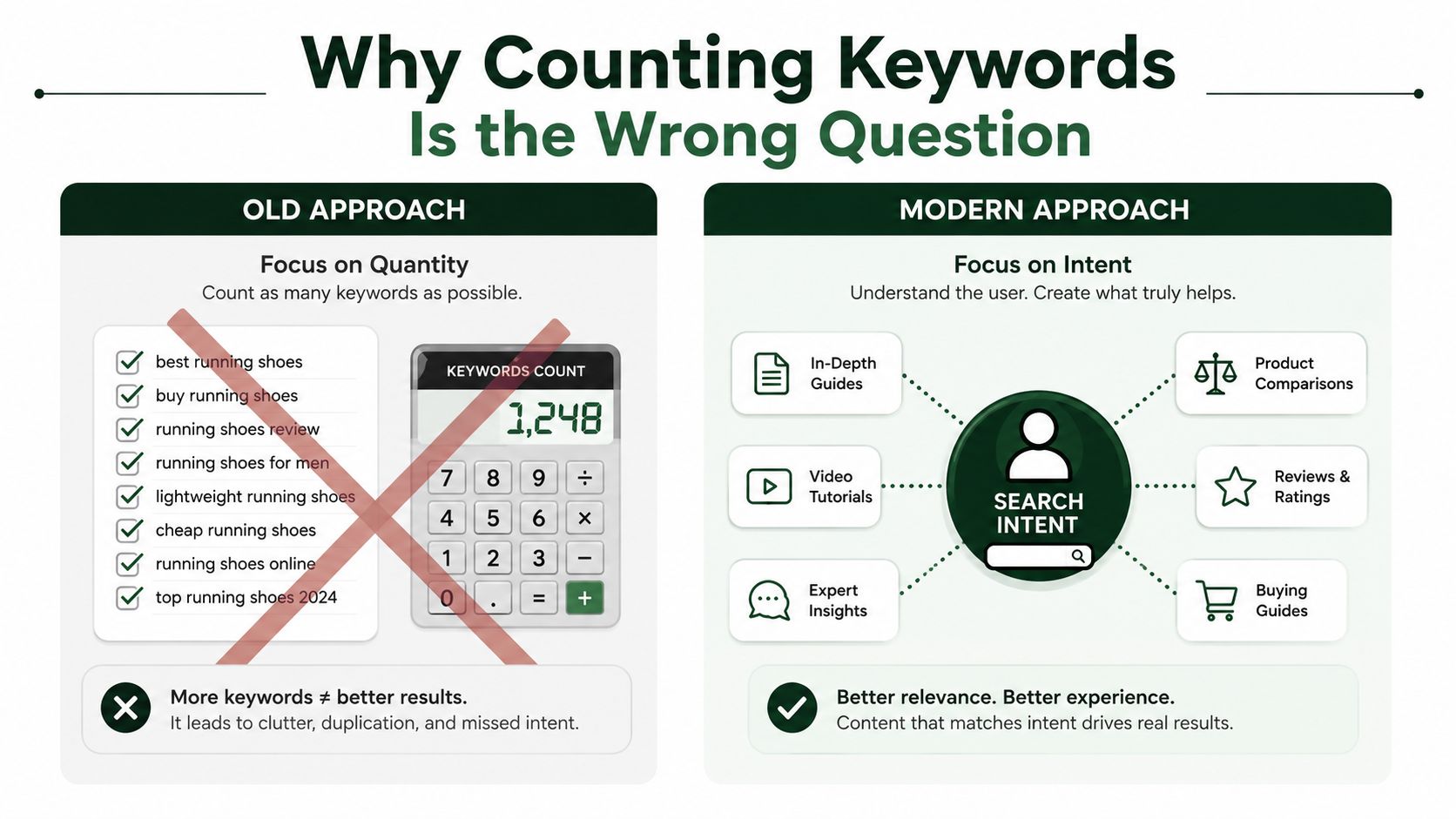
Practical rule: If two keywords belong to different intents, they don't belong on the same page. Separate them and let each page earn its own relevance.
The question is simple. How clearly does this page satisfy one search intent? If that answer is fuzzy, no keyword count will save it.
The One Primary Keyword Rule Explained
Every page needs one primary keyword that represents the dominant intent. That's the phrase the page should be built around in the title, the URL, the H1, and the main narrative. If a page tries to serve multiple unrelated intents, search engines get a muddled signal and users get a page that feels unfocused.
The practical guideline is straightforward. Choose one core phrase, then support it with a handful of closely related secondary terms that stay inside the same intent family. A technical guide from Grow and Convert recommends one primary keyword per page with 3 to 5 closely related secondary terms that share the same intent, because that keeps topical focus intact while broadening semantic coverage (one primary keyword per page guidance).
What counts as a primary keyword
A primary keyword is not just the term you like most. It's the phrase that best matches the page's main promise and has enough measurable demand to justify the page. If you're writing a landing page, that usually means the commercial head term. If you're writing a guide, it's the informational phrase people type when they need a direct answer.
The mistake marketers make is treating the primary keyword like an isolated target. Search engines read pages as entities and topics, not as single-word trophies. A focused page gives them one clear label to classify, while secondary terms help fill in the surrounding context.
Why the cluster matters more than the count
A page doesn't need twenty keywords to look relevant. It needs a tight set of related terms that confirm the same subject from different angles. That's how you capture variations without splitting attention across competing intents.
Pick the page's job first. Then pick the keyword that best matches that job. Everything else is support, not the main event.
If your topic naturally branches into different user goals, split it into separate pages. Don't force unrelated angles into one URL just to inflate the keyword list.
How Search Behavior Shapes Keyword Strategy
Search behavior is already telling you how to structure content. Independent reporting based on Similarweb data found that the average U.S. Google query length sat around 3.33 to 3.36 words from June 2024 through the launch of AI Mode in May 2025, then rose to over 3.51 words by May 2026, with a peak of roughly 3.52 words in April 2026. Separate summaries also describe the average U.S. query length as around 3.4 words, and one analysis cited 5 trillion Google searches per year, or about 9.5 million searches per minute (Google search statistics and query length trends).
That pattern matters for one reason. People don't search in neat keyword-tool buckets. They search in partial phrases, comparisons, questions, refinements, and task-specific variations. A page that covers the core intent plus the natural variants has a much better chance of meeting those searches without becoming a Frankenstein page.
| Strategy Type |
Avg. Keywords Targeted |
Traffic Coverage |
Ranking Stability |
| Single exact-match page |
1 |
Narrow |
Fragile |
| Intent cluster page |
1 primary plus related terms |
Broader |
Stronger |
| Mixed-intent page |
Many unrelated terms |
Scattered |
Weak |
A useful internal reference for measuring intent-fit is this keyword search volume framework. Use it to judge demand before you decide how broad or narrow a page should be.
The point isn't to pack more terms into one page. It's to mirror how people search now, which means building around one intent and surrounding it with the phrases people naturally use when they mean the same thing.
Keyword Density Myths vs Semantic Reality
Keyword density is not a ranking rule. The old 0.5% to 3% range is only a rough reference, not an official standard. Do not force a target percentage. Use the primary keyword where it fits naturally, then build the page around the searcher's intent (Semrush on keyword density).
Why density leads people wrong
Counting repetitions encourages awkward copy. Writers repeat the same phrase instead of answering the query, which harms readability and weakens the page's ability to cover related needs. Search engines can recognize a topic through its context, entities, subtopics, and terminology, so exact-match repetition is a poor substitute for useful coverage.
Semantic search rewards alignment across the page. A clear heading structure, accurate explanations, relevant examples, and supporting terms should point to one intent. That coordinated context gives search systems stronger evidence than an arbitrary density percentage.
What to use instead
Build an intent-based cluster with synonyms, related terms, and contextual phrases. Use those terms where they clarify the subject, such as headings, explanations, examples, image descriptions, and internal anchors. Do not insert a phrase merely to increase its count.
The best page usually answers the query directly, addresses nearby questions, and uses natural language throughout. A density-focused draft may satisfy a checklist, but an intent-focused page serves readers and gives search systems more meaning to evaluate.
Keyword counting is outdated advice for semantic search and AI-generated results. Plan the page around one primary intent, then make its supporting language broad enough to explain that intent clearly.
Building a Keyword Cluster for Each Page
Start with the intent, not the term list. If you know what the page has to do, the keyword cluster becomes obvious. If the intent is unclear, no amount of research tools will clean up the mess.
Build the cluster around one job
Take the primary keyword and map the terms that support the same outcome. Those support terms usually fall into three useful buckets. Variations restate the core phrase in slightly different language, contextual terms expand the subject, and question terms cover the way people ask for the answer in search or FAQ sections.
The article or page should then distribute those terms where they do the most work. The primary keyword belongs in the title tag, H1, and URL. Secondary terms belong in the subheadings, supporting paragraphs, image alt text, and internal link anchors where they fit naturally.
If a keyword points to a different intent, stop forcing it. Put it on its own page and connect the two pages internally. That's cleaner architecture and better classification.
Good SEO architecture is selective. One page, one intent, one main keyword, a focused support cluster.
For content planning, a simple template helps. This SEO content template is useful when you want to map topic, intent, headings, and supporting terms before anyone starts drafting.
Use the cluster to decide page scope
A strong cluster does more than help rankings. It tells you where the page should stop. If the related terms all feel like one conversation, you're in the right place. If they start pulling the article in different directions, you're looking at two or more topics, not one cluster.
Internal linking matters here too. Related pages should reinforce each other instead of competing for the same query. That's how you build topical depth without creating confusion.
Real Examples of Effective Keyword Targeting
A B2B SaaS landing page for project management software is a clean example of the one-primary-plus-cluster model. The primary keyword is obvious, and the supporting terms might include team collaboration tools, task tracking, and Gantt chart software. Those terms fit naturally inside feature sections, comparison blocks, and use-case copy without making the page feel stuffed.
A long-form informational article works differently. Its primary keyword may be broader, but the page earns relevance by covering the subtopics readers expect to see around that query. The best pages don't chase every variation with equal weight. They use the main term consistently, then use subheadings and body sections to answer the adjacent questions people ask.
A practical way to audit this is to look at where the keywords appear and where they don't. Good pages are selective. They include the primary phrase in the obvious places, then avoid repeating it when a synonym or related concept reads better.
| Page Type |
Primary Keyword |
Secondary Keywords |
Key On-Page Decisions |
| SaaS landing page |
Project management software |
Team collaboration tools, task tracking, Gantt chart software |
Primary term in H1, URL, and hero copy, supporting terms in feature sections |
| Informational guide |
Main topic phrase |
Related questions, context terms, use-case phrases |
Headings map subtopics, body copy stays natural, internal links reinforce depth |
| Comparison page |
Comparison intent keyword |
Alternative names, feature terms, decision terms |
Clear category framing, fewer broad terms, stronger intent match |
If you need software support for this workflow, AutoSEO can help organize keyword research, content briefs, and site-level prioritization in one place, which is useful when you're deciding which terms deserve a page and which ones belong in the same cluster. A separate utility like a keyword position checker tool can help confirm whether the page is ranking for the terms you intended.
Your Keyword Planning Decision Framework
Use a short decision chain for every page. First, identify the dominant intent. Second, assign one primary keyword that names that intent clearly. Third, add 3 to 5 secondary terms that stay in the same cluster. If a term pulls the page into a different job, it gets its own page.
That framework solves most keyword arguments before they start. It also keeps pages from competing against each other, which is the fastest way to waste organic potential. If two pages can answer the same query, one of them is probably unnecessary.
When the topic map starts to spread, use a content-gap process to decide what's missing and what should be split out. The ClipCreator.ai content strategy guide is a useful reference for that kind of planning because it keeps the focus on coverage, not just term counts.
The cleanest rule is the simplest one. One page, one primary keyword, one intent cluster. Apply that consistently and your site gets clearer, your content gets easier to write, and your rankings become more predictable over time.
If you want this handled with less manual keyword sorting, AutoSEO automates keyword research, content planning, internal linking, publishing, and tracking in one workflow. It's built for teams that want to stop debating keyword counts and start executing on intent-first pages that can rank.