A blank page isn't a topic. It's a signal that you haven't matched a reader, a search intent, and a useful outcome yet. Before asking what should I write an article about, ask a sharper question: which specific person has a problem I can solve better than the existing results?
The 10 briefs below turn that question into practical choices. Each one identifies an audience, a search opportunity, a useful angle, examples to include, trade-offs to accept, and steps for execution. Choose the brief that matches your expertise and business goal, then validate it with search data, competitor pages, customer questions, and knowledge already available on your site.
Organic search remains a major discovery channel. Industry summaries referenced by BrightEdge SEO statistics report that organic search drives 53% of trackable website traffic, while the first organic result receives 27.6% of clicks. That concentration makes topic selection and search intent more important than publishing often.
Your workflow should also connect research to production, publishing, internal linking, and measurement. AutoSEO is one relevant example of that connected approach, combining keyword research, content creation, technical SEO, CMS publishing, and performance tracking. Use the briefs below to decide what deserves your time before you open a document.
Table of Contents
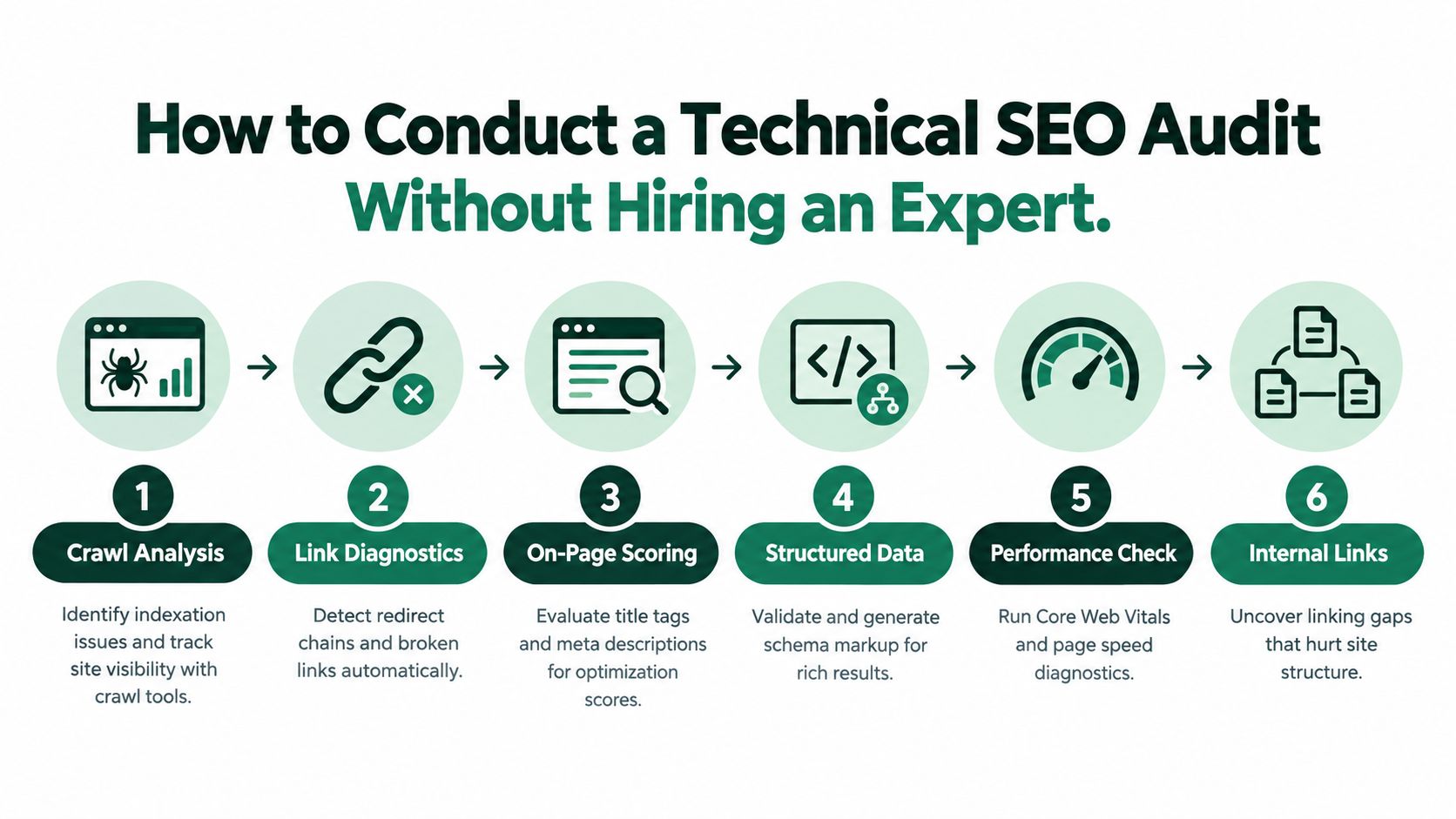
1. How to Conduct a Technical SEO Audit Without Hiring an Expert
A practical guide for small business owners, bloggers, and marketing generalists should begin with the problems that can prevent search engines from accessing or indexing a site. Readers don't need a lecture on every technical SEO concept. They need a sequence that tells them what to check first, what to fix next, and when to ask for specialist help.
Open with a clear promise: find the issues that block visibility before spending more time on content or link building. Explain indexation, crawlability, redirects, canonical tags, page speed, structured data, and internal links in plain language. Use scenarios that make the advice concrete, such as an e-commerce store creating duplicate URLs through category filters or a WordPress blog accidentally applying noindex to important posts.
Make prioritization the central angle
Don't tell readers to fix everything at once. Show them how to start with indexation and crawlability, because a page that search engines can't access won't benefit from other optimization work. Then explain how to rank issues by impact, effort, affected page count, and business importance.
A useful implementation sequence includes:
- Check indexation first: Review important pages, robots.txt, XML sitemaps, noindex directives, and canonical tags.
- Consolidate redirects: Shopify stores and other commerce sites often need to remove unnecessary redirect chains.
- Validate structured data: Use a schema generator as a starting point, then review the markup against the actual page content.
- Monitor recurring issues: Schedule regular checks so new problems don't remain hidden.
- Document every fix: Keep a changelog with the issue, action, date, owner, and verification method.
Practical rule: Fix the issue that blocks the most valuable pages before polishing issues that affect only minor templates.
Use technical SEO best practices as a supporting internal resource, then add a short audit worksheet readers can follow. Include screenshots, decision points, and a clear boundary between a safe DIY fix and a change that requires developer review.
2. From Keyword Research to Published Content: Building a Closed-Loop SEO Workflow
Which content ideas deserve production, and which will consume time without supporting a business goal? Write this brief for SaaS marketers, e-commerce teams, and agencies that move information between keyword tools, documents, spreadsheets, and CMS dashboards. The article should help them choose one opportunity, assign ownership, publish it correctly, and measure what happens afterward.
Start with the decision before the draft. Combine Google Search Console data, sitemap information, competitor research, search intent, and demand signals. Approve a keyword only when its audience, business relevance, ranking feasibility, and required effort make sense together. A high-volume term with weak product relevance is a poor brief. A narrower query with clear buying intent may deserve priority.
Then map the handoffs: approved opportunity, content brief, draft, metadata, internal links, review, CMS publication, and performance reporting. Give every stage an owner and acceptance criteria. This turns keyword research into a production system rather than a spreadsheet of unclaimed ideas.
The commercial case supports the topic. Industry summaries report an average B2B content marketing ROI of 647% and a typical payback period of 6 to 9 months in 2026, according to content marketing statistics from SearchLab. Treat those figures as context, not a forecast. The article earns its value by showing how content activity connects to qualified traffic, leads, sales, or retention.
Use five operating decisions to structure the workflow:
- Select: Set thresholds for intent, feasibility, relevance, and expected business value.
- Plan: Build topic clusters and add internal-link targets while creating the brief.
- Produce: Review AI-assisted titles, metadata, claims, examples, and brand language.
- Release: Test the draft, schedule publication, and require an approval checkpoint.
- Measure: Track rankings, indexed pages, traffic signals, conversions, and update needs.
Point readers to an SEO content plan to turn approved briefs into a calendar. Automation cuts manual transfers, while editorial judgment still governs what gets published.
3. Winning in AI Search for ChatGPT Claude Gemini and Beyond
What should you write if your audience checks ChatGPT, Claude, Gemini, or another answer engine before visiting a website? Choose a brief for publishers, product comparison sites, health-information teams, and businesses whose buyers research through generated answers. The article must connect search visibility to a concrete business need, not repeat vague advice about “optimizing for AI.”
Explain how clear information architecture, structured answers, authoritative pages, and crawlable content help answer systems interpret a site. The reason to cover this topic is practical. A 2026 dataset reports AI Overviews on 58% of Google searches, a zero-click rate above 65%, and a 61% organic CTR decline when AI Overviews appear, according to SEO statistics from Analytify. Use those figures as context. The brief should measure visibility through citations and mentions as well as blue-link rankings.
Build the article around the reader's verification task:
Answer the core question early. Place a concise, accurate response near the top.
Support it with evidence. Add definitions, limitations, comparisons, examples, and references so readers and answer systems can check the claim.
Mark up only visible content. FAQ and HowTo structured data should describe the page, not serve as a shortcut to rich results.
Make related information easy to find. Use topic clusters, descriptive anchor text, and clear navigation.
Test real prompts. Check ChatGPT, Claude, Gemini, Perplexity, and Google AI Overviews against the questions the audience asks.
A comparison table can turn a broad article into a decision tool. The same dataset reports that pages with three or more tables receive 25.7% more AI citations. Treat that as a format signal, not a promise. Include tables only when they clarify genuine differences.

Recommend AI visibility tracking tools for monitoring mentions over time. For multilingual audiences, WhisperAI translation service can support translation workflows. Human reviewers must still check accuracy, terminology, and cultural context.
4. The Complete Guide to Multi-Language and Multi-Market SEO at Scale
Are you expanding into new markets, or just translating pages and hoping they rank? Choose this brief for international e-commerce managers, SaaS growth teams, and agencies managing regional campaigns. Its business outcome is a repeatable market rollout that earns relevant visibility, rather than a collection of translated pages.
Start with the search problem in each market. A keyword that performs in the United States may not reflect how people search in the United Kingdom, Canada, Australia, or another region. Direct translation can create unnatural phrasing, inaccurate product terminology, and pages that answer the wrong question. The article should make this distinction clear before discussing implementation.
Build a market brief before publishing
Research each market independently. Record local vocabulary, search intent, competitors, product terms, and seasonal behavior, then choose the page type that best matches the local need. Connect equivalent regional pages with correctly implemented hreflang, so search engines can identify their intended audiences.
Assign approval to native speakers who can review tone, cultural references, claims, and calls to action. Track visibility separately by region, because one global ranking cannot show whether a market is succeeding. Give each market its own calendar for holidays, buying seasons, launches, and editorial priorities.
A useful execution test covers the full customer path: currency selection, language detection, URL structure, checkout flow, and mobile rendering. An e-commerce brand running Shopify stores across Europe, North America, and Asia-Pacific provides a practical scenario. Central governance can standardize templates, metadata, technical checks, and reporting. Regional teams should decide local positioning, research findings, and final approval.
The decision brief should state the target market, primary query, reader problem, page type, regional reviewer, and measurement plan. Select the idea if your team can name those owners and validate the experience before launch. That makes the article useful to teams choosing between centralized control and local relevance, rather than another translation checklist.
5. Measuring SEO ROI: From Keyword Rankings to Revenue Attribution
What should you write about if executives see SEO rankings but still question its business value? Write a measurement brief for marketing managers, founders, and executives who need to connect search visibility with qualified visits, conversions, revenue, and customer value.
Open with a baseline. Document the relevant pages, target queries, organic sessions, assisted conversions, lead quality, sales, and existing content before the campaign begins. Then assign each page a role. An informational guide may introduce a prospect, while a comparison page can influence a purchase much closer to the decision.
Build the article around the customer path:
Visibility: Identify which pages and keyword groups gained or lost exposure.
Traffic quality: Check whether visitors reached the right landing page and continued to the next step.
Conversion behavior: Attribute leads, purchases, demos, or subscriptions to organic landing pages.
Revenue contribution: Group content and queries to assess their influence on closed business.
Efficiency: Compare SEO costs with paid acquisition and other marketing channels.
Industry summaries report that content marketing can generate about three times as many leads as outbound marketing while costing roughly 62% less, according to the SearchLab content marketing overview. Treat that benchmark as context, not as a forecast. The article should recommend a company-specific measurement model that evaluates content by commercial outcomes rather than traffic alone.
Give readers a practical reporting brief: combine ranking movement, organic landing-page performance, conversion data, and revenue attribution in one dashboard. Add notes for seasonality, major site changes, campaign launches, and competitor movement. Define the attribution model before reporting begins, then apply it consistently so leaders can compare decisions over time. A perfect attribution answer is unlikely. A repeatable model is useful.
6. Content Gaps and Competitor Analysis for Untapped Keyword Opportunities
Which valuable customer question does your site still answer poorly? Start there, especially if you are an SEO manager, e-commerce team, or agency with the obvious topics already published.
Build a competitor set based on search results, not company charts. Direct competitors sell similar products or services. Search competitors may be marketplaces, review sites, publishers, or specialist blogs that rank for the same queries. Review several competing domains, compare the pages appearing for important keyword groups, and record where they rank while your site has no relevant answer.
A ranking gap becomes an article brief only after it passes five tests:
Commercial intent: Choose queries connected to a product, service, comparison, evaluation, or problem your business can solve.
Audience fit: Reject subjects that attract visitors unlikely to become customers or loyal readers.
Feasibility: Examine the quality and authority of current results. A weak set of pages may offer a practical opening, while authoritative results require stronger evidence and execution.
Distinctiveness: Commit only when you can contribute firsthand examples, an original process, expert review, supported data, or a clearer format.
Timing: Watch seasonal questions and emerging competitor pages before attention increases and the results become harder to enter.
The best opportunity often sits between a visible ranking weakness and a specific business outcome.
A SaaS company may find that competitors explain product features but leave implementation questions unanswered. An online retailer may see comparison pages for major products that ignore a specific use case. A publisher may find broad trend coverage without a practical decision framework. Each case points to a different brief, audience, evidence requirement, and conversion path.
Ask, “Which valuable reader decision are competitors still helping poorly?”
Turn the answer into a focused brief. Record the query, audience, search intent, weaknesses in current results, evidence your team can provide, proposed format, relevant internal links, and the next business action. Then choose an owner and set the research standard before drafting.
Originality must carry the page. A new article deserves resources when it resolves a real information gap with better evidence, sharper guidance, or a format that helps readers decide.

7. Publishing Automation and CMS Integration for Manual Content Deployment
A WordPress team publishing regularly can lose hours transferring drafts, metadata, images, and links by hand. The stronger article brief targets content teams, developers, and agencies facing that problem, then explains how to reduce repetitive work without surrendering editorial control.
Trace the workflow from approved content to live page. An integration may connect a writing or planning tool with WordPress, Shopify, Webflow, Wix, a custom site, or a webhook-based system. The article should show what each connection transfers and identify failure points, including missing metadata, malformed schema, incorrect links, broken layouts, and accidental publication.
Build the safeguards around the workflow rather than presenting automation as the outcome:
- Map fields first: Match titles, slugs, meta descriptions, featured images, authors, categories, schema, and canonical fields across systems.
- Test with drafts: Use controlled test pages before allowing live deployment.
- Keep approval checkpoints: Require human review of claims, brand language, links, and sensitive content.
- Maintain logs: Record publish times, users, statuses, errors, and revisions so teams can trace failures.
- Set linking rules: Define which related pages qualify for automated internal links, then review the generated output.
- Check mobile rendering: Inspect live pages on phones, tablets, and desktop layouts.
- Plan rollback: Make unpublishing or restoring a previous version straightforward when an integration fails.
The WordPress example should show the practical boundary. Automation can transfer approved fields and reduce manual copying, while editors remain responsible for accuracy, tone, links, and publication status. Removing repetitive entry is the goal. Removing accountability is not.
Speed depends on clear foundations. Templates, permissions, naming conventions, field mappings, and review rules must be set before deployment. Without them, an integration can distribute the same metadata, linking, or layout error across many pages faster than a manual process.
The article earns its place when it helps readers choose an integration, test it safely, and set controls that protect live content.

A bloggers, small e-commerce operators, and startup marketers audience needs fast answers, not a directory of SEO software. Build the brief around decisions: which page is blocked, which template is failing, and whether the issue needs a quick fix or specialist work.
Start with a realistic case. A WordPress blogger adds FAQ markup to an article, validates the implementation, then checks whether the page still answers the reader's question clearly. The workflow connects a tool result to an editorial decision, rather than treating a validation pass as proof of quality.
Give every tool a job by assigning each check a question:
- Can search engines access the page? Inspect robots.txt, sitemap files, noindex directives, and important URLs. Confirm that the sitemap is valid and includes the pages the site wants indexed.
- Does the page work for visitors? Run Core Web Vitals checks on representative templates. The homepage rarely reflects the experience of product, category, article, or conversion pages.
- Does the markup match the page? Validate structured data, then compare the output with visible content. A generated schema block still needs editorial review.
- Can AI systems reach the content? Review llms.txt changes and confirm that important pages remain crawlable.
- Is the problem isolated or repeated? Sample several representative URLs instead of diagnosing the entire site from one page.
- Will the issue return? Save frequently used utilities and record changes, so recurring access, template, or markup problems become easier to identify.
For an online store, pair a sitemap check with a sample of product and category pages. This can expose missing URLs, incorrect canonicals, or template-level issues before a larger audit.
Free utilities work well for quick diagnosis, but they often stop short of explaining root causes across a complex site. Escalate migration issues, large-scale canonical changes, JavaScript rendering failures, and server configuration problems. The finished article should help readers choose the right check, interpret its result, and set a clear boundary for outside technical support.
9. Building an SEO Culture for Non-Technical Teams
Can your team make search-informed decisions before a page reaches publication? Choose this article brief for content creators, product marketers, category managers, account managers, or founders who need SEO built into routine work. It addresses a process problem: search arrives late, specialist terms block cooperation, and page decisions lose connection with audience needs and business goals.
Open with three recognizable failures. A category manager publishes product pages using internal language instead of buyer language. A writer completes an article without checking intent. An account manager receives ranking data but cannot turn it into a recommendation. The article should show that clearer ownership and review points solve these breakdowns.
Give readers a practical operating model rather than a vocabulary lesson:
- Start with the reason: Link query language to audience questions, then explain how page structure helps people find useful answers.
- Set a shared page standard: Check the title, primary topic, introduction, headings, links, metadata, media, accuracy, and brand fit.
- Assign decisions to roles: Category teams own product language, writers assess intent during outlining, and account managers turn findings into actions.
- Add a pre-publication review: Require someone to confirm intent, accuracy, links, and brand alignment before release.
- Make quality visible: Use a simple internal score and review real pages, so teams can discuss specific improvements.
- Keep learning attached to work: Share lessons from published pages, new search formats, AI answers, technical issues, and successful fixes.
- Recognize business outcomes: Highlight stronger product engagement, qualified organic actions, better conversion paths, and useful page improvements.
Select the brief by matching the audience to its immediate problem. An e-commerce version should focus on category ownership and product-page language. A SaaS version should connect outlining with search intent. An agency version should teach account managers to convert client questions into clear actions.
The execution trade-off is standardization versus creative judgment. Define what a good page must contain, then let specialists choose the voice, examples, and editorial approach. That gives the article a measurable outcome: a repeatable SEO process that teams can use without making every page sound identical.
10. White-Label SEO Reporting and Agency Scaling Without Infrastructure Burden
Can your agency deliver useful SEO without building every research, reporting, content, and publishing system itself? This brief suits freelancers, web design agencies, and performance marketing firms adding SEO to an existing offer. Position the article around one decision: what should the agency standardize, what should automation handle, and where must an account manager apply judgment?
Start with the client-facing promise. A white-label service should give clients readable reports, clear priorities, competitive context, and a scheduled discussion about next actions. Metrics only matter when the report explains what changed, why it matters, what the team will do next, and which decisions require client approval.
Build the operation around three layers. Define the service agreement with response times, reporting frequency, optimization cadence, approval points, and responsibilities. Standardize research through fixed brief fields, keyword review criteria, competitor checks, and content templates. Create service tiers that separate reporting from content production, technical work, publishing, and strategic consulting.
Automation should monitor ranking movement, competitor changes, technical issues, and pages needing attention. Human review should cover content, metadata, links, and recommendations before anything reaches the client. Account managers should use reports to discuss priorities and decisions, not read every chart aloud.
Add proof only after the delivery process works. Build case studies from verified client data, and obtain permission before using results in sales material.
The best angle depends on the agency model. A digital agency can explain how SEO fits alongside website services. A solo consultant can focus on coordinating more clients without recreating every report manually. In both cases, templates improve consistency, while recommendations still need to reflect the client's market, site, audience, and commercial goals.
Choose this brief if the reader needs a repeatable service layer, not another list of SEO tools. The article should end with a practical operating rule: standardize inputs and reporting, automate monitoring, and reserve human time for interpretation, approval, and client-specific direction.
10 SEO Article Ideas: Side-by-Side Comparison
| Item |
Implementation Complexity 🔄 |
Resource Requirements ⚡ |
Expected Outcomes ⭐📊 |
Ideal Use Cases 💡 |
Key Advantages ⭐ |
| How to Conduct a Technical SEO Audit Without Hiring an Expert |
Medium 🔄, tool-driven; some dev fixes needed |
Moderate ⚡, crawl tools, access to server/CMS, occasional dev time |
⭐⭐⭐⭐ 📊 Improved crawlability, quick ranking wins, ongoing monitoring |
Marketing generalists/content managers fixing site health without consultants |
Prioritized fixes, reduces consultant costs, real-time alerts |
| From Keyword Research to Published Content: Building a Closed-Loop SEO Workflow |
Medium–High 🔄, integrations + workflow setup |
High ⚡, integrated platform, CMS access, content team |
⭐⭐⭐⭐ 📊 Faster publishing, consistent metadata, measurable attribution |
Content teams, SaaS, agencies scaling content operations |
Eliminates tool fragmentation, direct publishing, consistent linking/schema |
| Winning in AI Search: How to Optimize for ChatGPT, Claude, Gemini, and Beyond |
High 🔄, evolving signals and format requirements |
Moderate–High ⚡, structured data, llms.txt, monitoring across AI platforms |
⭐⭐⭐ 📊 Increased chance of AI citations and referral traffic (variable) |
Publishers, B2B, e‑commerce aiming for AI visibility |
Early-mover advantage; structured data benefits both AI and traditional search |
| The Complete Guide to Multi-Language and Multi-Market SEO at Scale |
High 🔄, hreflang, localization, compliance complexity |
High ⚡, localization teams, market research, platform support |
⭐⭐⭐⭐ 📊 Regional traffic growth, consistent multi-market presence |
E‑commerce and SaaS expanding into multiple countries/regions |
Centralized management, consistent brand messaging, cross-market analytics |
| Measuring SEO ROI: From Keyword Rankings to Revenue Attribution |
Medium 🔄, requires tracking & attribution setup |
Moderate ⚡, analytics, CRM/GA4 integration, reporting tools |
⭐⭐⭐⭐ 📊 Clear revenue attribution and business KPI alignment |
E‑commerce owners, marketing directors proving SEO value |
Connects SEO to revenue, automated stakeholder reporting |
| Content Gaps and Competitor Analysis: Finding Untapped Keyword Opportunities |
Medium 🔄, analysis and interpretation work |
Moderate ⚡, competitor data, keyword tools, content production capacity |
⭐⭐⭐⭐ 📊 Identifies validated opportunities, reduces wasted content effort |
Competitive verticals, agencies, merchants seeking quick wins |
Data-driven prioritization, real-time alerts, rapid opportunity discovery |
| Publishing Automation and CMS Integration: Eliminating Manual Content Deployment |
Medium–High 🔄, integration and admin coordination |
Moderate ⚡, CMS access, possible webhook/dev work, mapping metadata |
⭐⭐⭐⭐ 📊 Much faster publish velocity, fewer manual errors, scalable output |
High-volume publishers, e‑commerce product feeds, agencies |
Speeds deployment, consistent metadata/schema, scheduled optimal publishing |
| DIY SEO Tools and Resources: Free Utilities for Quick Site Diagnostics |
Low 🔄, minimal setup, web-based tools |
Low ⚡, free tools only, no subscriptions |
⭐⭐ 📊 Surface-level diagnostics, quick identification of urgent issues |
Solopreneurs, small businesses, budget-conscious teams |
Zero cost, accessible, good for quick checks and starting points |
| Building an SEO Culture: Getting Non-Technical Teams to Prioritize Search Visibility |
Medium 🔄, organizational change management |
Low–Moderate ⚡, training time, simple tooling, approval workflows |
⭐⭐⭐⭐ 📊 Sustained SEO adoption, improved content quality and velocity |
Marketing leaders scaling SEO without growing headcount |
Distributes responsibility, aligns teams, embeds SEO in workflows |
| White-Label SEO Reporting and Agency Scaling: Managing Clients Without Infrastructure Burden |
Medium 🔄, process, SOWs, and permissions setup |
Moderate ⚡, tool seats, reporting templates, account management |
⭐⭐⭐⭐ 📊 Scalable client delivery, reduced account management overhead |
Agencies, freelancers scaling services and client portfolios |
White-label reports, volume pricing, centralized billing and automation |
Choose the Brief You Can Execute This Week
The best article idea isn't the most impressive one. It's the one you can execute with enough expertise, evidence, and access to the reader's real problem. Choose a brief whose audience you understand, whose search intent you can satisfy, and whose examples you can support without inventing results.
Score each candidate against five criteria:
- Relevance: Does the topic solve a problem your audience already has?
- Differentiation: Can you add experience, evidence, examples, or a clearer process?
- Available expertise: Can you explain the subject accurately and answer follow-up questions?
- Production effort: Do you have the research, screenshots, interviews, data, and review time required?
- Business value: Does the article support a product, service, newsletter, lead, sale, or strategic goal?
Don't choose a topic because it sounds broad enough to attract everyone. Broad subjects often create vague articles. A focused brief gives you a defined reader, a clear promise, and a reason to include specific examples. “SEO” is a weak starting point. “How a Shopify owner can find and fix indexation problems on product and category pages” is actionable.
Turn the winner into a one-page content brief. Include one primary keyword, the intended audience, the search intent, the reader outcome, the key sections, the evidence you can support, the examples you can explain, relevant internal links, the call to action, and the measurement plan. Use existing site knowledge, customer questions, sales conversations, Search Console data, sitemap information, and competitor pages to validate the direction before drafting.
Your validation process should continue after writing. Check the page technically, review its structure and internal links, confirm that metadata and schema match the content, publish it through a controlled workflow, and monitor rankings, indexed status, traffic signals, conversions, and AI visibility where relevant. Current marketing practice increasingly combines AI personalization, automation, and SEO updates. A HubSpot marketing trends report reports that 48.57% of surveyed marketers identified AI for personalized content as a top trend, followed by 47.38% for automation and 40.60% for SEO updates. Use AI to accelerate research, outlining, editing, and workflow management, but keep human review responsible for accuracy, originality, and audience fit.
AutoSEO can support this process as one relevant option. Its workflow connects keyword research, AI-assisted briefs and articles, technical audits, internal linking, CMS publishing, rank tracking, and AI-visibility monitoring. The right tool won't rescue an unfocused topic, but a connected workflow can help you move a well-chosen brief from evidence to publication and measurement without losing the original business goal.
Choose one brief today. Write the audience, query, reader outcome, proof, and next action at the top of the page. If those five details are clear, you already know what to write.
AutoSEO combines keyword research, content briefs and production, technical SEO checks, internal links, CMS publishing, and performance measurement in one workflow. Use AutoSEO to turn a validated article idea into an approved, publishable, measurable SEO asset.