You open your rank tracker on Monday and see red arrows beside the keywords you've been working on. Before you rewrite a product page or ask whether an update hurt your site, you need to answer a less dramatic question: did your search visibility get worse, or did your tool capture a different view of the results?
That's the practical job of keyword rank tracking. A useful report helps you decide what deserves attention, what needs another observation, and what might affect sales. A position alone can't make those decisions for you.
Table of Contents
Why a Single Rank Number Is No Longer Enough
The marketing manager staring at that dashboard has a reasonable concern. If customers can't find the business, fewer will reach its website. But a downward arrow doesn't show whether the affected keyword attracts buyers, whether the intended page still appears, or whether clicks have changed.
Consider a hypothetical retailer whose buying guide slips while its product category gains visibility. A sitewide average might look worse even though the page closest to a purchase is doing better. The manager needs to understand the movement, not reverse every decline.
Follow the customer beyond the position
A search results page, or SERP, can contain organic listings, ads, local results, shopping modules, featured snippets, and AI-generated answers. A traditional organic position describes placement within a particular result inventory. It doesn't describe everything a customer encounters.
The distinction matters in observed search behavior. Research using March 2025 browsing data found that users clicked traditional results 8% of the time when an AI Overview appeared, versus 15% without one, while links within AI Overviews received about 1% of clicks, as reported in coverage of Pew Research Center's findings.
Use this funnel to keep the business question in view.
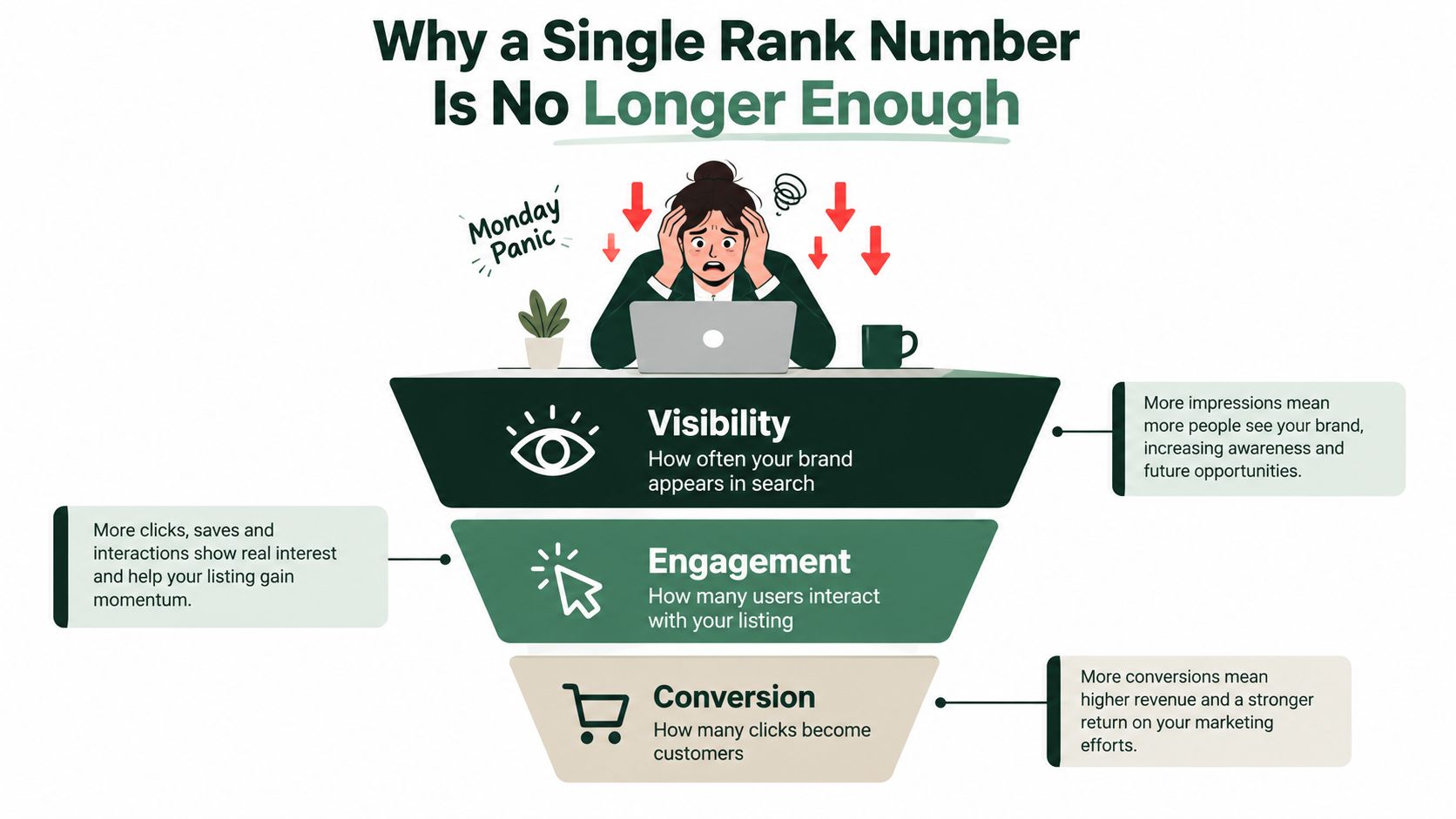
A useful dashboard separates the decisions you need to make:
- Visibility: Did your page or brand appear where a relevant customer could encounter it?
- Engagement: Did that appearance produce a click?
- Conversion: Did the visit contribute to an inquiry, signup, or purchase?
Don't treat an AI citation as interchangeable with a website visit. It's a visibility outcome worth recording, but its commercial value needs separate evaluation.
Practical rule: Treat rank as an input to a business decision, not as the business result.
The objective isn't to collect more green arrows. It's to identify which search changes deserve work and connect that work to outcomes your team can evaluate.
What Keyword Rank Tracking Actually Measures
Keyword rank tracking means repeatedly checking where a website or page appears for a selected query under specified search conditions. The keyword is the question being tested. The position is the observation, and the search conditions define what that observation means.
It isn't the same as checking whether a page is indexed. An indexed page is eligible to appear; a tracked ranking describes an observed placement for a particular query. Nor does a ranking prove that anyone clicked.
Read the record before the score
Start with the keyword, intended landing page, actual ranking URL, and position. Then inspect the device, location, language, search engine, and observation time. Keep search-volume estimates nearby for prioritization, but don't mistake estimated demand for visits your site received.
The surrounding metrics answer different questions:
- Position: Where did the observed listing appear?
- Visibility score: How does the tool summarize performance across its selected keywords and weighting method?
- Traffic: How many visits did the website receive?
- Share of voice: How much presence did your brand earn within the queries, competitors, or answer surfaces being measured?
A concept map helps separate these related measures.
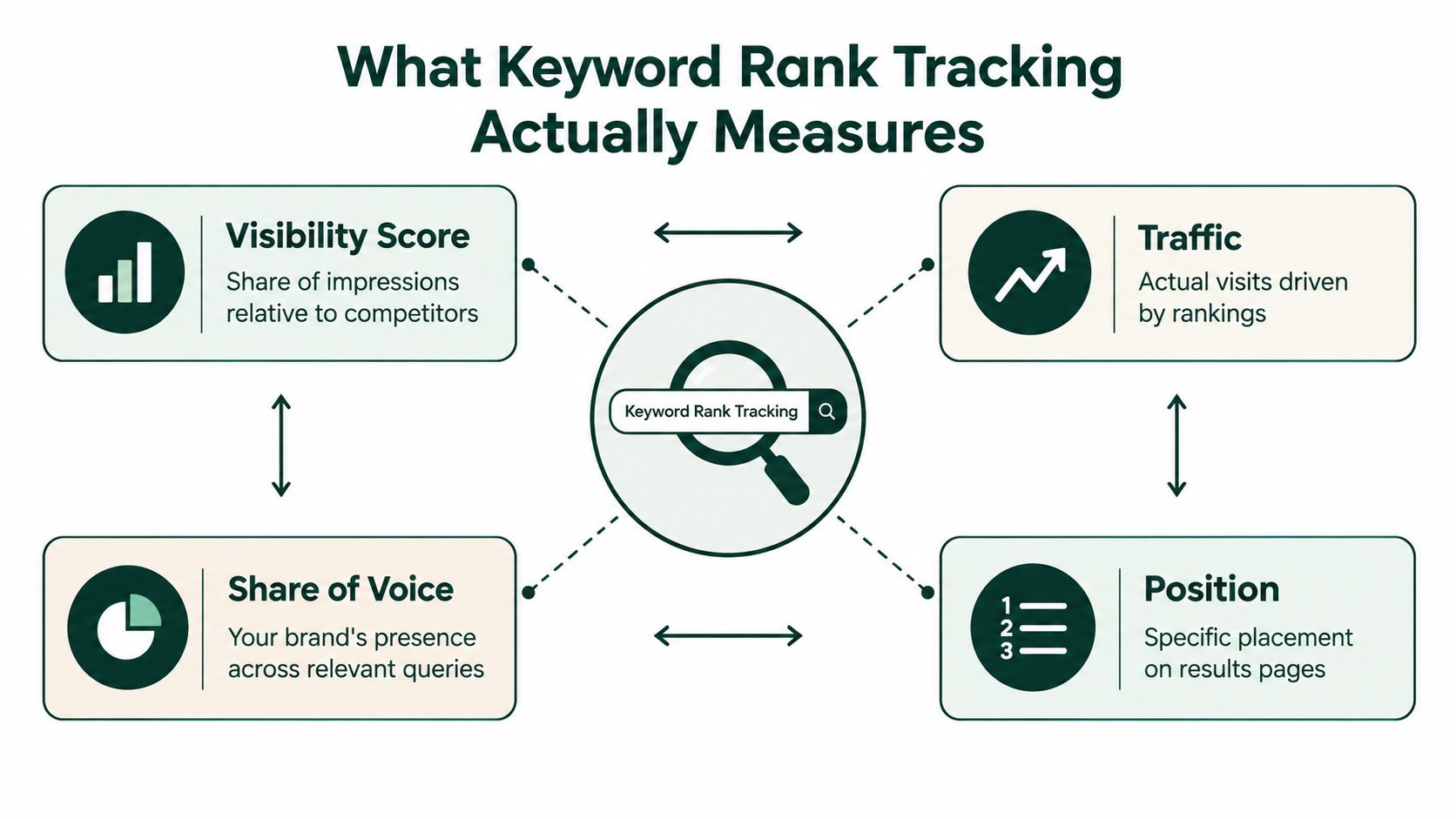
The important correction is that a tracker observes positions directly, while traffic needs outcome data and summary scores need interpretation. Before comparing visibility scores between tools, inspect what each includes.
Why placement still matters
Context doesn't make traditional rankings irrelevant. In a 2014 study, the first five results captured 67.60% of clicks, compared with 3.73% for positions six through ten, according to Advanced Web Ranking's historical organic click-through analysis. Those figures explain the importance of placement, but they aren't a current traffic forecast for your keywords.
For a hypothetical Shopify store, a reusable-bottle category might climb in traditional results without gaining visits. The owner should inspect whether demand changed, whether shopping results became more prominent, or whether the observed improvement occurred outside the store's main market.
Read the actual URL and search context first, then the position, then the outcome. Leave composite scores until you understand the underlying records. Otherwise, you're interpreting the summary before checking what was summarized.
The Data Points That Sit Behind Every Ranking
A ranking report becomes easier to interpret when you separate its data sources. Don't assume every column came from the same system or describes the same audience.
A SERP observation records what a collection system retrieved under configured conditions. Google Search Console provides query and page performance from your site's search exposure. Keyword-demand feeds supply estimates for planning, while website analytics helps you examine what visitors did after arriving.
These sources complement each other. They aren't interchangeable.
Give each source a specific job
| Data source |
Useful question |
Interpretation limit |
| SERP observations |
What appeared for this configured search? |
A captured result isn't every searcher's experience |
| Search Console |
Which queries and pages received impressions and clicks? |
Aggregated performance isn't a replay of a captured SERP |
| Demand estimates |
Which queries may deserve investigation? |
Estimated searches aren't guaranteed traffic |
| Website analytics |
What happened after the visit? |
A visit doesn't establish the precise ranking that produced it |
An SEO workspace may display several of these signals together.

Store a context bundle
The context bundle makes comparisons defensible. Keep the following fields attached to the observation rather than buried in project settings:
- Device and location: Distinguish mobile from desktop and retain the country or local market being tested.
- Language and timestamp: Make it possible to reproduce the intended search conditions and interpret when the result was collected.
- Search features: Record whether AI Overviews, local packs, shopping results, or snippets appeared.
- Observed destination: Store the ranking URL separately from the page you wanted to rank.
- AI presence: Distinguish a brand mention, a linked citation, and the particular cited URL.
Don't label a collected SERP as what a neutral searcher sees. Configured collection reduces ambiguity, but it doesn't represent every user's circumstances.
For AI reporting, define the denominator behind answer-level share of voice. Presence across a fixed set of monitored prompts is a different measure from presence across changing prompts or repeated observations.
Preserve missing values, too. If the system didn't capture an answer surface, mark it as unavailable rather than recording an absence. Otherwise, a collection failure could look like lost visibility.
Choosing a Tracking Setup That Fits Your Team
Choose a setup around the decisions your team can maintain, not the longest feature list. A learner monitoring a small website needs something different from an agency managing client reports or a marketing generalist responsible for publishing and technical fixes.
The key buying question is simple: Can you inspect how a reported change was measured? Automation saves effort, but it doesn't remove the need for transparent settings and usable evidence.
Rank tracking setups compared
| Setup |
Best for |
Accuracy |
Time cost |
AI Overview visibility |
| Spreadsheet with Search Console exports |
Learners and small sites |
Depends on consistent filters and careful recordkeeping |
More manual collection and reconciliation |
Requires a separate observation process |
| Dedicated rank-tracking tool |
Agencies and teams focused on search monitoring |
Evaluate location controls, capture methods, and retained evidence |
Less collection work, but interpretation remains |
Check citation, URL, and snapshot support |
| Integrated SEO platform |
SMB and SaaS teams connecting monitoring to execution |
Evaluate the same measurement controls, not suite size |
Can reduce handoffs between reports and tasks |
Check whether answer visibility is separately measurable |
A spreadsheet offers a useful starting point because you can see every assumption. Its cost is your time: exporting data, preserving settings, recording changes, and keeping the file understandable.
Dedicated tools such as AccuRanker or Advanced Web Ranking belong on an evaluation list when monitoring depth is the priority. For broader workflows, compare integrated options such as Semrush or Ahrefs, then verify the features available in the plan you're considering.
Test the workflow before committing
Ask a vendor to demonstrate the tasks you'll perform:
- Reproduce an observation: Can you identify its location, device, timestamp, and ranking URL?
- Inspect an AI result: Can you distinguish a mention from a citation and see the destination?
- Investigate a decline: Can you compare like-for-like segments and export the underlying records?
- Share a decision: Can a colleague understand why an alert matters without opening several systems?
Don't assume a free checker is unsuitable or a paid platform is accurate by default. Inspect sampling frequency, history, export access, and feature coverage.
A tool earns its place when your team can move from an alert to an evidence-backed decision without reconstructing the measurement.
Compare subscription cost with collection effort and review effort. A cheaper interface isn't necessarily a cheaper operating process.
Setting Up Tracking That Survives the First Quarter
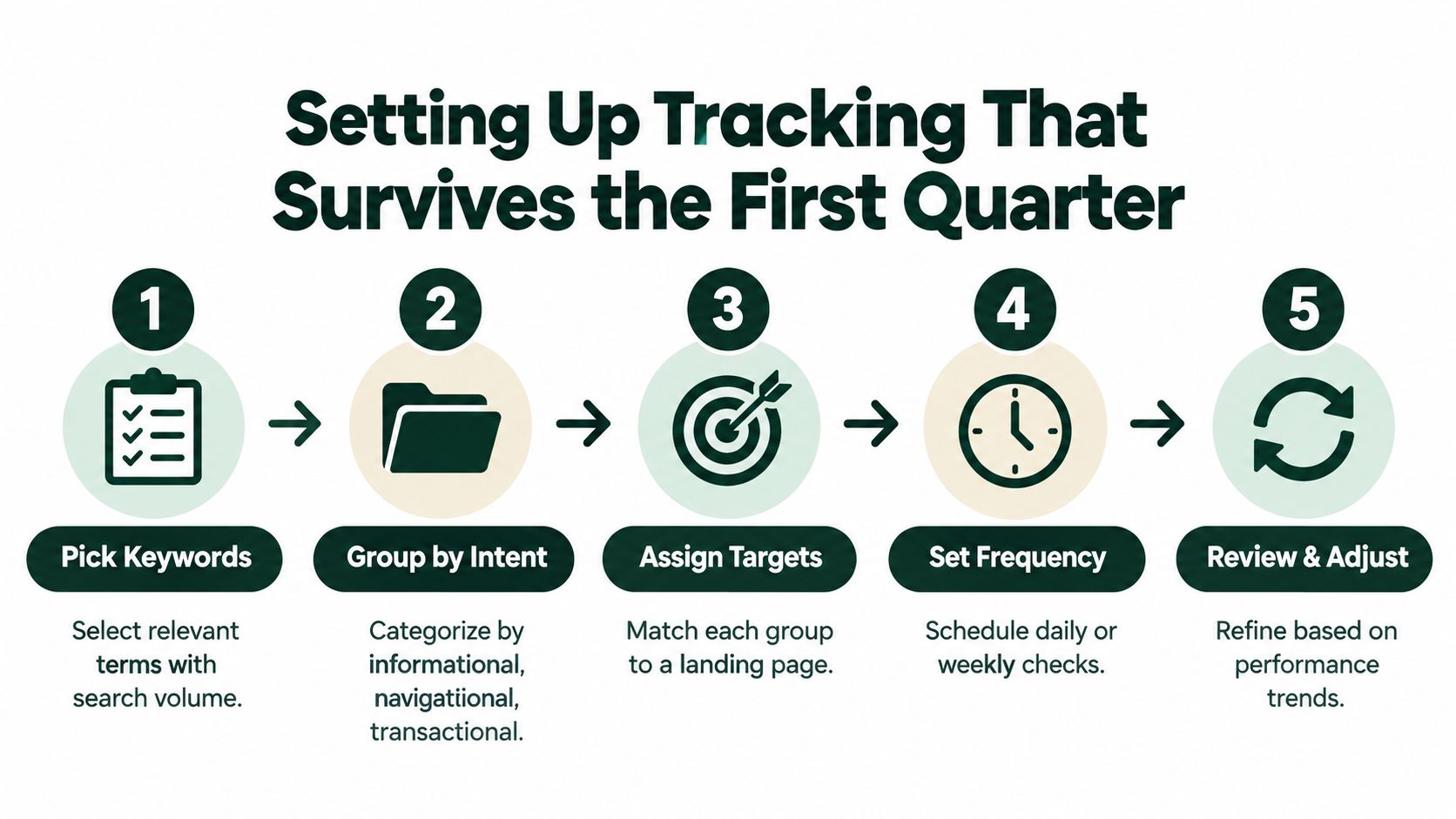
Start with keywords you can connect to a real page and a business purpose. Use Search Console queries, customer questions, product categories, and competitor research to build the working set. Don't import every suggested phrase just because your subscription allows it.
The setup sequence below keeps each choice connected to the next.
Organize around decisions
Group keywords by intent, then add the business distinctions that matter. A purchase-ready category query needs a different evaluation from a troubleshooting question. Separate branded searches from non-branded discovery so that changes in existing customer demand don't obscure acquisition work.
Assign a preferred landing page to each group. For a WooCommerce store, a category page might be the intended destination for a product-type query, while an editorial guide serves a comparison question. Keep the actual ranking page visible so that an unexpected URL becomes something to investigate.
Build the reporting rules into the project:
- Market coverage: Track the countries and devices relevant to customers rather than every available combination.
- Observation frequency: Match collection to how quickly you could act and how variable the monitored results appear.
- Annotations: Record publishing, redirects, title changes, and technical work so reviewers have a usable history.
- Ownership: Give each keyword group or landing page a person responsible for evaluating changes.
A segmented keyword set is more useful than a larger collection summarized into an unexplained average.
Make validation part of the routine
Connect Search Console before alerts become urgent. Compare the affected query and page using aligned dates, countries, and devices where available. The purpose isn't to force the systems to agree exactly, but to check whether the observed movement has a corresponding audience-level change.
This video provides an additional reference while you establish the workflow.
Use a weekly review to summarize meaningful changes, assign investigations, and record decisions to leave pages alone. Keep collection automated where practical, but don't confuse the collection schedule with the intervention schedule.
A maintainable report names the affected page, the evidence, the proposed response, and the owner. If nobody can explain what action a dashboard supports, simplify it.
When Rank Swings Are Real and When They Are Noise
Daily checking isn't the problem. Treating every daily difference as an instruction to edit your website is.
A result can vary between observations even when your team hasn't changed anything. Search context, result composition, and AI answer generation can complicate comparisons. That makes measurement consistency the first question in a volatility investigation.
Don't turn sampling differences into content tasks
An analysis of 10,000 keywords checked three times in one day in Google AI Mode found 9.2% exact-URL overlap, while 21.2% of keywords had no overlapping URLs across the observations, as discussed in this explanation of search personalization and AI result volatility.
That evidence concerns AI Mode. It doesn't establish the same volatility for every traditional organic listing, and it doesn't provide a universal threshold for deciding when a change is statistically meaningful.
It does justify caution about reacting to an isolated observation.
Before editing: Confirm that you're looking at a persistent change under comparable conditions, not merely a different sample.
Use repeated checks with fixed settings, then inspect the distribution of outcomes. Do results cluster around a new placement, fluctuate widely, or intermittently disappear? A single average can conceal those different patterns.
Require corroboration before acting
There's no universal observation count that guarantees certainty. Collect enough comparable observations to understand the pattern, and require stronger evidence before making a disruptive change.
Use this checklist:
- Comparable conditions: The search engine, market, language, device, and keyword set haven't changed.
- Repeated movement: The pattern persists rather than appearing in an isolated capture.
- Identifiable cause: Inspect the destination URL, competing pages, search features, and relevant site changes.
- Outcome evidence: Check Search Console impressions and clicks, along with page availability and indexed-page changes where relevant.
- Proportionate response: Match the intervention to the confidence and business importance of the finding.
A confirmed redirect mistake or unavailable landing page warrants prompt attention. An erratic informational query may warrant monitoring instead.
If rankings decline but clicks remain steady, don't manufacture an emergency. If clicks decline while rankings look stable, investigate demand and result-page changes rather than assuming the tracker proves everything is fine. Disagreement is a diagnostic clue, not a reason to ignore either dataset.
Automating Tracking and Closing the Loop on Results
Automation is useful when it reduces repetitive collection and prepares a better decision. It's risky when it turns an uncertain observation directly into a published change.
Build alerts around investigations and approval, not automatic rewrites. A persistent decline can create a review task containing the affected keyword group, landing page, search context, relevant snapshots, and outcome data. The reviewer should be able to see why the task exists.
Match the response to the evidence
Different findings call for different work:
- Wrong landing page: Review intent alignment and internal links before changing the intended page.
- Competitor improvement: Compare usefulness, relevance, and content coverage rather than copying the competing page.
- Technical problem: Queue the specific indexation, redirect, or accessibility issue for correction.
- AI citation change: Inspect the cited URL and answer context before recommending a content or schema update.
An AI citation isn't proof that structured data caused visibility. Nor is losing a citation, by itself, proof that adding schema will restore it. Keep the proposed action separate from the observed fact.
Platforms can bring these steps into the same workspace. AutoSEO is one option alongside dedicated trackers and broader SEO suites: it connects keyword research, AI-drafted briefs and articles, internal links, schema, publishing, technical tasks, rank tracking, and AI-visibility monitoring through an approval-first workflow.
Close tasks with a measurement plan
Before approving an update, write down the problem, the proposed explanation, and the signal you expect to change. If the issue is an unsuitable destination, success means the intended page becomes the relevant result. If the issue is weak commercial performance, improved rank alone won't close the task.
After publishing, annotate the change and evaluate the affected segment against its earlier baseline. Avoid declaring causation because an improvement followed an edit; other changes may have occurred.
A useful digest separates observations, decisions, actions, and outcomes. It also includes investigations closed without an edit, because avoiding unsupported work preserves time for real problems.
The operating loop is straightforward: measure, decide, act, and remeasure. Rank tracking starts that process. It shouldn't be where the work ends.
AutoSEO brings keyword tracking, AI-visibility monitoring, content production, and technical SEO tasks into a connected, approval-first workflow. Visit AutoSEO to explore how you can turn a ranking change into a reviewed action and measure what happens afterward.