Zero-click searches for news queries increased from 56% to 69% between May 2024 and May 2025, according to Similarweb figures reported by ITLibra's AI-search timeline. That's a news-specific finding, not a forecast for every website, but it highlights the trade-off: people can consume an answer without visiting its sources.
Learning how to appear in AI search results therefore starts with a business decision, not a formatting trick. You need to decide which answers should cite you, which pages deserve a visit, and how much content you're willing to make available for reuse. Then you can improve technical eligibility, write passages that support accurate answers, and measure citations separately from clicks.
Table of Contents
How to Appear in AI Search Results
Appearing means more than getting your brand mentioned. An assistant might name your business without linking to it, cite your page for a narrow claim, or recommend a competitor while using your documentation as evidence. Those outcomes have different value.
The channel is substantial: Google's AI-search announcement described the May 2024 US rollout of AI Overviews and an expected reach of more than 1 billion people by the end of 2024. That announcement established the intended scale, not a promise of traffic for participating websites.
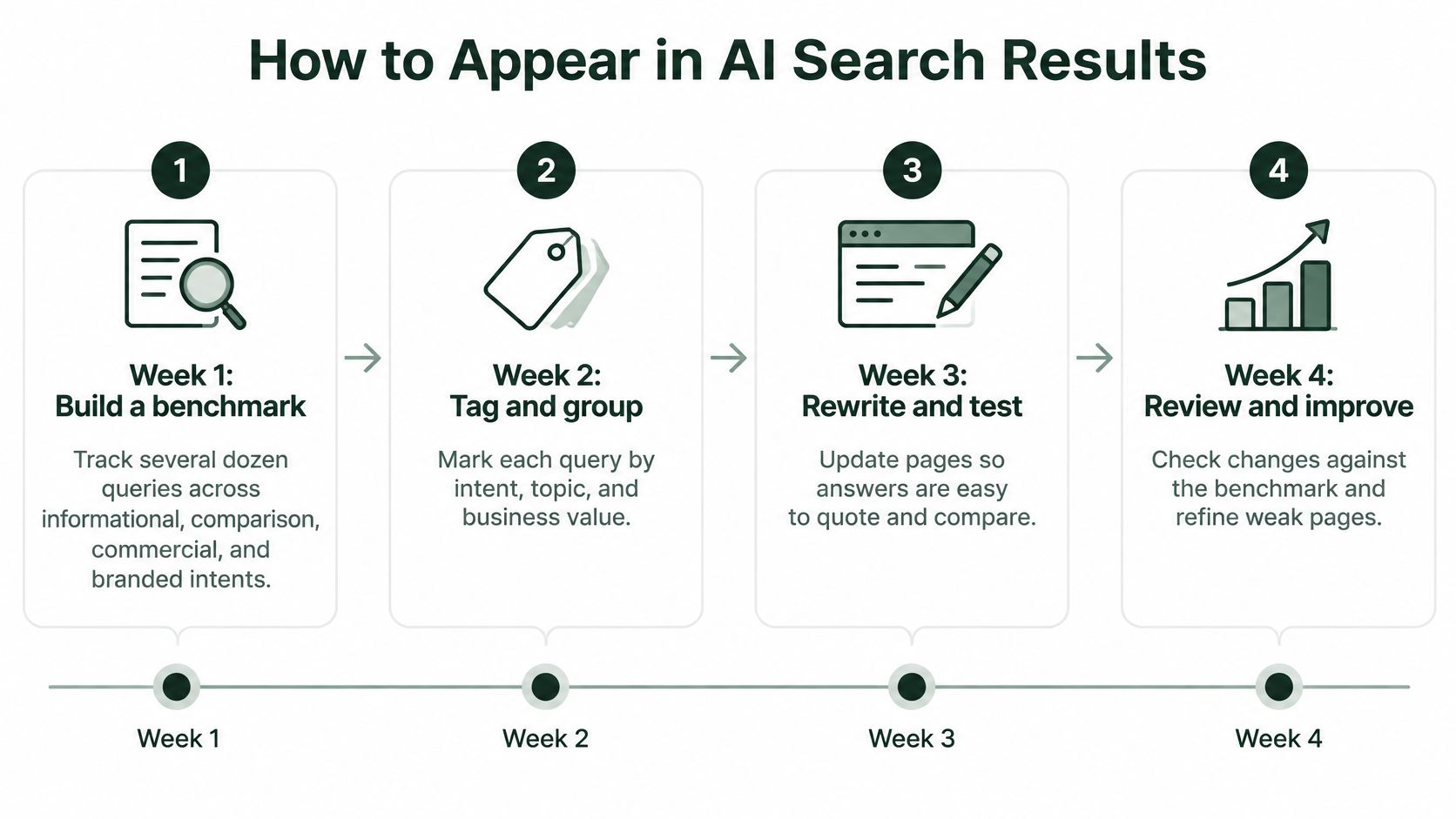
A month-long implementation sequence
Use a month as an implementation window, not a deadline for guaranteed results. Start with a manageable group of commercially relevant pages rather than rewriting your entire site.
Build a fixed query benchmark. Collect several dozen informational, comparison, commercial, and branded questions from Search Console, sales conversations, and customer support. Tag each with its intended outcome, such as a citation, branded demand, or a visit needed to complete the task, so visibility has a business purpose.
Check target-page eligibility. Confirm that each target URL returns a successful response, is indexable, uses the intended canonical, and isn't blocked for Googlebot. This prevents you from rewriting content that search systems can't reliably access.
Put the answer near the top. Add a direct answer in visible HTML under a descriptive heading, using consistent company and product names. A passage should remain understandable when someone reads it without the surrounding page.
Align and validate structured data. Add appropriate markup only where it describes information readers can see. Validation helps you catch implementation errors before incorrect entity or product details spread across templates.
Make crawler preferences deliberate. If you publish an llms.txt file, curate your preferred canonical pages, and review robots.txt rules for the AI crawlers you accept. Treat this as access management and an optional discovery aid, not a way to purchase or guarantee placement.
Assign a snippet policy to each URL. Choose whether to allow normal snippets, limit their length, exclude a passage, suppress snippets, or remove the page from the index. The reason is economic: a public help page and a proprietary report shouldn't automatically receive identical permissions.
Repeat the benchmark and inspect the evidence. Test the same questions across ChatGPT, Claude, Gemini, Perplexity, and Google AI Overviews on different dates. Record citations and check whether the cited page supports the answer, because a visible but inaccurate citation isn't a clean win.
Use the weekly schedule to keep implementation and measurement separate.
Keep the first test interpretable
Capture your baseline before publishing changes. Save the query wording, selected market, engine, and answer so you can compare like with like rather than relying on memory.
Choose a page group with a shared template, such as product comparisons or integration documentation. Leave a comparable group unchanged where practical, and record every edit to the tested pages. If you simultaneously change pricing, navigation, copy, and crawl permissions, you won't know which change mattered.
Practical rule: Improve the smallest group of pages that can answer a meaningful business question. Expand after you can distinguish accurate citations from useful visits.
Frame Pages So Answers Can Quote Them
Say you're writing a comparison page for a hypothetical product called Planwise. A buyer asks which plan fits a 12-person team. Don't open with the company's mission or a long explanation of project management. Start with the choice, the condition that makes it appropriate, and the main exception.
The consultation example illustrates the kind of specific decision your opening should address.
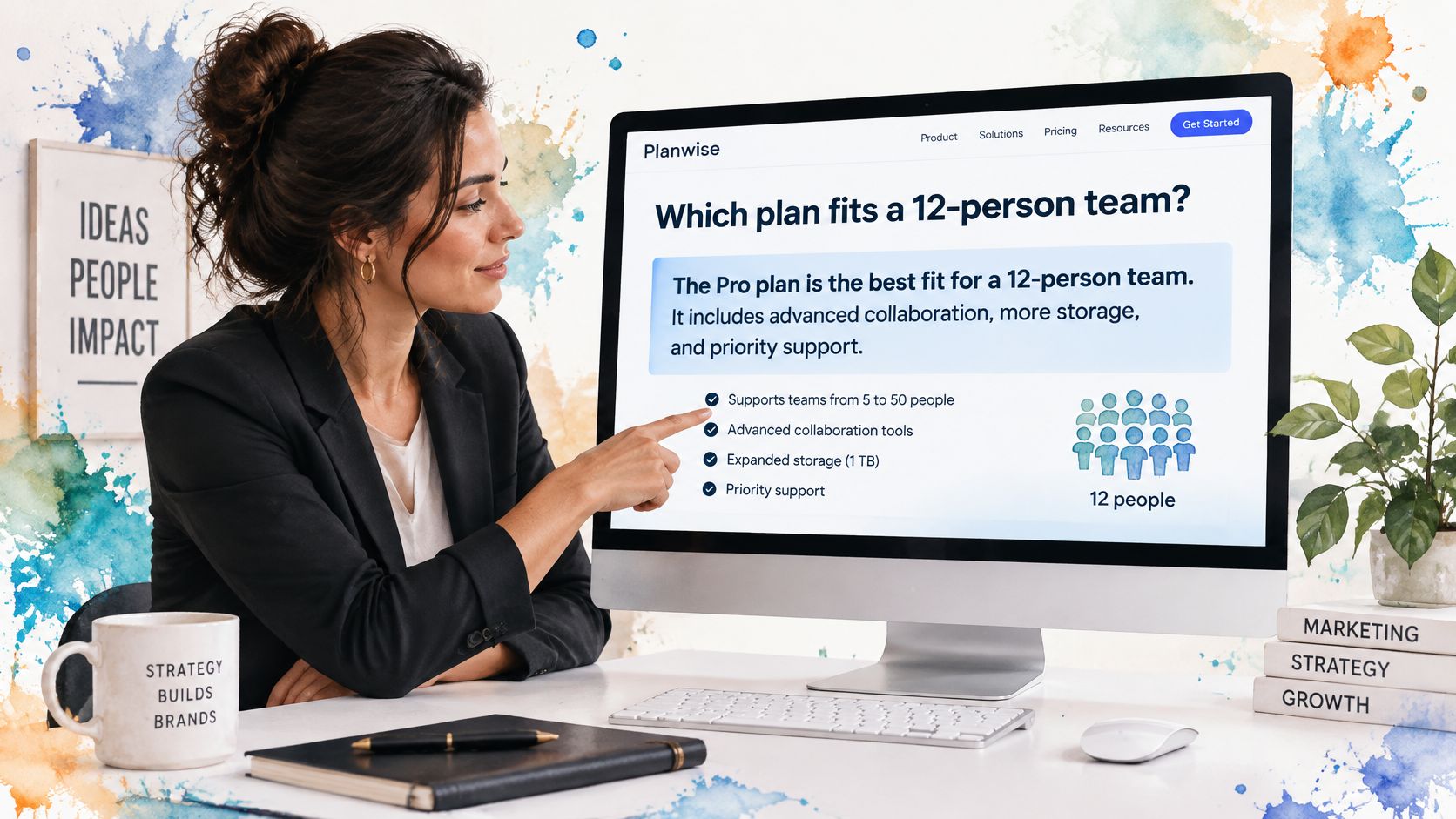
A hypothetical opening could say: “Planwise Pro is the better fit when everyone needs shared project access and centralized administration. Choose the simpler plan if only project leads need paid access, and check guest permissions before deciding.” That's useful without inventing a price or implying that team size alone determines the answer.
Build a passage that can stand alone
Follow the opening with descriptive sections such as Price and billing basis, Member and guest limits, and Who should choose each plan. Under each heading, state the relevant fact before discussing its implications.
Keep the answer in HTML text, not solely in a screenshot, downloadable brochure, or script-dependent widget. Images can illustrate a comparison, but readers and crawlers should be able to find the underlying facts in the page itself.
Use stable names for each entity. The company, product, plan, and author aren't interchangeable, so don't shorten them in ways that blur their roles. Make the title, opening, byline, and markup agree about who created the page and what it describes.
For important numbers, attach the unit, effective date, and method. A price needs its currency and billing basis; a performance comparison needs its test conditions. Link the original pricing page, documentation, or measurement report rather than a roundup that may have copied an older version.
Test structure without promising a lift
The GEO benchmarking paper published by ACM reported visibility improvements of up to 40% from optimization strategies, with effectiveness varying by domain. Treat that as an experimental finding, not an expected return from adding headings.
Change a template, rerun the fixed questions, and inspect the extracted claims. For implementation ideas, these structured data examples can help you map visible content to suitable markup without adding unsupported claims.
Use the video as a companion to a page-level review.
Remove the common sources of ambiguity:
- Keyword stuffing: Replace repetitive phrases with a complete answer.
- Unsupported statistics: Publish the evidence or remove the number.
- Vague superiority claims: Explain the criterion behind “better.”
- Contradictory schema: Correct markup that disagrees with the visible paragraph.
- Near-duplicate pages: Consolidate overlapping answers into a clear canonical resource.
A writer can reuse this evidence-line pattern without filling the page with boilerplate:
One claim, one number, one source, one date: State the finding, include its unit, identify the primary document, and give its effective or measurement date. Add the method whenever the result depends on how it was measured.
Set Crawl Access Schema and Snippet Rules
Access, description, and reuse permission are separate decisions. A bot may be allowed to fetch a page without that page becoming a cited source. Likewise, publishing schema doesn't override a blocked crawl or an indexing restriction.
Google's guidance on succeeding in AI search says the foundations remain ordinary Search eligibility: Googlebot must have access, the page must return a successful response, and its content must be indexable. It also explains that snippet and indexing controls can restrict how content appears in AI features.
Controls that decide if a page can be cited
| Control |
What it changes |
Use it when |
| Indexable URL with a 200 response |
Whether Google can consider the page for selection |
The page should be eligible for Search and AI features |
| Googlebot allowed in robots.txt |
Whether Googlebot may crawl the page |
You want the URL fetched and kept fresh |
| AI crawler rules in robots.txt |
Which compliant assistant bots may fetch the site |
You want to allow some AI crawlers and restrict others |
| Schema matching visible text |
How clearly the page's type and entities are described |
The markup reflects on-page content and validates |
| llms.txt |
Which preferred URLs you advertise to tools that support it |
You want to publish a curated list of canonical, current pages |
| max-snippet |
The maximum permitted text-snippet length |
A citation is useful but a long extract isn't |
| data-nosnippet |
Whether a marked passage may appear in a snippet |
A particular block shouldn't be exposed in snippets |
| nosnippet |
Whether a text snippet may be generated |
The URL may remain indexed but shouldn't supply a text snippet |
| noindex |
Whether the URL may remain in Google's index |
The page shouldn't appear in Search or its AI features |
These controls aren't universal instructions for every assistant. Google's snippet directives govern Google's features, while other services have their own crawling and usage policies.
Robots.txt controls crawling, not secure access. Don't use it to protect customer records or confidential documents; those belong behind authentication. It also isn't a reliable substitute for noindex, because a blocked crawler may be unable to read the page's indexing directive.
Choose allow, limit, or block
Allow is sensible for a public integration guide whose purpose is discovery and successful setup. Keep the complete instructions available, with links to the relevant product workflow.
Limit may suit a report with a public summary and a differentiated evidence section. You can exclude a marked passage from Google snippets, but that isn't a licensing agreement or a guarantee against reuse elsewhere.
Block from Search suits a public utility page that shouldn't be discoverable, provided noindex is accessible to the crawler. If the content is private, require authentication instead.
When editing bot rules, verify current user-agent documentation for tokens such as GPTBot, ClaudeBot, and PerplexityBot. Don't assume a training crawler and a search-retrieval crawler have the same role. Google-Extended doesn't control inclusion in AI Overviews; those follow Search eligibility.
An llms.txt file is an optional curated guide, not a ranking switch or replacement for indexing. Use this robots.txt file example to review crawler-rule structure before making changes.
Assign a named owner to each policy. Record whether the URL is allowed, limited, or excluded, and review that choice whenever the page's commercial purpose changes.
Measure Citations Rather Than Rank Alone
Define your scores before collecting results. Answer activation records whether the engine produced an AI answer, citation rate records whether an eligible answer cited your page, and claim fidelity records whether that citation supported what the engine said.
The core formula is:
Citation rate = responses citing your site ÷ eligible responses. Define an eligible response as an AI answer produced within your chosen benchmark and testing conditions.
Keep retrieval separate. Unless the engine exposes its sources or your logs provide suitable evidence, you may not know whether it retrieved an uncited page. Mark that observation as unknown rather than treating an unsupported brand mention as proof of retrieval.
What to record for each AI query
| Metric |
How to calculate it |
Do not count |
| Answer activation |
Queries producing an AI answer divided by queries run |
A prompt with no summary as a failed citation |
| Retrieval |
Eligible answers with observable evidence of using your hostname, cited or not |
A brand mention with no page evidence as a URL win |
| Citation rate |
Cited responses divided by eligible responses |
Every prompt, including prompts without an AI answer, in the denominator |
| Claim fidelity |
Cited answers whose relevant claim matches the page |
A citation that misstates the price, date, or limit |
| Rank overlap |
Cited URLs that also appear on the conventional first page |
Conventional rank as proof of citation |
Store the raw answer and every cited URL, not just a dashboard total. Normalize tracking parameters and URL variants to the canonical page, while retaining the original URL for inspection. Keep both page-level and hostname-level records so a citation to an unrelated section doesn't look like a win for your target page.
A weekly sheet can use these columns: date, engine, query, market, language, answer shown, cited URL, claim faithful, and notes. Add an unknown option when the evidence doesn't support a yes-or-no decision.
Avoid the two misleading shortcuts
The first mistake is substituting rank for source selection. A large-scale AI Overviews study found that nearly 30% of cited domains didn't appear among the displayed first-page results. A conventional rank tracker can therefore miss citations and suggest visibility that the generated answer never delivered.
The second mistake is celebrating a citation without reading its associated claim. A page might be cited for an obsolete price, a competitor's feature, or a recommendation that reverses the page's conclusion. Save the answer sentence beside the supporting passage so someone can audit the match.
Repeat identical queries on different dates and keep markets, languages, intents, and engines separate. Mixing them can conceal an improvement in comparison queries behind a decline in unrelated informational answers.
Report a range rather than a single definitive share-of-voice score. With enough observations, bootstrap confidence intervals can help show sampling uncertainty; with a small manual log, disclose the sample and avoid declaring small differences meaningful. When choosing AI visibility tracking tools, prioritize access to prompts, cited URLs, and answer evidence over an unexplained composite score.
Decide Which Queries Deserve a Citation
A citation isn't automatically a traffic win. The practical question is whether being included helps the buyer remember you, trust you, evaluate you, or complete a valuable action on your website.
In Pew Research Center's analysis of March 2025 browsing activity, users clicked a traditional or cited link on 8% of visits with an AI summary, compared with 15% without one. The study's other planning signals are grouped below; they describe the observed participants and searches, not guaranteed outcomes for your audience.
When AI summaries appear and what users do next
| Signal |
Figure |
What to plan for |
| All Google searches in the study |
Approximately 18% produced an AI summary |
Summaries affected a meaningful minority of observed searches |
| People who saw at least one summary |
58% |
Many study participants encountered this format |
| One- or two-word searches |
8% generated a summary |
Short queries were less likely to trigger summaries |
| Searches with 10 or more words |
53% generated a summary |
Longer questions deserve explicit testing |
| Summaries citing at least three sources |
88% |
Expect to compete for inclusion among several sources |
| Summaries citing a single source |
1% |
Don't build a strategy around exclusive citation |
| Visits with a summary |
8% clicked a traditional or cited link |
Compare with 15% without a summary |
| Clicks on a link inside the summary |
1% of visits with a summary |
Don't assume an in-answer citation delivers a visit |
| Summary result pages |
26% ended the browsing session |
Compare with 16% on conventional results |
The visualization emphasizes the difference between answer exposure and a click.
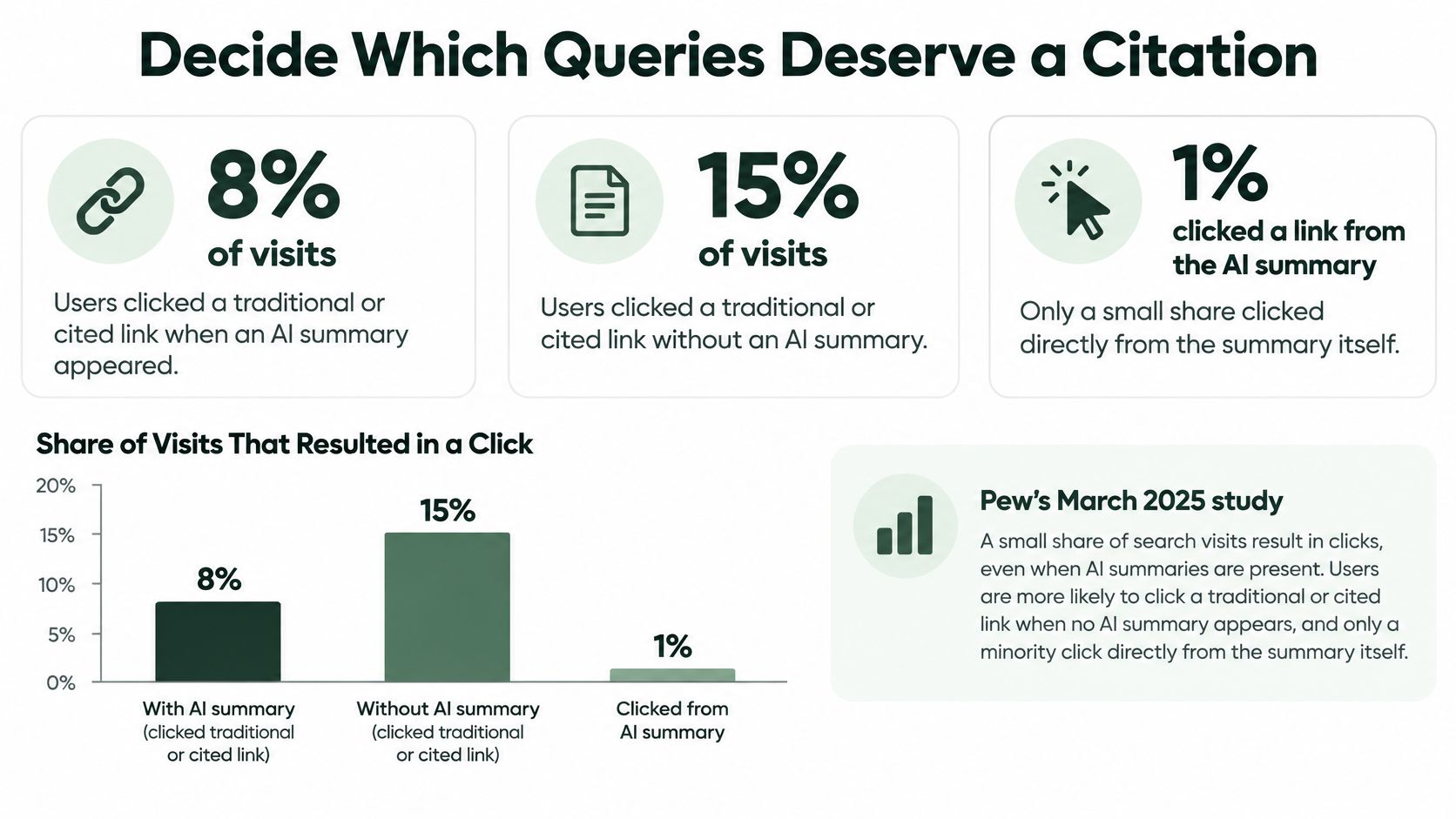
Mashable's coverage of Pew's findings highlights why citation visibility and referral traffic need separate evaluation. The business implication isn't to abandon informational content. It's to stop assigning every query the same success metric.
Sort queries by the outcome they can produce
- Citation: Pursue questions where your original evidence or explanation deserves attribution. Judge success through accurate source inclusion, not an assumed downstream visit.
- Branded demand: Keep company, product, category, and positioning facts consistent. Watch branded search and direct enquiries as directional signals, without claiming every change came from AI exposure.
- Assisted conversion: Answer evaluation questions that help buyers shortlist an option. Pair citation monitoring with sales feedback and conversion-path evidence where available.
- Direct click: Prioritize tasks that require your website, such as configuring a product, checking current inventory, using a calculator, or completing a transaction.
A definition query can often be satisfied entirely in the answer. If you publish that page, accept its possible role as brand exposure or add something useful beyond the definition, such as a diagnostic worksheet. Don't hide the basic answer merely to force a click.
A comparison query has different economics. A summary may explain the broad alternatives, while your interactive comparison applies the buyer's permissions, usage, and procurement requirements. Build that next step because it improves the decision, not because interactivity guarantees referrals.
At AutoSEO, we include an AI-visibility tracker across 5 engines and an AEO audit, connecting citation checks with signals such as schema, llms.txt, crawler access, and quotable content. Use those observations to choose work, rather than treating a larger citation total as proof of revenue.
Start with a manageable subset of your benchmark, apply the implementation sequence, and retain changes that produce faithful citations or useful customer actions. Review the outcome tags monthly, and reduce effort on queries that generate exposure without serving an agreed business objective.
AutoSEO connects AI citation monitoring with an AEO audit and fixes for schema, crawler access, llms.txt, and quotable content. Visit AutoSEO to audit your priority pages, identify visibility gaps, and turn the findings into a measurable improvement workflow.