A rank tracker review that only compares keyword limits, dashboard design, and update frequency misses the risk that matters most: the number on the screen may not represent the result your customer sees. Rankings vary by location, device, personalization, SERP layout, and refresh timing. A tracker can look polished while giving an agency a weak basis for deciding what to fix next.
The useful question isn't “Which tool tracks the most keywords?” It's “Which system gives us a dependable view of visibility, explains why it changed, and moves the team toward an informed action?” This review evaluates rank tracking through that lens, with particular attention to accuracy, cadence, localization, history, integrations, and execution.
Table of Contents
Rethinking What Rank Tracking Delivers
Rank tracking started as a manual SEO task. Practitioners checked Google positions, recorded them, and compared results over time. Dedicated tools emerged in the mid-2000s, then expanded into competitor analysis, SERP feature monitoring, and multi-location tracking. Historical context matters more than a single daily position, as the rank tracking glossary from Amicited explains.
The problem is treating a position report as the finished product. A keyword moves from position 8 to position 4, and the dashboard labels it a win. But the report may not show whether the result appeared in the right city, on the right device, above or below major SERP features, or on the landing page that converts. A ranking change is an observation, not a diagnosis. The useful question is what the team should do next.
Practical rule: Treat ranking data as a decision signal, not as a business outcome.
A serious rank tracker review should assess five dimensions:
| Evaluation area |
What to inspect |
Why it matters |
| Accuracy |
Agreement with same-location manual checks |
A consistent variance can distort recommendations |
| Cadence |
Daily updates, refresh options, and change alerts |
Weekly data can hide short-lived movements |
| Localization |
Country, city, ZIP code, and device controls |
Local results rarely behave like national results |
| History |
Archived snapshots with stable baselines |
Teams need to compare movement against a known SERP |
| Execution |
Connections to audits, content, analytics, and reporting |
Data has value only when someone can act on it |
Those dimensions separate a monitoring utility from an operating system for SEO. Accuracy establishes whether the measurement is credible. Cadence determines how quickly a team can identify a meaningful change. Localization keeps national averages from masking local performance, while history shows whether a movement is a trend, a temporary SERP shift, or noise. Execution connects the observation to an audit, content update, technical fix, or client report.
History remains an overlooked differentiator. One major platform reports monthly historical data back to January 2012 for selected databases, daily change data for 28 days, and daily or weekly tracking for up to 140 weeks. Another service reports ranking data collected since 2006 and offers 18 years of history. These records let teams compare changes against a known SERP rather than interpret isolated snapshots. The operational requirement is simple: preserve enough context to distinguish a real trend from a noisy day.
The market has grown beyond a narrow utility. Independent estimates place keyword rank tracking software at US$1.0429 billion in 2024, projected to reach US$2.5 billion by 2035, while a separate estimate values it at US$1.366 billion in 2025 and forecasts US$2.484 billion by 2032. These are separate estimates, not one agreed market figure, but both indicate a substantial software category. The market estimate from Dataintelo also describes cloud deployment and software-led use across agencies, e-commerce teams, and SEO operators.
That maturity raises the buying standard. Keyword volume and dashboard polish matter less than dependable measurement and a workflow that turns a visibility gap into a prioritized task. A tracker that produces isolated reports creates more review work. A useful platform connects the signal to execution.
How to Evaluate Rank Tracker Accuracy and Cadence
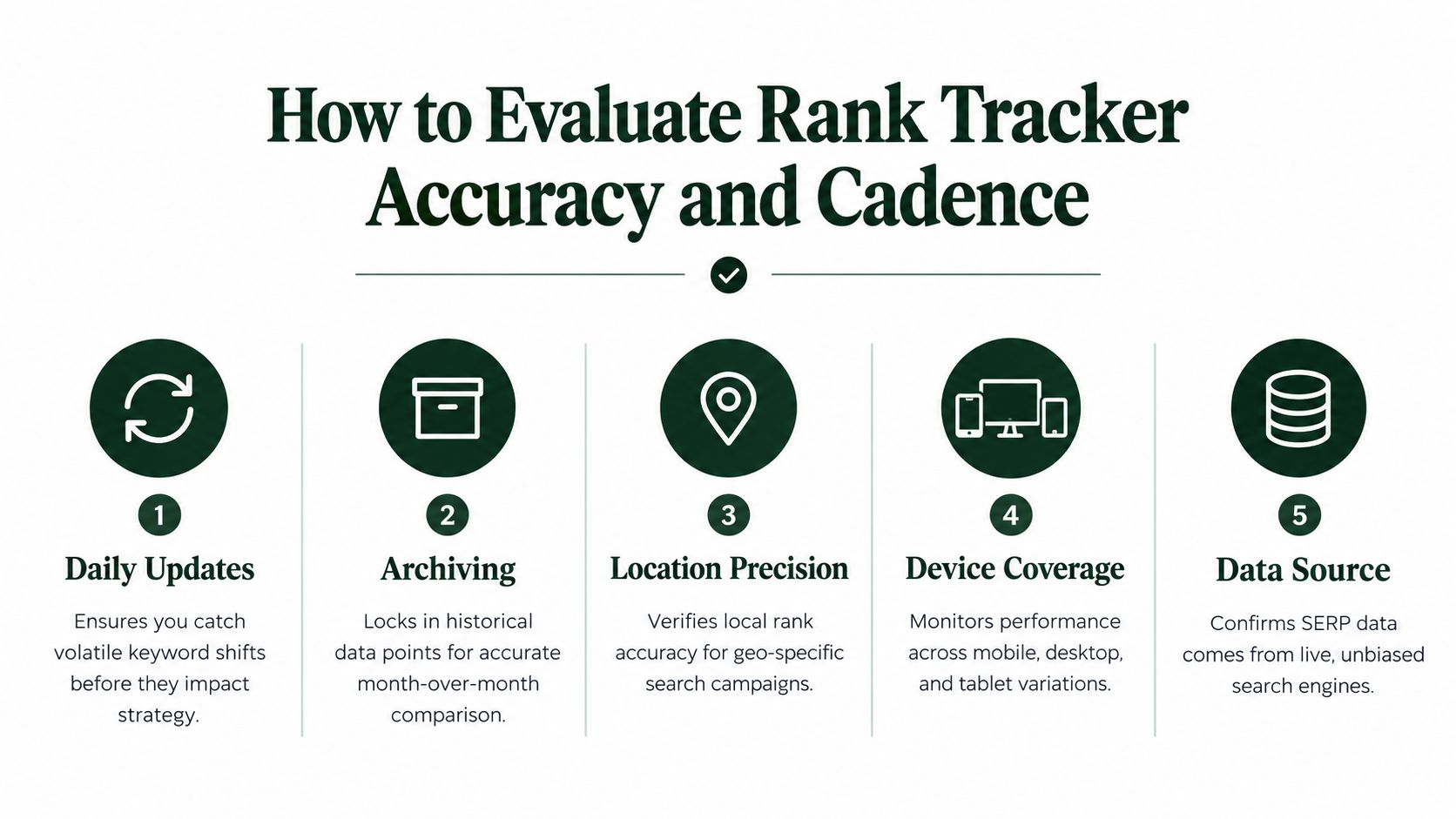
Accuracy is not a label a vendor can claim. Test it by comparing the tracker with same-location manual checks, using the same device and search context. Treat consistent gaps above 2 to 3 positions as a configuration problem, not an acceptable measurement difference. A national baseline cannot validate a city-level SEO decision, even if the software reports the result with precision.
Daily refresh is the baseline for serious monitoring. Weekly updates may suit a stable informational project, but they can miss a temporary decline, a SERP feature change, or recovery after a technical fix. Independent review coverage of ranking software highlights daily refresh and archived snapshots organized by keyword, location, and device.
The baseline must stay consistent
A credible tracker preserves the conditions behind each measurement. At minimum, record:
- Keyword and URL: Which query was checked, and which page appeared?
- Location: Was the result measured nationally, in a city, or at a more precise local level?
- Device: Did the result come from desktop or mobile?
- SERP context: Did a local pack, featured result, video result, or another feature change what users saw?
- Timestamp and snapshot: Can the team inspect the result that produced the reported position?
Archiving gives each position useful context. A move from position 3 to position 6 could reflect a competitor improvement, a feature insertion, URL switching, or a measurement difference. The number alone cannot show which explanation is plausible.
A useful review benchmark is variance against same-location manual checks. Consistent differences above about 2 to 3 positions indicate that the crawl setup or measurement configuration needs investigation. For a hands-on comparison process, see our guide to the rank checker tool. Tooltester's SERP tracking review also points to daily checks, on-demand refresh, separate mobile and desktop baselines, and localized snapshots as signs of stronger tracking.
Cadence changes the quality of decisions
Refresh frequency should match business risk. A national publisher may accept less frequent checks for stable pages. A multi-location service business, online retailer, or agency reporting on a volatile commercial category needs faster feedback. If a page drops and recovers between weekly checks, the report can falsely imply stability.
Alerts need significance filters. Email for every minor movement creates fatigue, while ignoring a cluster of drops across one template delays diagnosis. A practical setup combines daily collection with filters for important keyword groups, landing pages, locations, and SERP features. The operator receives a manageable queue instead of another dashboard to refresh.
Rank Tracker Categories and Core Capabilities
Rank tracking tools fall into three practical groups. The first is the desktop or lightweight tracker, useful for a focused keyword set and straightforward reporting. The second is the cloud-first SaaS platform, built for recurring monitoring, collaboration, competitor comparisons, and location management. The third is the integrated SEO system, where rankings sit beside keyword research, technical audits, content production, publishing, and reporting.
The categories overlap, but their operational consequences differ. A small site owner may prefer a simple interface that answers, “Did this page move?” An agency needs permissions, project separation, scheduled reports, historical evidence, and repeatable onboarding. A content team may care less about having the largest keyword database than about connecting ranking changes to briefs, internal links, content updates, and approvals.
| Category |
Best fit |
Strength |
Limitation |
| Lightweight desktop tracker |
Focused projects and individual operators |
Direct control and simple position checks |
Less convenient for distributed teams and automated reporting |
| Cloud-first SaaS |
Agencies, brands, and multi-project teams |
Collaboration, localization, competitors, and recurring reports |
Data may remain separate from execution workflows |
| Integrated SEO platform |
Lean teams managing research through publishing |
Turns visibility signals into tasks and content actions |
May offer less depth than a specialist tool in a narrow reporting area |
A dedicated checker can be perfectly appropriate when the question is specific. For example, a consultant auditing a short list of service terms may value fast manual verification, notes, and a clean export more than a broad content suite. The trade-off appears when the project expands. Multiple countries, devices, competitors, and reporting stakeholders quickly make a local file-based workflow difficult to maintain.
Cloud tools are stronger when several people need the same source of truth. They can preserve snapshots, assign projects, compare competitors, and generate client-facing reports without depending on one employee's computer. Their weakness is fragmentation. The rank data may be reliable, but the person receiving a ranking alert still has to open another tool for the audit, another for content planning, and another for publishing.
Integrated systems reduce handoffs
An integrated system earns its place when the team needs to close that gap. A ranking change can feed a technical task, a content refresh, an internal-linking recommendation, or an approval queue. That doesn't make the data automatically accurate. It does make the data more useful because the next step is visible beside the evidence.
The category decision should follow the workflow, not the feature count. More keywords won't compensate for weak local baselines, and a beautiful report won't repair a disconnected execution process.
The Accuracy Problem Most Reviews Miss
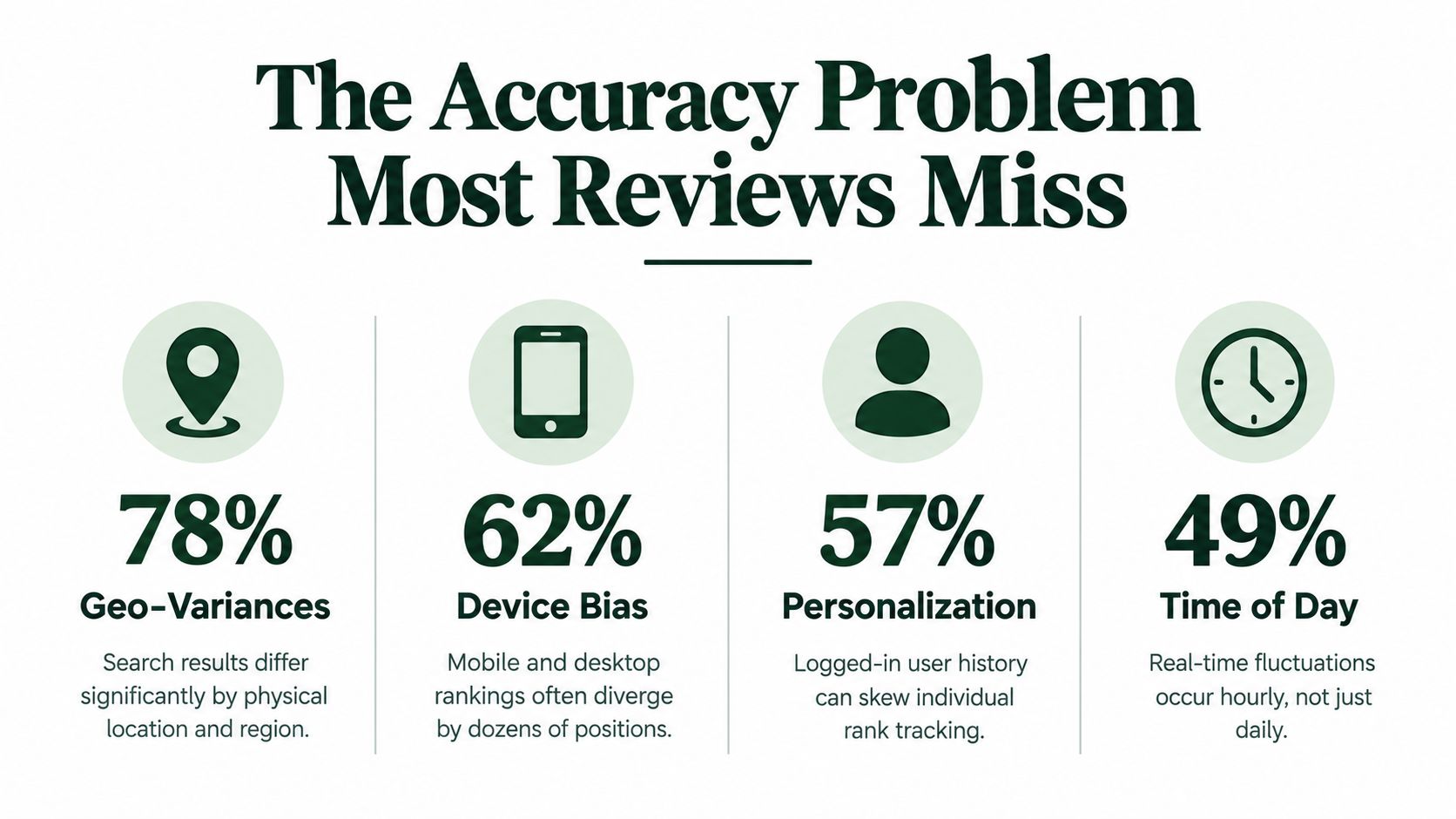
“Accuracy” isn't one universal score. A tracker can match a national desktop result while missing the mobile result in a specific city. It can report the correct organic URL while failing to represent the local pack, personalization, or the SERP feature that pushes the result below the visible area.
Independent testing found exact-match accuracy ranging from 68% to 94% across rank trackers. A broader local study reported a mean variance of 0.82 across a 97-keyword by 20-city grid, while the top result changed on 31.7% of consecutive days. These findings are summarized in Siteup's analysis of rank-data accuracy. They don't identify one universal winner. They show why buyers need to test the conditions that matter to their own campaigns.
Four variables change the result
Geolocation is decisive for local SEO. A national result can hide weak performance in a service area, while a city-centre check can overstate visibility near the business. City and ZIP-level tracking is more useful when the team is trying to understand coverage across a real operating area.
Device type also matters. Mobile layouts can expose different features, page formats, and competitive results than desktop layouts. A tracker that combines both into one average gives the team less information precisely where the user experience differs.
Personalization creates another layer of uncertainty. Search history, account state, and previous interactions can change what a person sees. The tracker should reduce that noise through a consistent collection method, but no tool can turn a personalized SERP into a perfectly universal result.
Refresh cadence determines whether volatility becomes visible. If the platform checks only weekly, short-lived movements disappear from the historical record. That matters for local packs and feature-heavy queries, where the visible result can change quickly.
The reviewer's test: Ask whether the vendor can reproduce the location, device, and SERP context behind a reported position. If it can't, the headline accuracy claim isn't enough.
Local packs remain especially difficult to measure because proximity and map results don't behave like ordinary blue links. AI-generated search surfaces create a further challenge. A traditional keyword position may remain stable while the brand's presence in an AI answer changes, so classic rank data should be complemented with Search Console, traffic, and AI-citation signals where those signals are available.
Rank Tracking in Real Operational Workflows
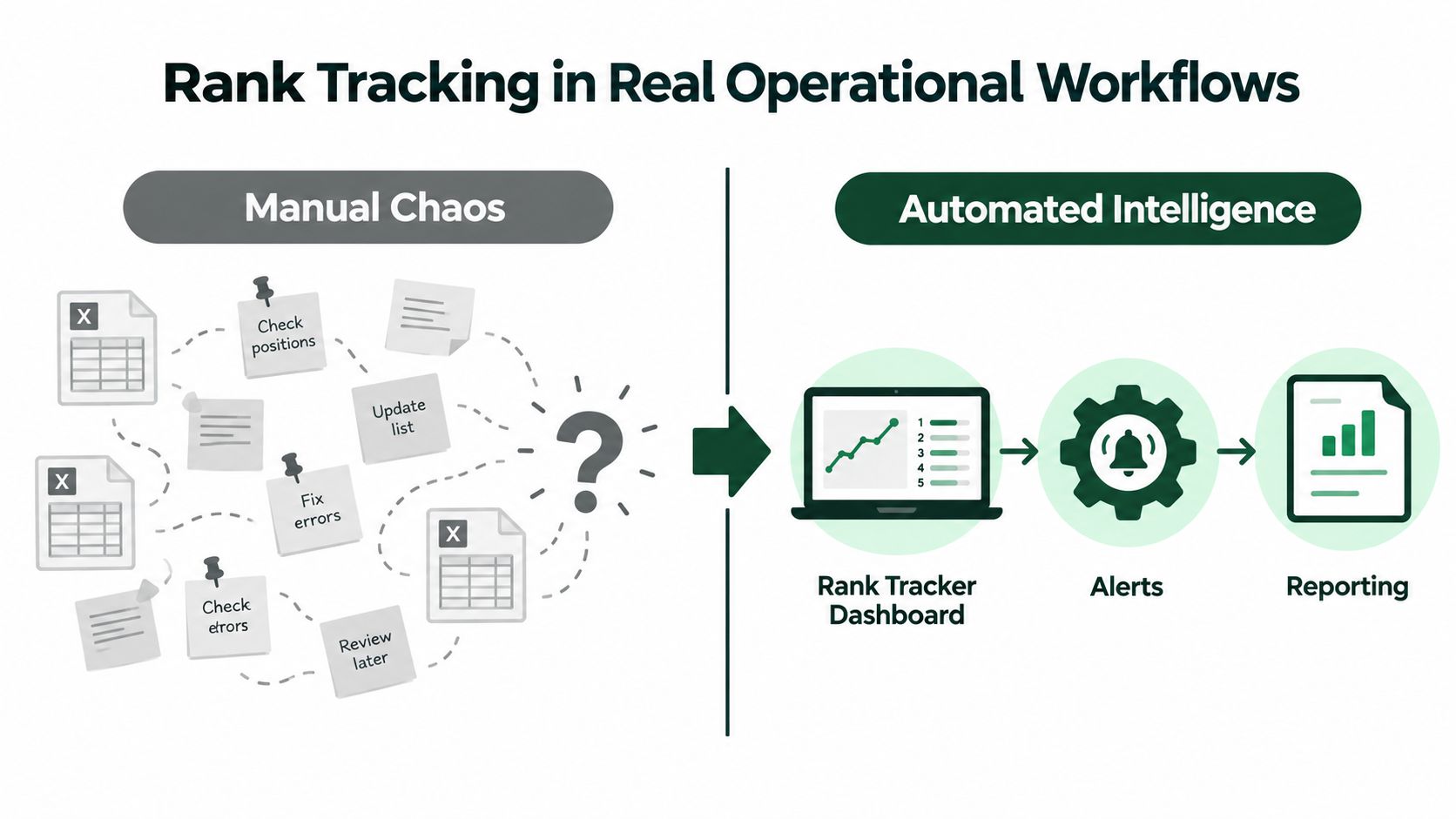
A rank tracker should enter the workflow at the point where the team can make a decision. Standalone reporting often follows this sequence: the platform sends a change, an SEO opens a spreadsheet, someone checks the page manually, another person writes a ticket, and the content or development team starts work later. Every handoff creates delay and raises the chance that the original context gets lost.
Use rank changes as triage signals
A practical workflow starts by grouping tracked terms according to business purpose:
- Commercial terms: Check whether a movement affects a product, service, or lead-generation page.
- Content terms: Look for pages that need better coverage, clearer intent matching, or updated supporting evidence.
- Local terms: Compare locations rather than relying on a single city-level average.
- Technical indicators: Investigate whether many pages moved together after a release, template change, redirect update, or indexation issue.
The important step is correlation. One page moving may justify content analysis. A whole template moving at once points toward a technical review. Several URLs competing for the same query suggests cannibalization or unclear internal linking. The tracker can't make that diagnosis alone, but it can surface the pattern quickly if the data is organized by URL, template, location, and keyword group.
Put action beside evidence
For an agency, the useful output isn't “12 keywords declined.” It is a task that includes the affected URL, location, device, previous snapshot, current snapshot, likely issue, owner, and approval state. The account lead can then explain what happened without rebuilding the investigation from scratch.
For a small business, approval-first workflows reduce the risk of publishing an unreviewed change. The operator can inspect the recommendation, approve a content update or technical fix, and monitor the next measurement. For a larger team, centralized projects, permissions, billing, and white-label reporting reduce administrative work around client delivery.
The video below illustrates the broader distinction between passive monitoring and connected SEO operations.
A report is successful when it changes what someone does next. If the ranking data never reaches a content queue, technical audit, publishing system, or revenue analysis, the organization is measuring activity rather than managing search performance.
Dedicated platforms usually provide greater specialization. Their strengths include extensive keyword databases, granular competitor views, configurable exports, and reporting templates built around positions and SERP features. That depth supports agencies with advanced analysts, large research programs, or reporting pipelines that already connect several systems.
Integrated tracking is designed around fewer handoffs. In a connected platform, ranking changes can appear beside keyword research, technical diagnostics, content briefs, internal-linking suggestions, publishing, and analytics. AutoSEO's SEO automation platform overview illustrates this broader operating model. The advantage is not a more impressive ranking number. It is the ability to turn an observation into approved work without repeatedly copying data between tools.
A fair comparison looks like this:
| Requirement |
Dedicated rank tracker |
Integrated tracking system |
| Specialist rank reporting |
Usually stronger for granular views, filters, and exports |
Often sufficient for monitoring and operational decisions |
| Competitor research |
Commonly deeper and more configurable |
More useful when connected to content and strategy tasks |
| CMS publishing |
Often requires another tool or integration |
Can sit within the same approval workflow |
| Technical diagnosis |
May surface changes without explaining the cause |
Can connect movements to audit findings |
| AI visibility |
Depends on the product and plan |
More useful beside organic and traffic data |
| Multi-site operations |
Strong in mature agency products |
Strong when projects, billing, and execution are centralized |
The trade-off is control versus continuity. A dedicated tracker gives analysts more room to define views, compare competitors, export raw results, and build custom reporting. An integrated system gives operators more context around each movement, but its reporting may be less configurable and its specialist research features may be narrower.
The choice also affects data ownership. If one tool records the baseline and another supplies the workflow, teams must define which position set, location, device, and search context governs reporting. Otherwise, small differences between platforms can create disputes about accuracy rather than decisions about rankings.
A hybrid setup can work well when responsibilities are explicit. Use the dedicated tracker for specialist analysis, historical comparisons, or client-facing exports. Use the integrated system for briefs, approvals, technical follow-up, publishing, and measurement. Set one system as the reporting baseline, document the collection settings, and pass only agreed findings into execution.
That arrangement preserves specialist depth without turning rank tracking into an isolated reporting exercise. It also makes the operational boundary visible: one system explains the ranking record, while the other helps the team act on it.
When to Choose Dedicated Tracking Versus Integrated Systems
The deciding question is not which platform displays more rankings. It is whether the team can turn a trusted movement into an assigned, completed, and measured change. A tracker that produces isolated reports may satisfy analysts while leaving writers, developers, and account leads without a clear next step.
Consider a 12-site agency with two analysts. A dedicated platform may remain the better operational choice if those analysts need to standardize reporting, investigate competitor movements, and export findings into the agency's existing client process. The agency should pilot the setup against its current workflow, checking how long it takes to validate a movement, explain it to a client, assign follow-up work, and include the result in the next report. Migration is worthwhile only if the added analysis offsets the cost of rebuilding projects, historical baselines, and reporting templates.
A two-person marketing team managing 40 pages across three markets faces a different constraint. It will lose more time to tool handoffs than to missing a niche export feature, so the integrated system is the stronger fit. The useful test is whether a ranking opportunity can move from detection to brief, approval, publication, and outcome review without manual copying between tools.
For either setup, run a short side-by-side pilot using the same keywords, locations, devices, and reporting dates. Compare data consistency, analyst time, handoffs, and the percentage of findings that become completed work. Keep the dedicated option when specialist investigation is the bottleneck. Keep the integrated option when execution stalls after reporting. Set one baseline for official reporting before the pilot ends, so competing dashboards do not create an accuracy dispute.
Moving From Tracking Data To Measurable SEO Outcomes
Start by auditing the tracker itself. Compare important keywords against same-location manual checks, inspect mobile and desktop separately, confirm that local campaigns use the intended geography, and review whether historical snapshots preserve enough SERP context to explain changes.
Next, map rankings to outcomes. Use Search Console data, traffic signals, conversions, and qualified leads where available. For AI-facing work, add citation or visibility observations rather than treating a classic blue-link position as a complete account of discovery. The point is to distinguish a movement that changes business performance from one that merely changes a dashboard row.
Then review the action path. Can a ranking decline create a technical task? Can a striking-distance page enter a content queue? Can an approved update publish through the existing CMS? Can the next report show what changed and whether visibility improved? Arch's guidance on measurable impact for product studios is useful context for keeping measurement tied to outcomes instead of activity.
Teams that need repeatable reporting should also examine automated SEO reporting workflows for ways to connect changes, explanations, and next actions. The strongest rank tracker is rarely the one with the most keywords. It's the one that combines reliable geo-specific data with a workflow people can easily use.
AutoSEO combines rank tracking with keyword research, technical audits, content production, CMS publishing, traffic measurement, and AI-visibility monitoring in one approval-first workflow. If your current tracker produces isolated reports instead of execution-ready priorities, visit AutoSEO to assess whether a connected system fits your team.